Few things are more satisfying in a story than a well-executed plot twist. The kind that makes readers gasp, flip back a few pages, or text their friends in all caps. A great twist doesn’t just shock. When done CORRECTLY it deepens the story, redefines characters, or forces the audience to see events in a new light. But how do you craft a twist that doesn’t feel forced, cheap, or predictable?
The key to a successful plot twist is planting subtle clues throughout your story while keeping the big reveal hidden until just the right moment. Below is a list of plot twists you can use, adapt, or mix into your writing to keep readers on their toes. I will reiterate though that plot twists need to be BUILT into a story. They’re not supposed to be cheap punches to invoke a response from your reader. Pacing is everything. Clues are everything. Hints are everything. The devil is literally in the details! Anyways, enough precursors and disclaimers. I trust you with my list of plot-twists. (I’m assuming you’re a big kid writer who knows exactly what you’re doing! Don’t all writers know exactly what they’re doing ahaha….)
Classic Identity Twists
The protagonist is actually the villain but doesn’t realize it.
A trusted ally was working against the hero all along.
The villain is secretly related to the protagonist.
The protagonist’s memories have been altered or erased.
The main character isn’t who they think they are—a clone, an imposter, or someone else entirely.
Revelations About the Past
A seemingly minor character was the true mastermind behind everything.
A past event didn’t happen the way everyone remembers.
The protagonist was unknowingly responsible for a tragedy.
The villain is actually seeking revenge for something the hero did.
The hero was lied to about their origins or purpose.
Unexpected Alliances & Betrayals
The hero and villain must work together to stop a greater threat.
A sworn enemy turns out to be a long-lost friend.
The mentor figure betrays the protagonist at a crucial moment.
A character thought to be dead is alive—and has switched sides.
The sidekick was the real hero all along.
Reality-Shifting Twists
Everything was a simulation, test, or dream—but the consequences are real.
The story is actually taking place in a different time period or world than initially believed.
The narrator has been unreliable, misleading the audience the whole time.
Magic or supernatural elements exist in what was thought to be a realistic setting.
The protagonist is not the first version of themselves—they’ve been replaced, cloned, or resurrected before.
Unexpected Outcomes
The villain wins, and the hero must find a way to live with it.
The big battle never happens because the conflict was a misunderstanding.
The supposed chosen one is a fraud—or the real chosen one is someone else.
The hero gets what they wanted but realizes it wasn’t what they needed.
The villain was never actually evil—just misunderstood or manipulated.
Final Thoughts
And here is the conclusion where I restate my hypothesis-er, intro I mean. A great plot twist isn’t just about shocking your readers. It should enhance the story, add emotional weight, and feel earned. By layering foreshadowing and character depth, you can craft twists that will surprise without feeling random. Do you have a favorite plot twist from a book or movie? Or have you written one you’re especially proud of? Share it in the comments! I love reading everything everyone has to share.
Finding My Writing Rhythm: What Time of Day Works Best?
I’ve spent a lot of time (maybe too much!) figuring out the best time of day for me to write. It turns out, it’s a bit of a Goldilocks situation: not too early, not too late, but just right…
Let me explain.
Mornings? Not for me. I admire the people who can spring out of bed, brew a strong cup of coffee, and dive straight into creative flow. But I am not one of those people. Before 7am, my brain feels like it’s running on fumes. I can barely make sense of my to-do list, let alone string together creative sentences. Morning writing is a no-go. I must wait until I am coherent.
Afternoons are appealing… but tricky. There’s something lovely about the afternoon: the day has settled in, you’re warmed up mentally, and it feels like a natural pause point. But if you work a regular job, afternoon writing is basically impossible. Unless you’re on a break or you have an unusual schedule, it’s hard to carve out that time consistently. Afternoons are awesome but ENTIRELY unrealistic.
Nights are magical… but a slippery slope for sure. I will say, writing at night has a certain charm. There’s this quiet energy in the evening hours, when the world slows down and distractions fade. But wow, does time fly. I’ve sat down to write at 9pm, blinked, and suddenly it’s midnight. If I’m not careful, I end up sacrificing sleep in the name of creativity (not ideal for someone who needs to be functional the next day and rather early I might add).
So what works best? Right after work. For me, the sweet spot is around 6pm. I like spending the day letting ideas simmer in the back of my mind while I’m doing other things like going about my job or doing chores. Then, when I get home, I’m ready to go. It’s like my brain has been preheating all day, and by the time I sit down to write, everything’s at the right temperature. I still have enough energy, but the workday is done and I can shift into my creative zone.
Of course, everyone’s rhythm is different. Some people thrive in the early hours, others love the late-night quiet. The trick is to experiment and pay attention to when you feel most creative and not just when you think you should be writing. For me, writing after work feels natural and sustainable, especially with a full-time job. Maybe it will for you, too.
What’s your favorite time of day to write? I’d love to hear!
So, apparently NaNoWriMo is shutting down. Yep. The site. The support. The whole infrastructure that turned November into a word party for writers around the world…it’s closing up shop..
And hey, listen, before we dive in, I have a confession: I never did NaNoWriMo. Not personally.
Never even tried. Every year, I’d watch the clock tick toward November like someone standing outside a marathon, holding a coffee and a donut, cheering with my whole heart but fully unwilling to put on running shoes.
Goodbye, NaNoWriMo: I Never Knew You, But I Loved You Anyway
It’s not that I didn’t want to write a novel in 30 short days. It’s that I… well, I like sleep. And not failing my college classes. And knowing I won’t collapse into a spiral of self-loathing by Day 12 when I realize I’m 15,000 words behind and my main character still doesn’t have a name.
But even from the sidelines, I loved NaNoWriMo. I loved the wild ambition of the whole event! I loved that it made writing feel less like a lonely, tortured pursuit and more like a chaotic group project that anyone could get in on. I loved that it dared people of all sorts, busy people, tired people, discouraged people alike, to show up and write stuff.
NaNoWriMo wasn’t just about writing a novel. It was about making writing a habit that you consistently stick with. Just so you could see what you could do if you actually gave it your all.
So when I heard it was shutting down, I couldn’t help but feel a little sad and taken aback. Not because I’m going to miss my annual November guilt trip (okay, maybe a little), but because it truly felt like the end of an era. NaNoWriMo was one of the few internet relics that survived the Great Attention Span Collapse™ as audiences moved towards short form content as a whole. It got people excited about writing, which is no small feat in a world of TikToks, inboxes with 472 unread emails and a new attention suck right around the corner. I think this legacy dying is what I’m most sad about.
I’m sad to say goodbye to what it used to be.
From what I’ve seen, NaNoWriMo in recent years has been tangled up in some complicated and concerning controversies. I’m not going to pretend I fully understand all of it, but it’s enough to make me step back and say, maybe this shutdown isn’t entirely a bad thing. Maybe the version of NaNoWriMo that existed at the end wasn’t the one I admired all those years ago. Maybe it had run its course.
Either way, it’s coming to a close (justified or not). It is taking a final bow and putting away the word count tracker for good.
To the people who did NaNoWriMo every year, who started and sometimes even finished their 50,000 words: I salute you. To the folks who got halfway through and still learned something about themselves in the process: I see you. And to the dreamers like me, cheering from the sidelines with our untouched WIP’s and a vague hope of “maybe next year”: we mattered too.
But, even though the organization is shutting down, the spirit of NaNoWriMo isn’t going anywhere. The stories will still get written. The writers will still find each other. November will still come, and some wild souls will still decide, “Yep, I’m gonna write a whole dang book this month.”
And maybe one of these years, I’ll finally join in. Maybe. Probably not. But maybe.
NaNoWriMo reminded us that writing doesn’t have to be perfect. It just has to be written. And honestly? I think that’s a legacy worth honoring.
RIP NaNoWriMo. I never joined your chaos, but I’m thankful you existed. 💻💔
As writers, we put a lot of effort into crafting compelling beginnings and exciting middles, but endings? Endings are what stick with readers long after they close the book. A great ending can leave them satisfied, stunned, or even haunted. But not every story needs to wrap up with a neat little bow and a happily ever after. Sometimes, the most powerful endings are the ones that subvert expectations, introduce a twist, or leave a lingering sense of mystery.
Whether you’re writing a novel, short story, or screenplay, here’s a list of unique ways to end your story that go beyond the traditional happy ending. Feel free to use, tweak, or combine these ideas to create your own memorable conclusion to the tale!
Bittersweet & Tragic Endings
The hero wins but loses their memories.
The villain is defeated, but the hero becomes what they once fought against.
The protagonist gets everything they wanted but realizes it doesn’t make them happy.
The hero survives but is the only one left.
The love interest is saved, but they no longer love the protagonist.
The hero sacrifices themselves, but their sacrifice is forgotten.
The protagonist escapes, but their home is lost forever.
The prophecy is fulfilled, but it didn’t mean what they thought.
Open & Ambiguous Endings
The hero wins, but the story hints that the villain may return.
A character vanishes without explanation—did they run, die, or something else?
The story ends mid-action, leaving the outcome uncertain.
The protagonist achieves their goal, but a single clue suggests something was missed.
The final line contradicts what the reader believed was true.
The hero is given a choice, but the story ends before they make it.
Twist Endings
The villain was never real; it was all in the hero’s mind.
The “good guys” were actually the bad guys all along.
The entire story was a test, simulation, or dream—but the protagonist isn’t sure what’s real anymore.
The hero realizes they were the villain in someone else’s story.
The protagonist wins, but only because the villain let them.
Everything resets, trapping the characters in a loop.
Unsettling or Dark Endings
The villain wins, and no one knows the truth.
The hero stops the big bad, but a greater threat emerges.
The protagonist thought they escaped—only to find they’re still trapped.
The hero saves the day but has lost all sense of self.
The world is saved, but it’s unrecognizable.
The hero becomes immortal and must watch everyone they love fade away.
The story ends with a minor, eerie detail that suggests something is very wrong.
So, I heard all the hype about Obsidian. Yaknow, the digital brain-builder everyone’s (or at least my side of the internet) raving about. Naturally, I was intrigued by the idea of weaving a web of my thoughts into an interconnected masterpiece. But then I saw the price tag. I wasn’t exactly thrilled to part with my money just yet.
So after a little googling I came up with Log Seq. It’s the free alternative that claims to do the same thing. By the same thing I mean build a network of your thoughts like some sort of mind-map wizardry. So, I took it for a spin for a week, all in the name of saving a buck (or several). Here’s how it went.
The Good Stuff
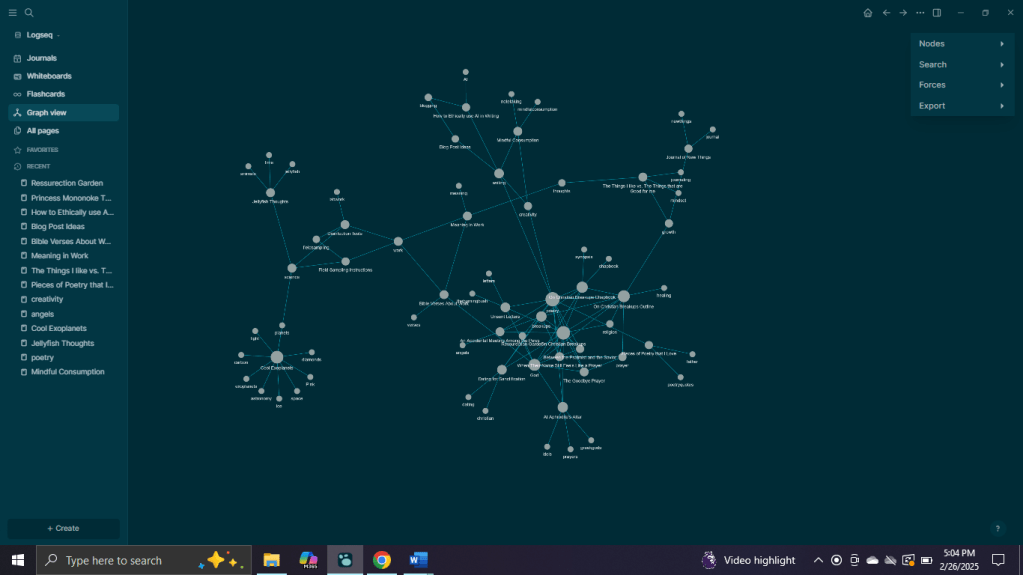
First off, Log Seq is phenomenal. Like, truly fascinating. The ability to link thoughts, ideas, and random musings into this complex web of information is seriously cool. I started from scratch, and by the end of the week, I had an impressive digital mind-map that was organized based off of tags. My main tags were #poetry, #science, #writing, #religion.
The Not-So-Good Stuff
There is only one thing that I really think hurts the log seq experience. Log Seq has no app. And while typing on my laptop is fine when I’m already sitting at it, capturing thoughts throughout the day? Not so much. I don’t know about you, but I have a knack for coming up with my best ideas at the most inconvenient times. Like, standing in line for coffee or pretending to listen during a meeting. Without an app to sync my thoughts, I was left trying to remember everything until I got back to my laptop… which is like trying to carry water in a colander. To well that’s reaaaally far away. An unneccessary metaphor I know. It’s just a funny mental image.
The Verdict
So, would I recommend Log Seq? Definitely. Especially if you’ve got the discipline to sit down and dump your brain at the end of the day. If not, you might be out of luck until they roll out an app. But overall, it’s an incredible tool with a ton of potential. I might just keep using it (at least until my wallet decides Obsidian is worth it).
Oh, and as promised, here’s my brain-web after a week of using Log Seq.
So, what do you think? Have you tried Log Seq or Obsidian? Do you have any other alternatives I should check out? Drop a comment below!
I have historically have had a really forgiving view of AI. I think it’s here to stay and that much is true, but as time has gone on, I have gravitated to a more critical view of AI content, specifically AI writing. I think it’s great for brainstorming when you’re on square 1 or perhaps outlining a blogpost (here is where I reveal that it is not uncommon for me to ask chatgpt for help with organizing blog posts, titling, and other such small tasks that allow me to focus on my blog post’s actual content). Heck, I think it’s maybe even good for writing filler text that allows you to move your story forward until you can return and fill it with something better and far more creative. But over the past year, I’ve really seen the quality of writing content being replaced with quantity and this is no doubt due to the rise of AI.
AI garbage books flood KDP and many so-called-writers are making tutorials on how you can shortcut the process of creating a story and avoid *gasp* writing! I think someday I’ll make a post on this in the future about how these pretend writers must not really enjoy the craft if they’re continuing to engineer ways to NOT write but now is not that time. Today, I’m here to talk about a specific AI writing platform known as LEX.
Lex AI Writing Platform: A Powerful Tool with a Hidden Catch
Lex is one of the most intriguing AI writing tools I’ve explored. With a wide array of functions, it offers a startlingly diverse set of tools. I could see Lex catering to writers across various disciplines due to this diversity, whether you’re drafting blog posts, brainstorming story ideas, or simply fighting off writer’s block. However, as with any tool of this caliber, its strengths come with a critical caveat. But we’ll get there shortly. First, an introduction to Lex’s toolbox is in order.
A Brief Overview of Lex’s Tools
One of the few positives I will say is Lex impresses with its thoughtful organization and user-friendly interface. The platform boasts features designed to streamline the writing process. Maybe a little too streamlined, but again, I’m getting ahead of myself. The tools and functions are as follows:
Idea Generation: It helps writers overcome blank-page syndrome with prompts and suggestions.
Continuity Tools: Lex can pick up where you left off, offering full paragraphs based on the context you provide it.
Editing Suggestions: It attempts to analyze tone, grammar, and structure to help refine your writing.
Customization: You can tweak Lex’s settings to better fit your style or project goals. Probably the most impressive and useful tool in my opinion.
For writers seeking an all-in-one productivity aid, Lex delivers. It’s particularly helpful for outlining or fleshing out ideas quickly. I could see Lex being a useful tool in brainstorming or drafting stages when used wisely. However, we’re going to move on to my main concern with Lex and most Ai writing assistants as a whole.
RIP Individuality
While Lex offers remarkable utility, my primary concern lies in what tools like this mean for the art of writing itself being the erosion of individual style.
When used sparingly, Lex is a fantastic collaborator. Keyword being “sparingly”. How many people will use it sparingly? The temptation to rely on AI for large swaths of text is undeniable, but in doing so, we risk losing the unique voices that define good writing.
To illustrate this concern, I experimented with Lex by beginning a short story:
My opening line: “Deep in the recesses of an experimental laboratory, rows of cages can be found.”
Lex’s continuation: “Within these cages, a colony of felines reside. These are no ordinary cats, however. They are the subjects of a groundbreaking experiment, where scientists seek to unravel the mysteries of genetic manipulation. With each passing day, the cats undergo a series of tests and procedures, their DNA meticulously analyzed and altered. The researchers are driven by a singular goal: to create a new breed of cat, one that possesses enhanced abilities and traits beyond the scope of their natural counterparts.”
On the surface, this continuation isn’t bad—it’s clear, grammatically sound, and flows logically. However, it’s unmistakably AI-generated. The tendency to “tell rather than show” is glaring. Instead of inviting readers into the story through evocative imagery or nuance, Lex provides a clinical summary, flattening the narrative.
This paragraph reads more like a report than an actual story, and, while serviceable, it lacks the depth and personality of human storytelling. Such patterns, if adopted uncritically, could homogenize creative writing, sacrificing artistry for efficiency. I have yet to see any AI writer tackle this concern successfully. Everything a computer spits out tends to sound the same or very similar to each other: bland, uncreative, and report-y. AI tends to be trained on articles and educational resources after all so no surprise there.
Conclusion
Lex is a powerful tool that can be a game-changer for writers, offering diverse features and has a great organization and presentation of said tools. For brainstorming, outlining, and rough drafting, perhaps it’s worth a try. But the ability to write large sections of text quickly can also be its biggest drawback and churn up a lot of concern.
Overall, I think as we incorporate AI into the writing process, we must remain vigilant and oh-so-cautious. Writing is more than putting words on a page despite what school might have taught us. It’s about crafting a voice, an atmosphere, and an experience for readers. Tools like Lex should be wielded with care, enhancing human creativity rather than replacing it. For now, Lex is an impressive companion but ABSOLUTELY not a replacement for the writer’s pen.
Thanks for taking the time read and take care, friends!
A Retrospective Look at Writing and Book Trends: From Magic Schools to Feminist Retellings
If you’ve been reading books for, well, any amount of time, then you’ve probably noticed that certain trends in literature pop up like clockwork—sometimes for a few years, sometimes a little longer, but they’re always there. And as much as we try to resist it, we find ourselves falling into the hype. We all know that one trend we swore we wouldn’t get into, and then suddenly we’re 200 pages deep into a series about people who can control fire and water and possibly have a secret underground society. It’s fine, it’s normal.
So, in the spirit of nostalgia and bookish trends that once ruled the shelves, let’s take a trip down memory lane. Here’s a look at some of the most notable writing trends of the past, separated by the years when they were super prevalent. Buckle up, it’s about to get trend-tastic.
2000s: Magic Schools & Faction Fandoms
Ah, the early 2000s. It was a simpler time, before social media ate up all our free time. But books—oh, books were living their best life. If you weren’t reading Harry Potter, were you even reading? Seriously though, J.K. Rowling kicked off the magic school trend, and the world fell in love with Hogwarts, wands, and wizarding wars. It was like we all went to school with Harry, Hermione, and Ron, even if we were just hanging out in our living rooms with a cup of tea. And don’t get me started on the sorting hat. Suddenly, was finding out what house they were (if you weren’t Gryffindor, well, we’ll talk about it later) along with their Patronus, their wand and… well.. you get the idea.
But Hogwarts wasn’t the only magical academy out there. And let’s not forget the “Team Edward vs. Team Jacob” phenomenon that was Twilight. Was it fantasy? Was it supernatural? Was it… a lot of emotional turmoil over the fate of Bella Swan? Whatever it was, it had people choosing sides.
If it’s not clear, The early 2000s were dominated by the rise of books where characters were sorted into distinct factions. Presenting factions based on personality traits became another way for readers to ask themselves, “Which one would I belong to?” and effectively engage the reader. These sorting systems didn’t just reflect different aspects of identity; they also gave readers a sense of belonging in the fictional world.
2010s: The Post-Apocalyptic Dystopia Takeover
Fast forward to the 2010s, and suddenly, we were all obsessed with the end of the world. Everyone was either fighting in a deadly arena or surviving some government-imposed dystopian nightmare. And honestly, who could blame us? The Hunger Games was literally all the rage. We couldn’t get enough of Katniss Everdeen, bow and arrow in hand, fighting for her life (and also fighting for her place in that love triangle that we didn’t need but somehow loved anyway).
But it wasn’t just Katniss—there was Maze Runner, where kids with amnesia were running from giant creepy monsters in a maze. And don’t forget Divergent (yes, it fits both categories. No wonder it was so popular), where people were divided into factions based on their personalities- wait I definitely talked about this already. These books sparked a whole trend of dystopian universes where our protagonists had to rise up against an unjust government, typically after some sort of catastrophic event. We were all about survival, rebellion, and… romance, of course.
Late 2010s: Fairytale Retellings, Because Who Doesn’t Love a Reboot?
Then, just when we thought we couldn’t take any more life-or-death stakes, fairytale retellings came swooping in. It was like, “Why read the same old fairytales when you could read them again—but with a twist?” Enter The Lunar Chronicles, which took Cinderella, Little Red Riding Hood, and others, and threw them into a world of cyborgs, androids, and space missions. It was like the fairytale we kind of knew, but with lasers and intergalactic politics.
But let’s be real, it wasn’t just science fiction authors having fun with fairytales. Writers like Sarah J. Maas and Holly Black started blending folklore and mythology with darker, more adult themes, serving up stories full of magic, romance, and the kind of characters who may or may not have committed some morally questionable acts. I’m not saying we were all suddenly into faeries, but maybe we were all suddenly into faeries.
2020s: Feminist Mythological Retellings—Let’s Give the Women Their Due
Now, we’re in the age of feminist mythological retellings, and I’ve got to say, I’m here for it. Sure, Percy Jackson brought Greek mythology into the mainstream, but now we’re diving deeper into the stories of the women who’ve been left out of the traditional narratives. Think Circe by Madeline Miller, where we finally get to hear the story of the infamous witch from the Odyssey, and she’s not just some villain. She’s complicated, which (hopefully) makes her way more interesting.
And we’re seeing it everywhere, from Ariadne by Jennifer Saint to Lore by Alexandra Bracken, where the women in myth aren’t just being swept aside by the men—they’re fighting back. They’re reclaiming their stories, and it’s pretty epic. These retellings give the female figures of myth the depth and agency they deserve. Though whether or not it’s done effectively is up for debate in the reading community.
Honorable Mentions: Other Trends That Came and Went
Some trends were like that one hit song we all loved for a summer, but by next year, we couldn’t remember the lyrics. A few notable mentions:
Vampires, Werewolves, and Supernatural Romance (2000s-2010s): The Twilight era sparked a frenzy over all things supernatural. Vampires, werewolves, and the eternal, beloved, and ENTIRELY necessary love triangle. It was a phase, okay? But also, apparently not, because love triangles would go on to become prominent plot point in YA media from thence forth.
Grimdark Fantasy (2010s): If you wanted to dive into a world where everything was bleak, brutal, and morally ambiguous, this was your moment. Books like Game of Thrones, Six of Crows and The Broken Empire filled our need for complex, gray-area characters who weren’t afraid to get their hands dirty. It was kind of like if your favorite character was a mix of a hero and someone you shouldn’t trust, but you loved them anyway. And probably hated them too. But in a good way.
YA Thrillers (2010s): After the success of Gone Girl, and The Girl on the Train, the YA thriller market exploded. Suddenly, everyone was reading books about murder, mystery, and figuring out who was really the bad guy—which, let’s be honest, made for some super intense reading sessions. The most recent success in this genre that I can think of is Where the Crawdad’s Sing.
So… What’s Next?
While we can never be sure what trend will take over next, one thing’s for sure: books will always change and evolve. Whether it’s more retellings of ancient myths, something completely new, or perhaps another wave of dystopian chaos (honestly, who can say?), there will always be something to capture our imaginations.
What do you think? Are we due for a new trend? Or are we all just hanging out in the land of retellings and myth for the foreseeable future? Drop a comment! I’d love to hear your thoughts on this very important and pressing matter.
Welcome to a writer’s guide to Pinterest where I plan to discuss the good, the bad, the pretty. (I’m sorry, I love this tag line format, okay?) And rest assured, as someone who has dumped many, MANY hours that I cannot get back into this social media app, I am an expert on this matter.
Pinterest is where I go to build my dream library, organize my “writing room” ideas, and pin cute coffee shops I probably won’t visit but love to look at. As a writer, Pinterest has been an absolute gem for inspiration; you could almost call it a mood board for my entire brain. But as far as promoting my writing? Well, let’s just say Pinterest isn’t quite built to send people flooding to your latest blog post or novella.
Here’s the scoop on how Pinterest can actually help (and where it kind of misses the mark).
The Good: The Perks of Pinterest for Writers
An Endless Well of Inspiration (Literally, It’s Bottomless) If you’re ever stuck on a writing project, Pinterest is the perfect place to scroll through photos of foggy forests, vintage journals, and other people’s aesthetically pleasing bookshelves. The platform is a visual feast, which makes it amazing for building storyboards or getting character inspiration. Dreamy landscape? They’ve got you covered. You’ll be drowning in imagery before you even get through the first page of your search.
Organizing Writing Ideas Like a Pro Pinterest boards are a lifesaver when it comes to keeping track of all those ideas we want to come back to someday. Want to keep that list of dialogue ideas, character profiles, or writing prompts handy? Just pin it! In a way, Pinterest lets us organize our creativity, which is both refreshing and slightly magical (especially if you’re like me and tend to misplace things…like ideas).
Perfect for Building an Aesthetic (Hello, Vibes!) Whether your story is set in a gloomy castle or a sunny seaside town, Pinterest boards let you curate a “vibe” that can bring your creative world to life. You can find everything from historical costumes to quirky cafes, and it all adds a splash of personality to your work—even if it’s only for you to look at. Sometimes, having that mood board handy is just what you need to get into the writing groove.
The Bad: The Downsides of Pinterest for Writers
Driving Traffic to Your Work? Not So Much Here’s the thing: people on Pinterest are mainly looking for visuals and ideas, not links to blog posts. Most users are there to save images, maybe jot down a few notes, and then go on their merry way. I’ve pinned some of my writing work before, but it’s rare for people to follow an image all the way to an actual article or story. Pinterest is more about the “aesthetic save” than the “click-through,” so don’t expect it to be a major traffic source.
Lack of Community Engagement Pinterest is not the place to chat, bond over writing struggles, or get feedback on your work. There are no extensive comment sections where people are swapping tips or sharing the same cozy creative space you might find on other platforms. Truth be told, they DO have a comments section on individual pins but it’s not laid out very well nor is it heavily used among the platform’s users. Pinterest is more of a solo mission; everyone’s there for their own pins and projects, so if you’re looking for a writing community, look elsewhere.
It Can Become a Time Sink (Oops) Pinterest may look harmless, but let’s not kid ourselves—it’s a gateway to spending hours pinning everything under the sun without actually writing. There’s so much content that it’s easy to fall into the “one more scroll” trap, especially when it feels like you’re being productive. At some point, it’s best to stop pinning and start typing. (Believe me, I speak from experience here, ok.)
The Verdict: Is It Worth It? If you’re in need of visuals or inspiration, Pinterest is fantastic and I highly recommend it. With your own private library of images to draw from, it can make the writing process a lot more fun as well as help you visualize things you’re struggling to picture yourself. Just don’t rely on it for promotion, because Pinterest users are likely just passing through.
We’ve all seen it. The cozy, curated bookshelf perfectly displayed in the background of an Instagram post. The morning coffee next to an antique-looking journal, pens neatly arranged, ready for creative genius. The aesthetic of “being a writer” has become so commonplace it’s practically a meme. And for a while, I fell for it. Hard. I thought I could just step into the mold of being a “dark academia” enthusiast, channel my inner mysterious intellectual, and instantly become a better writer.
And no, I didn’t just stop at buying a couple of vintage blazers or considering how many old books could fit into my perfectly styled bookshelf. Oh, no. I wanted more. I envisioned a life filled with vintage stationery, my writing desk cluttered with typewriters, antique books, and candles to match the vibe. I even fantasized about changing my wardrobe entirely to fit the look. Because, apparently, if you look like a writer, you are one, right?
But then something happened. I realized that I was more interested in creating the perfect aesthetic than in actually doing the thing I was supposedly passionate about. At some point, I paused, looked around, and asked myself, “When was the last time I actually sat down and wrote a story? And more importantly, when was the last time I ENJOYED the process?”
The answer? It had been way too long.
And here lies the problem: aesthetic can sometimes eclipse substance, especially in the realm of writing and reading. With social media platforms like Instagram and TikTok offering a constant stream of perfectly crafted book recommendations, it’s so easy to fall into the trap of thinking that if you curate the right images, use the right hashtags, or post the right “reading corner” content, you somehow become a reader or writer. It’s the illusion of accomplishment without the actual work.
Take, for example, the BookTok phenomenon. While the community has certainly brought attention to books in a way that’s fantastic for some authors, there’s a darker side to this trend that needs to be talked about. Many BookTokers proudly show off their massive book collections, talk about how they love reading, yet in some cases, by their own admission, they skim books with long descriptions and skip straight to the dialogue. They complain to their audience that the book in question calls them to, in fact, read. There’s no real engagement with the material, no deep dive into literary analysis. It’s just the act of being a reader that counts. These BookTokers have “the look” down to a science – their bookshelves are gorgeous, their reading glasses stylish, their curated bookshelf photos scream “book lover,” but when you actually look at their reading habits? It’s a different story.
I’ve had personal conversations with friends who have immaculate bookshelves, whose collections I envy and admire, only to hear them admit they struggle to read physical books now that they’re adults. Life, responsibilities, and other distractions get in the way, and the joy they once found in reading simply isn’t there anymore. One of my friends confessed that she hasn’t read as much as she used to, and when she does, it’s via audiobooks – which is totally valid, of course. But the fact that the aesthetic of her being a bookworm was so ingrained in my head that this fact surprised me goes
It’s not just the reading habits that have been impacted by social media culture – it’s the writing too. We’ve all heard people describe themselves as “writers,” and yet when it comes down to it, they’ve never actually written a word, or if they have, they treat it like a hobby to post about rather than a craft they genuinely invest in. They enjoy the idea of being a writer more than the act of writing itself. I was once there, chasing after the idea of being the writer, making sure my writing-related content looked good on my feed, all while avoiding the actual process of putting words on paper. Because, let’s face it, the aesthetic of being a writer is a lot more comfortable than the challenge of writing itself.
This leads me to my conclusion: the rise of pseudowriters and pseudoreaders is a direct result of the social media culture we find ourselves in. We can fall into the trap of curating an image of ourselves, of building a persona online that seems like we fit the mold of the artist or intellectual. But deep down, we might not even be engaging with the thing we claim to love. And honestly, there’s no shame in that. The shame comes when we let ourselves believe that looking like a writer or reader is enough to actually be one. It’s easy to get swept up in these trends and lose sight of the fact that writing isn’t about the clothes we wear or the books we pose with – it’s about the words we write and the stories we tell.
The real takeaway here is that it’s okay to step away from the aesthetic sometimes. It’s okay to redefine what being a writer or reader means for you. You don’t have to fit a certain mold or maintain a curated online persona. What matters is whether or not you are truly engaging with your craft, whether you’re reading because you love it, or writing because you want to. And if the aesthetic happens to come along with it? Great. But it shouldn’t be the reason you do what you do.
So, let’s focus less on how we look as writers and readers and more on whether we’re actually enjoying the process. Don’t be afraid to put down the fancy stationery and pick up the pen. If it’s not working, change your approach. But never, ever let the aesthetic of it all replace the substance.
Is a picture really worth a thousand words? Well, we aim to analyze that very thing today as I walk you through what it’s like to use Instagram as a writer. If you’ve some much as even glanced at Instagram, you’ve probably noticed it seems to the hotspot for creatives. I mean, it’s basically one giant virtual gallery of coffee cups, open books, and people with serious-looking headshots writing snappy, one line poems. But is it actually useful for writers trying to build their craft and audience, or just another time-suck we justify as “networking”? Spoiler: it’s a little bit of both.
So here’s the full rundown of using Instagram as a writer—complete with highs, lows, and plenty of aesthetic pressure.
The Good: The Highlights of Instagram for Writers
Connections, Encouragement, and the Validation of Strangers Instagram is kind of like the local open-mic night—someone will always clap, even if you just read your grocery list (as long as you use enough hashtags of course). Through hashtags like #WritingCommunity and #AmWriting, you can find other writers to cheer you on and remind you that yes, there are people out there who care deeply about your haiku on existential dread. Plus, it’s a safe bet that people will comment something nice on your posts, even if it’s just a thumbs-up emoji. HOWEVER, whether these are real people or just bots vying for attention to promote themselves everywhere is up for debate.
The Sheer Joy of Making It Look Pretty Who doesn’t love a good aesthetic? Instagram encourages us all to be photographers, so if you’ve got snippets of writing or a stack of favorite books, there’s endless fun to be had. (Although, honestly, does my journal really look better next to a potted plant? The people say yes.) If you’re visually inclined, Instagram might be your paradise.
Slow but Steady Growth (If You Have the Patience) I can attest to this one personally. When I first tried sharing my writing, I started to see a slow and steady trickle of followers—as long as I was babysitting my page like a needy plant. But take a break? You’ll be lucky if the algorithm even remembers your account exists. It felt like stepping away for a week was like hitting the reset button, and I didn’t have the energy to keep jumping back in. Eventually, I just let it be, and now my poor little writing page is collecting dust in the dredges of the Instagram algorithm. Oops! Sorry, this was supposed to be the positives section. But now that you mention it, I think it’s time we move onto….
The Bad: The Drawbacks of Instagram for Writers
The Algorithm = Frenemy #1 Oh, the elusive, ever-changing algorithm. Instagram doesn’t just let you share writing; it expects you to be a part-time social media strategist. Posting at the right time? Check. Engaging with followers? Check. Making Reels? Triple check (seriously, Reels are in). And sometimes you’ll pour your soul into a post only for it to be seen by three people, two of whom are your mom and your bestfriend (love ya girl!).
Perfection Pressure: For When Words Aren’t Enough Being on Instagram as a writer is kind of like being told you have to paint a picture every time you write a sentence. A good line of poetry is no longer enough—you have to make it look Pinterest-worthy. This can be draining, especially when all you want to do is, you know, write. But you have to! Because this isn’t the time nor the space to share a novel. You MUST stick to the witty one-liners. That’s all people have time for. Instagram content is made to feed an audience in bite-sized portions. And so you must trim the fat.
Time: Instagram Will Eat It All, Trust Me Let’s be real—if there’s a way to waste time online, Instagram will help you find it. Between scrolling through your feed, obsessively checking your notifications, and looking for the perfect font for that post, it’s easy to lose hours. And while we could be writing, we’re often scrolling for “inspiration”—or at least that’s what we tell ourselves.
The Verdict: Is It Worth It? If you genuinely enjoy sharing your work visually and don’t mind the hustle of keeping up with the algorithm, Instagram can be a useful space for writers. But if it’s taking more time than it’s giving back, maybe dial it back. Remember: your worth as a writer isn’t measured by the number of likes.
Happy posting (or happy ignoring the algorithm entirely)!

 By the Brooke