Spring Reset for Writers: Refreshing My Writing Routine đŸŒˇâœď¸

Ah, spring. The season of blossoming flowers, fresh starts, and freshly ignored writing goals. Oops. Did I say that outloud?

Anyways, I am determined to refresh my writing routine this spring as well as declutter my workspace, and become the productive, flourishing writer I was always meant to be. Or at least… try.

Step One: The Desk Purge

Right now, my desk is less of a workspace and more of an archaeological dig of sorts. There are at least three half-filled notebooks, a graveyard of pens (some working, some with ink mysteriously dried up overnight), and a coffee cup that may or may not be from last week. If I dig deep enough, I might find a long-lost plot outline or a note that simply says, “fix this, it’s bad.” Oh, and stickers. Lots and lots of stickers.

This happens periodically. My desk space over any given amount of time will become…how is it we say here in the south? Ah, yes, a HOT MESS.

So, I’m decluttering. The goal is to turn my desk into a space that actually invites creativity instead of making me want to lie down and take a nap. A candle? Yes. A cute notebook that I will definitely use? Absolutely. The ten random receipts and a variety of rogue paperclips? No thanks. You’re out of here (until I somehow collect another collection and do another deep clean this next fall).

Step Two: Reworking the Writing Routine

Right now, my “routine” consists of staring at my laptop at odd times (basically when the whimsy hits), opening a blank document, and then somehow ending up scrolling on my phone for 45 minutes. It’s an art form, really. And while I have been trying to tackle my phone addiction lately (it’s its own issue separately, ok?) my writing routine still lacks consistency.

To fix this, I’m trying out a more structured approach this spring. Instead of telling myself “I’ll write later” (which is a fancy way of saying “I won’t write at all”), I’m setting dedicated writing times. Mostly in the evening after work or after dinner. I have experimented with a few time slots (will be writing a blog post about this later, I’m all about experiments over here), and the evening time slot seems to work best with my lifestyle and schedule. So that’s what we’re going with.

Step Three: Setting Writing Goals That Aren’t Overly Ambitious

I alluded to this already in my New Years post in January. I love making big, dramatic writing goals. “I’ll finish my novel in two weeks.” “I’ll write 1,000 words every single day without fail.” “I’ll win a Pulitzer by June.”

And then reality hits. Life is busy. Some days, writing just doesn’t happen. So I’m continuing to focus on, goals that are actually achievable. Maybe it’s writing for 20 minutes a day. Maybe it’s finishing a single chapter this month. Small, consistent progress is better than unrealistic goals that just make me feel guilty when I inevitably don’t hit them. Right now I’m attempting to finish my Poetry book by the end of summer. That’s THE goal right now.

Step Four: Romanticizing the Writing Process

If there’s one thing I know, it’s that writing is way more fun when you make it an aesthetic experience. I’m talking fairy lights, soft music, a warm cup of tea, and the illusion that I am a 19th-century author composing a masterpiece in my candlelit study. Does this actually help me write better? Debatable. Does it make me want to write more? Absolutely.

So, part of my spring reset is making my writing time feel special. A cozy spot by the window, a new playlist, maybe even a fancy new pen. Whatever it takes to trick my brain into thinking this is a magical, must-do activity. If everything feels stale in your writing process right now, just try and make a few fun little changes.

Final Thoughts: Let’s Make This Our Season of Writing Wins

Spring is a time for growth, so I’m going to try and grow into better writing habits. Whether it’s finally decluttering that desk, setting realistic goals, or simply making writing feel more fun, this is my effort to reset and refresh.

How are you resetting this spring? Do you even believe in spring resets or is time simply an illusion to you? Let’s talk about it in the comments! 🌸✨
Things to Remember as an Anxious Creator

Being a creator of any sorts whether it be a writer, an artist, or anything in between can be an awesome experience with the internet. More than ever before, you can share your work with a larger audience than you would have ever imagined. But, if you’re anything like me, this can come with its own set of stresses. Especially if you’re a people pleaser, sharing your work can be a tough process especially when you find yourself fighting with your own insecurities. What was once fun and freeing can turn into a huge stressor as you worry about how people perceive you and the work you produce. So I composed this list of “Things to Remember as an Anxious Creator”. I’m not saying it going to fix some of the stressful aspects of being a creator who posts their work online but it may help you remember that the important thing about creating is that you enjoy the process and at the end of the day, no one can make everyone happy. Which, coincidentally, is the first reminder.

1.You can’t make everyone happy.

It’s unrealistic to think otherwise. The things you create won’t be everyone’s cup of tea. Additionally, there are always going to be people who think you should be doing something differently. And while one should make room for constructive criticism, at the end of the day, your work will speak to some people and not to others. And that’s okay.

2. Nothing you create will be perfect. Take pride in your work but don’t agonize over it.

You are an imperfect person. So, by proxy, you will create imperfect art. You are always going to think you that you could have done something differently in a piece when looking back on it. That’s good, that means you’re improving. But don’t discredit your past work as being useless because it’s not perfect. Additionally, don’t discredit your present or future work because it’s not perfect either.

3. Don’t take every critique or criticism as gospel.

Listen to people’s advice but if you took in and applied everything people said about your work, it wouldn’t look like your work any more which would be an even bigger tragedy than producing something imperfect. Learn to filter the criticism and apply where you think it is needed.

4. Also note, that criticism is still good.

Don’t let the stressful thought of listening to others make you plug your ears and ignore ALL OF IT. This benefits no one and especially not you. You’ve got to walk the line between “taking all criticism” and “taking no criticism at all”. There is a happy medium to be found.

Also note that is still valid to walk about from some criticism when you feel like you cannot handle it AT THAT SPECIFIC TIME. If you are feeling that you are not in a good mental space to accept to respond to people’s critiques, it is good to recognize that and walk away from it and return to it when you feel you can handle it in a healthy way.

5. Perfectionism inhibits the artistic vision.

Don’t get in your head that as soon as you start a project that it must be perfect. I know I have reiterated this already but it is such a common struggle among artists that I feel the need to remind you again. If begin to fall into the lie that everything you make needs to be on a masterful level, you will most likely experience a sort of “creator’s paralysis” and will become so scared of creating something imperfect that you will not create at all.

Aaaaand I know this because I do this. A lot. And I have to continually remind myself that perfectionism has only ever hindered my act of making something. It never helped it.

6. Taking a break is okay.

Remember you are not a machine. Taking a step back from creating for a little while it healthy and you are more likely to return to your work with a fresher perspective and clear mind which will result in even better and more inspired art work!

Breaks are good.

7. Creating is supposed to be fun.

If you are stressed over your work constantly, it might be time to pause and take a step back and evaluate as needed. Creating is not supposed to be a pain staking act every step of the way. Also note that sometimes we are made to enjoy something only for a time and then move on. If you find yourself constantly hating the act of making your art, it may be time to change how you are approaching that art, or take a break from being an artist entirely. We all need to do this sometimes with all kinds of work, not just creating.

For example, if I found myself dreading the very thought of working every day in my field of expertise, that would be a sign that I would need to pause and evaluate my choice of career. Whether this means changing it entirely or simply switching to another job in the same career field but with a slightly different approach to that thing, depends on how I feel.

It doesn’t make you a failure to do this. Life is too short to force yourself to subject yourself to something that you hate on a daily basis. I repeat, take a step back.

And I think that’s it. Those are all the big reminders I have to tell myself as an anxious creator. I hope you got some sort of insight from them! If so, maybe consider following my blog as I post a lot of content similar to this on my little space here. I also encourage you to leave any thoughts you have on these reminders in the comments below and whether or not these helped you! Is there a specific one that you struggle with? For instance the *cough* perfectionism *cough* one? I’d love to hear your thoughts!

Have a lovely day & take care of yourself!

Role Reversal Fairytale Prompts

★Foreversea 

Wendy makes it to Neverland but finds herself disgusted with the childish cruelty of Peter Pan. Filled with rage at his mistreatings of the Lost Boys, she finds herself siding with the pirates. The last straw comes when Peter’s immaturity and callousness leads to her brother’s death. Alone and seeking revenge, Wendy picks up a blade, taking on a title that Peter would learn to Fear. 

★Snow White the Dwarf 

A tale about a dwarf with dark hair, ruby red lips, and pale skin who is being hunted by a group of seven gifted and dangerous hunters. 

★Rapunzel the Witch 

Rapunzel is a herb collecting, magic worker who is sought out for her fabled “magic” hair and abilities. So she hid herself away in a tower. But an Evil Prince has plans to find her. 

★Belle the Beast 

A girl who is shunned by a town finds a home in a mysterious castle. An enchantress finds her here and casts a spell on her that transforms her into a powerful beast so that she would never feel helpless again and has the means to make people leave her alone.  

★The Little Sea Witch 

Tell me the story of a young sea witch who fears humans and their polluting ways. Also tell me of the prince who vowed to hunter her down. 

★The Bear with Gilded Fur 

A heartwarming story about a bear cub with gilded fur who wonders her way into a cottage in the woods. There, a family of three finds her and wishes to take care of her.  

★Rumpelstiltskin 

Tell me the story of a female fae creature and her adventures trying to con irresponsible nobles and royalty who wish to make flippant promise that they cannot fulfill. 

★Red Fur 

A Wolf with bright Red Fur must outwit a hunter so she can reunite with her pack on the other side of the woods. 

★Hansel and Gretel 

A pair of magic working siblings run an orphanage in the woods where they take in children abandoned by their parents. 

★The Piper Children 

A group of orphans band together and learn bardic magic to get revenge on a town that shunned them and turned them away. 

★The Sleeping Witch 

In this version, Maleficent was actually invited to the gift giving of Sleeping Beauty. She was gifted with magic more powerful than any that has been seen before but signs of such power would not show until her 16th birthday. Fearing the child to be dangerous, the fairies put her in a deep sleep. Until an unsuspecting prince decides to force himself upon her, awakening a deep rage in her and the magic. 

★Alice, Queen of Wonderland 

Alice stumbles upon wonderland and, instead of being confused and misled by its inhabitants, she decides to take matters into her own hands. She brings an end to the Queen of Hearts and very swiftly. Soon, the courtyard echoes with the announcement. 

“All bow to Alice, the Queen of Hearts!” 

Evening Poem: I

I dont know why

I try and try

But theres no strength left in I

I turn left, and then turn right

I feel I am lost without a light

There is no strength left in I

I rely on that “I” so much.

So much that I start most sentences with an I.

I

I

I

Identity starts with I.

That’s on who I rely.

Me, myself, and I.

But not matter what I do

There is no strength left in I

At end of I

There is nothing.

Ironic.

Writing Prompt: Murder Museum

A museum displays the many artifacts and backgrounds of famous serial killers. It is popular for bone chilling as well as informative exhibits and draws a crowd world wide.

This is the Murder Museum.

Due its popularity, an exclusive tour is offered to those who sign up for the drawing to be allowed to roam this museum free of crowds. All night.

And of course things go wrong.

During the tour, someone notices the doors locking. And then the tour guide shows up dead.

Someone begins their murder spree using the many left over serial killer weapons and tools in the museum from the exhibits, everyone who turns up dead, dying in their own unique way to commemorate the serial killer exhibit it is based off of. It is now up to a few attendees to figure out who the killer is.

Sounds like an exciting night ahead at the Murder Museum.

Writing Prompt: The Ghostly Cafe

There’s a cafe in town in which residents frequent and go to decompress from their hard days. Lilting jazz music fills the air and produces an ambiance of peace that falls over the place and washes over its customers. It is such a serene scene, one would never think it was haunted. But, surprisingly, the ghosts are the heart and soul of this restaurant. Every hour, the ghost of a musician will serenade the customers as they listen with expectant ears and faces. Drinks are served by animated bone corpses. And that weird knocking on the wall keeps time with the music, not at all creepy.

Tell me the story of the ghostly cafe.

Writing Cheat Sheets You Should Know About

Writing can be really hard sometimes. Some days the words flow seamlessly from my finger tips and there other days where I get stuck on every little thing. One things that I have found that has helped me with these mini challenges and road blocks is having a few choice writing cheat sheets on hand that can help me when I’m stuck on how to write a specific scene or character. And so I would like to share these little cheat sheets with you.

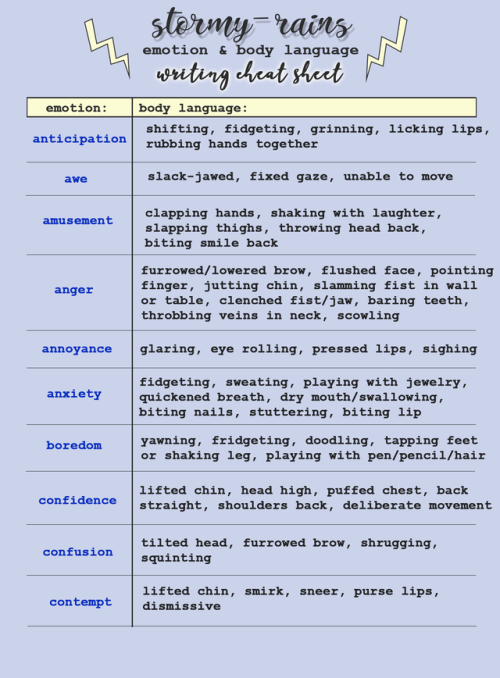
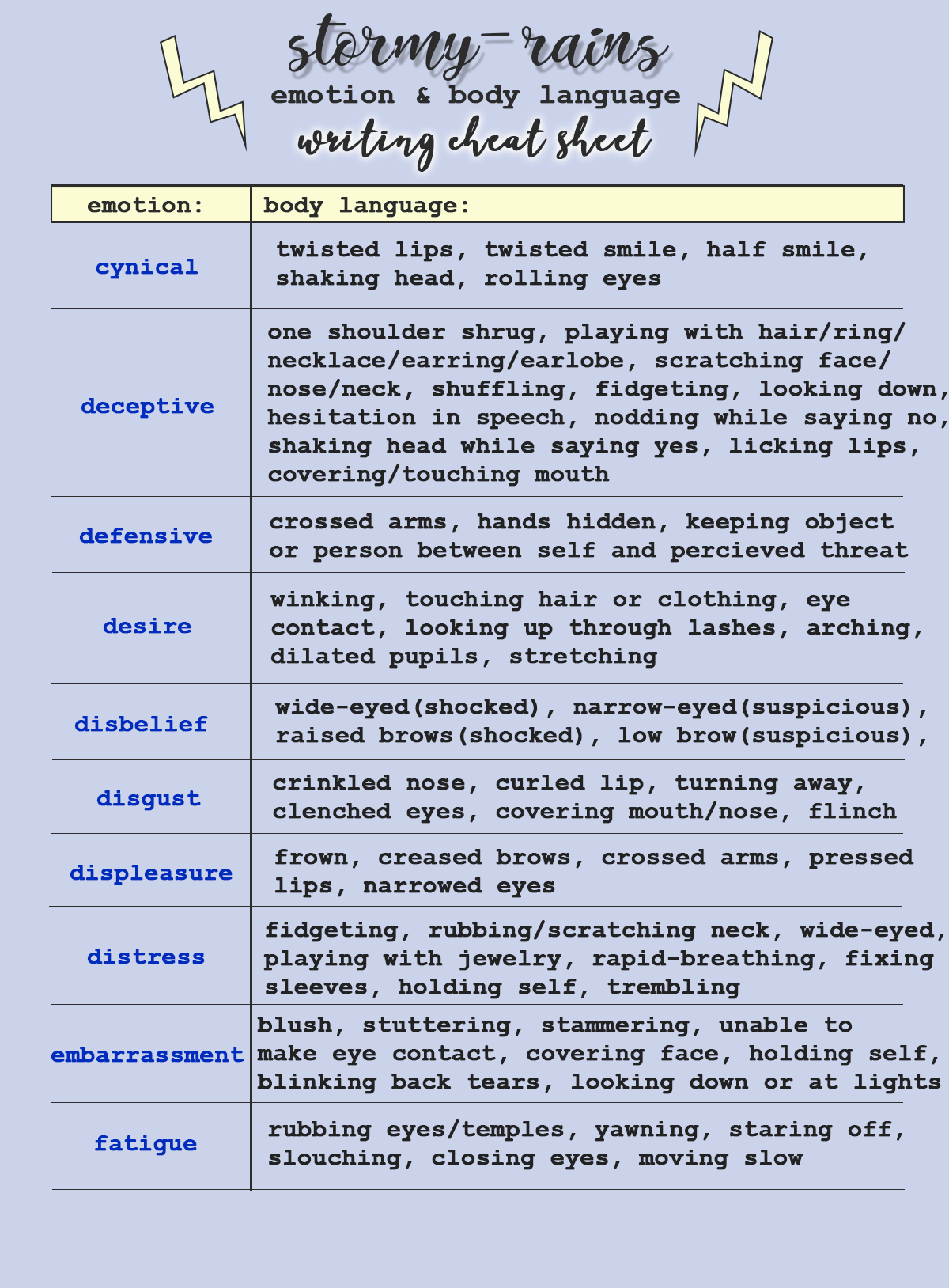
Emotion Cheat Sheets

Writing certain emotions are harder for me than others. Especially when writing more obscure emotions that go beyond “happy” and “sad” and “angry”. This is because, sometimes, I can only recall one or two actions that reflect that specific emotion and I don’t want to sound like a broken record when writing their non-verbal cues. “She shook her head”, “She grit her teeth”, “He smirked”, “She smirked”. It can get pretty redundant.

These emotion cheat sheets help me with that. They each give me an emotion and a brief list of mannerisms and reactions associated with that emotion that one can integrate between the dialogue.

cheat sheet 1

cheat sheet 2

cheat sheet 3

Conciseness

This might be more helpful for essay writers or article writers but it can be useful for story writer’s as well. If you have a bad habit of writing overly wordy phrases that could be replaced with a more condensed version of the phrase for clarity, then this cheat is for you. It goes through a few commonly used wordy phrases in writing and suggests replacements.

clarity of writing cheat sheet

Actions that don’t sound repetative

I have a bad habit of over using specific actions in writing.

Look. Walk. And smile.

These are three actions that happen quite a lot in a book. But I personally struggle to find other words that convey the same meaning to avoid sounding redundant. So here are a few cheat sheets I use to help me “dress up” and better describe these actions.

Words to replace “look”

Words to replace “walk”

Words to describe a smile

Various ways to integrate “smiling”

The Replacement of very

Yet another cheat sheet that can help you specifically combat the redundancy of overusing the word very.

A Very Helpful Cheat Sheet

The Death of Said

Aaaaand here is the last one. And probably the one I struggle the most with. Said. Now contrary to what you might have read online, said is not dead. Let’s not overlook the danger of getting to flowery with our writing. There are still places for simple versions of words. Said will always have a place in writing, But again, this is cheat sheet is made simply for when you fear you’re sounding tedious and like you’re repeating the same word over and over and over and over and over and over again. And sometimes these words and phrases can better describe the tone with which an action is done much better than “said” can.

Said Cheat Sheet

Pausing vs. Quitting

I have a hard time with self-guilt when it comes to writing. I feel like I am never satisfied with my productivity levels when I write, like I can always be doing better. But despite this attitude, I’ve found it takes away from my productivity more than it helps it. You see, it’s taken me awhile to figure this out, but holding myself to such a high “writing” standard that I am inevitably am not going to meet hinders me much more than it helps me. Procrastination feels much more attractive when I am disappointed in myself.

I think this is why I have a tendency to take looooong gaps in between my writing weeks. Ones that I didn’t plan. And all that time I’m mentally yelling at myself, “get back to writing your book! Stop being a quitter!” and yet this attitude does very little to get me back into my writing habit. I just feel guilty.

So recently I wanted to reframe my thinking. To stop demonizing “breaks” because breaks are not synonymous with quitting. Quite the opposite actually. Everyone needs a break every now and then, even from stuff they really enjoy. So I decided to start referring to my non-writing periods as “pauses” not “quitting”. Already I can tell a difference in the way I view writing. It feels less like a chore. And I won’t leave it to sit for weeks on end either. Because a “pause” I implies that it will be continued, whether it be tomorrow or next week. Pauses are healthy every now and then, I shouldn’t yell at myself for taking them otherwise I will associate writing with dissatisfaction and this immense feeling of “I don’t want to do this”.

So if you’re a writer like me who has bad habit of yelling at yourself every time you step away from a project, maybe consider taking a well-needed “pause”. And then come back to it.