Evening Poems: Twenty-Something

People rarely say what they are feeling. We mask our hearts in a cloak of quiet.
Why do we stay silent?
But what do I know?
I’m only twenty-something.

We travel around the sun on this floating rock and yet we do not believe in miracles.
When did we let cynicism poison us?
But what do I know?
I’m only twenty-something.

We have forgotten what it means to have faith in something because in the end it all disappoints.
But isn’t that the point of faith?
But what do I know?
I’m only twenty-something.

Rain actually feels quite nice and yet we complain and pull out our coats in annoyance.
Have you forgotten what it feels like?
But what do I know?
I’m only twenty-something.

But someday we will age. And we will regret not allowing our breath to be taken away or not pausing in the downpour or holding our tongues.
Because as we all know,
You will not always be twenty-something.

Writing Cheat Sheets You Should Know About

Writing can be really hard sometimes. Some days the words flow seamlessly from my finger tips and there other days where I get stuck on every little thing. One things that I have found that has helped me with these mini challenges and road blocks is having a few choice writing cheat sheets on hand that can help me when I’m stuck on how to write a specific scene or character. And so I would like to share these little cheat sheets with you.

Emotion Cheat Sheets

Writing certain emotions are harder for me than others. Especially when writing more obscure emotions that go beyond “happy” and “sad” and “angry”. This is because, sometimes, I can only recall one or two actions that reflect that specific emotion and I don’t want to sound like a broken record when writing their non-verbal cues. “She shook her head”, “She grit her teeth”, “He smirked”, “She smirked”. It can get pretty redundant.

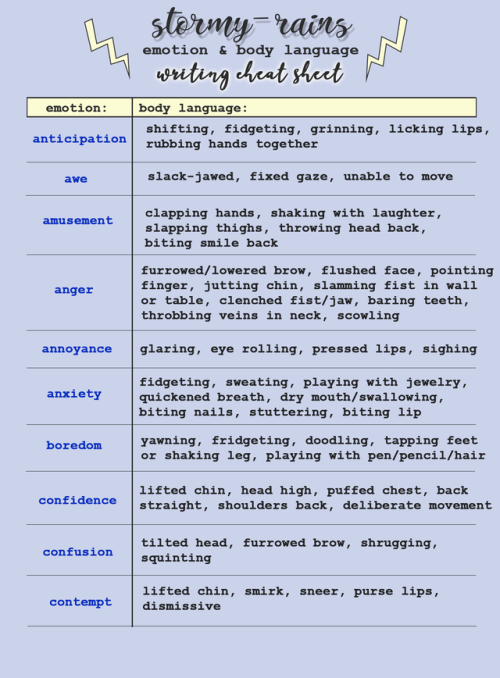
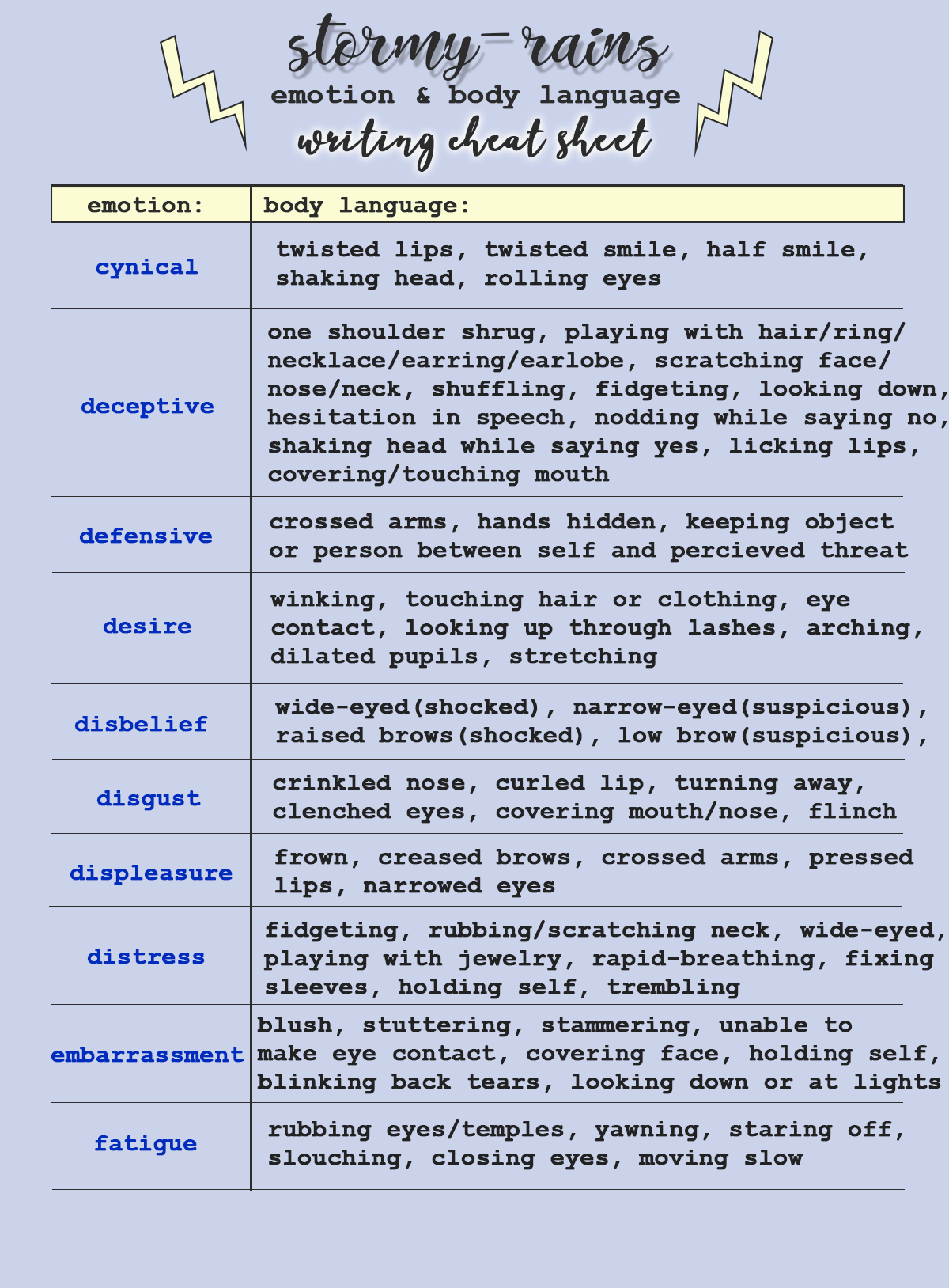
These emotion cheat sheets help me with that. They each give me an emotion and a brief list of mannerisms and reactions associated with that emotion that one can integrate between the dialogue.

cheat sheet 1

cheat sheet 2

cheat sheet 3

Conciseness

This might be more helpful for essay writers or article writers but it can be useful for story writer’s as well. If you have a bad habit of writing overly wordy phrases that could be replaced with a more condensed version of the phrase for clarity, then this cheat is for you. It goes through a few commonly used wordy phrases in writing and suggests replacements.

clarity of writing cheat sheet

Actions that don’t sound repetative

I have a bad habit of over using specific actions in writing.

Look. Walk. And smile.

These are three actions that happen quite a lot in a book. But I personally struggle to find other words that convey the same meaning to avoid sounding redundant. So here are a few cheat sheets I use to help me “dress up” and better describe these actions.

Words to replace “look”

Words to replace “walk”

Words to describe a smile

Various ways to integrate “smiling”

The Replacement of very

Yet another cheat sheet that can help you specifically combat the redundancy of overusing the word very.

A Very Helpful Cheat Sheet

The Death of Said

Aaaaand here is the last one. And probably the one I struggle the most with. Said. Now contrary to what you might have read online, said is not dead. Let’s not overlook the danger of getting to flowery with our writing. There are still places for simple versions of words. Said will always have a place in writing, But again, this is cheat sheet is made simply for when you fear you’re sounding tedious and like you’re repeating the same word over and over and over and over and over and over again. And sometimes these words and phrases can better describe the tone with which an action is done much better than “said” can.

Said Cheat Sheet

Evening Poems: To be an Artist

I romanticize my suffering, 

And then I call it art.

Pathetic is now pretty,

Because it is from the heart. 

Cutting words are poetry,

Because now they rhyme .

Beats that flow perfectly.

Words that read in time. 

Bleeding is now beautiful.

The pain to be a creator. 

This is my written world,

And I am the dictator.

And so I will write them,

To any who will listen. 

But little do they know,

The words I weave are my prison. 

Pausing vs. Quitting

I have a hard time with self-guilt when it comes to writing. I feel like I am never satisfied with my productivity levels when I write, like I can always be doing better. But despite this attitude, I’ve found it takes away from my productivity more than it helps it. You see, it’s taken me awhile to figure this out, but holding myself to such a high “writing” standard that I am inevitably am not going to meet hinders me much more than it helps me. Procrastination feels much more attractive when I am disappointed in myself.

I think this is why I have a tendency to take looooong gaps in between my writing weeks. Ones that I didn’t plan. And all that time I’m mentally yelling at myself, “get back to writing your book! Stop being a quitter!” and yet this attitude does very little to get me back into my writing habit. I just feel guilty.

So recently I wanted to reframe my thinking. To stop demonizing “breaks” because breaks are not synonymous with quitting. Quite the opposite actually. Everyone needs a break every now and then, even from stuff they really enjoy. So I decided to start referring to my non-writing periods as “pauses” not “quitting”. Already I can tell a difference in the way I view writing. It feels less like a chore. And I won’t leave it to sit for weeks on end either. Because a “pause” I implies that it will be continued, whether it be tomorrow or next week. Pauses are healthy every now and then, I shouldn’t yell at myself for taking them otherwise I will associate writing with dissatisfaction and this immense feeling of “I don’t want to do this”.

So if you’re a writer like me who has bad habit of yelling at yourself every time you step away from a project, maybe consider taking a well-needed “pause”. And then come back to it.

Evening Poems: Little Things

People say that little things are what makes life worth living for. 

The little rays of sunshine and coffee that warms you to your core.  

But what if the little things are what can kill you too? 

Thing after thing piles on and ends up crushing you.  

Spilling that glass of your favorite drink 

Failing that class and crying till you cant think.  

A head cold that normally wouldn’t matter. 

You find yourself sinking sadder and sadder.  

Gas prices are up; they shut down a line. 

I find it a lie to simply say “I’m fine.” 

I need a new job with vastly better pay. 

Friends that love and actually stay.  

And I have found that I can’t taste. 

But it doesn’t matter because money spent on the unnecessary feels like a waste.  

I’m broke now. Emotionally too.  

They say it gets better. 

But I waited so long- so what now do I do? 

Evening Poems: Anxiety

Anxiety is man, 

He tells earnestly 

For what I should worry 

But as I focus on his features 

He seems to be blurry 

So I’ve come to find out 

He thinks he knows best 

In his well trimmed suit 

With a velvet vest. 

But his words are empty 

A spiral of care. 

Obsession dressed in good intentions

To hide the nightmare.

Evening Poems: Bridges

You say I burn bridges 

Reckless and without care 

But I implore you to listen 

Such a judgement is not fair 

I did not light the match 

I did not start the fire 

It was them I say  

Who piled up the pyre 

But one day I was done. 

One day I began to tire. 

Of bailing water on the blaze 

That persisted in growing higher.  

So I stood still.  

And let it burn down. 

Perhaps it would have lasted 

If it were more structurally sound.  

World Building Questions to Ask

Here are a few World Building Questions I tend to ask myself when building a world, specifically a fantasy one. These questions can help you flesh out and get a good feel for the world you plan on placing your characters in. Enjoy!

Magic System:

What can the magic do?

What can the magic not do?

Is there a price or drawback for overusing and reaching the magic’s limitations?

Does the Magic require the use of external tools? (ex. wand, book knowledge, incantation of sorts, etc.)

Are there people who cannot perform magic?

Technology:

What are the various means of transportation?

Is there a time period in which you can compare the development of tech to?

Who regulates the use of the world’s tech?

Any specific laws or regulations concerning it?

What are some common everyday uses of this world’s tech?

Laws and Leadership:

Is there a high ranking official above everyone or a council?

How is this government structured, generally?

Who makes the War decisons?

Who lays the law of the land?

How are leaders appointed?

Any limitations of said leaders?

Are laws permanent?

Describe the military power.

Society:

Are there various social classes? If so, describe them.

What are the specific traits assigned to each social class? Signs of status?

What does common “everyday” clothes look like?

Geography and Climate:

Describe the seasons.

Describe the weather.

How important are weather patterns to this society? How are they affected by it?

Give a general description of the notable geographic features of this world.

Are there any tundras, deserts, mountains, lakes, or coastlines?

How are cities in these various climates different from each other?

Other:

What happens to the world/city’s sewage and waste?

Where do textiles and various materials come from?

Are there imports? If so, from where?
Evening Poems: Art Therapy

Once upon a time
I laid in a bed of disgrace
Running from my demons
That kept perfect pace
No matter how much I ran,
They always won the race.
I sought a way to beat them,
So I gave then a face.
Armed with a brush
Their features I did trace.
Till I trapped them in a portrait.
I put them in their place.
On my wall they hang.
Frozen in time and space.
A monument in acrylic,
To the demons I face.