What Kind of Friend Are You? Introducing My Friendship Animal Theory 🐕🐻🐍

I have a new internet project! But then again, don’t I always?

Well, technically I have had this internet project for a little while now, but I have finally given it a proper home.

I started a TikTok called Whimsy Theories, which is basically a place for me to take the random systems and theories that my brain comes up with and turn them into something other people can actually think about.

You may have seen my Fantasy Style Theory post, where I divide aesthetics into seven fantasy archetypes: Princess, Goblin, Knight, Wizard, Dragon, Mermaid, and Angel. That one is probably my favorite I’ve ever come with but it is definitely not the last. That theory started with me thinking about fashion and eventually turned into a whole little world of archetypes, combinations, modifiers, and aesthetics.

Then I moved onto another fun little theory except this one focuses on friend types.

And that is how I ended up developing the Friendship Animal Theory.

To preface, it is loosely inspired by the Six Besties Theory by Alexandra Hayes (You can check out more of her work HERE, I especially enjoy her podcast on youtube which is a delightful advice column.)

So What Is Friendship Animal Theory (The Friendship Bestiary)?

The basic idea is pretty simple:

Different people tend to fall into different roles and dynamics within their friendships.

Not personality types. And, importantly, Not permanent identities. Not “you are a Hound and therefore you behave this way in every relationship.” Instead, these animals describe the role you tend to take on within a particular friendship or friend group.

You might be a Hound with one person and a Bear with another. Or you might have a very different dynamic with your childhood best friend than you do with your coworkers or your newest friend. And I think that is part of what makes this more interesting than a traditional personality quiz or something akin to that.

Friendships bring out different versions of us.

You might be extremely independent in most areas of your life but become incredibly loyal and sentimental with your oldest friends. Or you might be the responsible one at work but the absolute chaos goblin of your friend group.

The question isn’t necessarily “Which animal am I?” though I will add, that if you are one type of friend, there is a higher chance that that tends to be a role you have in other relationships in your life. These are relationship patterns that can be consistent but definitely aren’t the hard rule for how you relate to people. The idea is that friendships aren’t just collections of individual personalities. They’re little ecosystems.

And in an ecosystem, different creatures interact with each other.

Some relationships are nurturing. Some are protective. Some are complicated. Some become unhealthy. Some change completely over time.

Ask yourself: What kind of ecosystem are you creating together, you and your friends?

Sheesh that was a lot of yapping. Are we ready to talk about the actual theory now? I hope so, because here we go!

The Core Friendship Creatures

The first group contains the creatures that represent healthy or generally constructive friendship dynamics.

These are the Bear, Fox, Frog, Owl, Magpie, Rabbit, and Whale.

🦊 The Fox: Mischief & Adventure

The Fox is the friend who makes life more interesting. Their core, if you will, is mischief and adventure.

They are the person who says:

“Okay, but what if we just went?”

Fox friendships thrive on experiences and Exploring somewhere you’ve never been. Sometimes even trying something ridiculous. The Fox brings movement and curiosity into a friendship. They’re your spontaneous friend.

They’re often the reason a perfectly ordinary afternoon turns into a story you tell six months later.

The Fox reminds us that friendship isn’t only about emotional support. Sometimes friendship is about having something to remember and experiencing stuff together!

🐸 The Frog: Silliness & Humor

The Frog is the friend who makes you laugh.

Their core is silliness and humor.

Frog friendships are full of inside jokes, ridiculous conversations, funny voices, memes, terrible ideas, and laughing at things that absolutely should not be that funny. The Frog is also the friend who can make an ordinary day feel lighter.

They remind us that friendship doesn’t always have to be profound. Sometimes the most meaningful thing someone can give you is an hour where you forgot about everything bothering you because you were laughing so hard that you both cannot even breathe anymore. Truly healing.

The Frog brings fun into friendship.

🦉 The Owl: Wisdom & Perspective

The Owl is the friend you go to when you need perspective.

Their core is wisdom and perspective.

The Owl can help you step outside your immediate emotions and look at the bigger picture. They’re the friend who listens to the entire story before responding. Or they might ask the question you hadn’t considered. Or they might even gently point out that the situation you are currently convinced is the end of the world probably isn’t. We need these people badly in our lives to often ground us.

The Owl doesn’t necessarily solve your problems.

Sometimes they just help you see them differently.

🐕 The Hound: Loyalty

The Hound is the loyal friend.

So, as you could probably guess, their core is loyalty.

The Hound remembers who their people are. They do this by showing up. They check in. And they ALWAYS notice when someone is missing. They care about maintaining the bond.

The Hound’s love often looks like consistency.

It’s the feeling of:

“I’m still here.”

🐻 The Bear: Protection

The Bear is the protector.

Their core is protection.

This is the friend who wants to make sure you’re okay. They might walk you to your car or defend you when someone treats you badly. Sometimes they might bring you food when you’re sick or help you through a difficult situation without needing to be asked. They want to help, at the end of the day, and make sure you’re OK.

The Bear’s instinct is:

“Let me take care of you.”

At its healthiest, this is a beautiful form of friendship.

The Bear reminds people that they don’t have to handle everything alone. Sometimes you really do need someone willing to stand beside you.

🪶 The Magpie: Thoughtfulness, Sharing & Connection

The Magpie is one of my favorites because their friendship language is thoughtfulness.

Magpies notice little things. They always remember what you like. They are the kind of friends to see something in a store and think, “Oh my gosh, Brooke would love this.” Or they might send you a picture because it reminded them of you. They LOVE to give gifts and share things.

They collect little pieces of life and bring them back to the people they love.

The Magpie is about connection through thoughtfulness.

It isn’t necessarily about expensive gifts or grand gestures either. It can be as small as a snack you mentioned wanting to try or A funny rock you found on a walk. A common gesture is a book recommendation. Some days it’s just a message that says, “I saw this and thought of you.”

The Magpie says to their friends:

“I saw this and thought of you!”

🐇 The Rabbit: Encouragement & Enthusiasm

The Rabbit is the friend who gets excited with you.

Their core is encouragement and enthusiasm which makes them very fun to tell good news.

You tell them you want to start painting? They’re excited.

You tell them you got a new job?

They’re excited.

You have a weird little hobby you’ve become obsessed with?

They’re asking questions.

You want to try something you’ve never done before?

They’re probably already cheering you on.

The Rabbit helps other people believe in themselves.

They celebrate their friends’ victories, including the tiny ones.

They’re the:

“YOU DID IT!!!”

friend.

The Rabbit reminds us that encouragement is its own form of love. Sometimes you don’t need someone to give you advice. You just need someone who is genuinely excited that you are excited. They are the cheerleader friend and are amazing for it.

🐋 The Whale: Depth & Emotional Intimacy

The Whale is the deep friend.

Their core is depth and emotional intimacy.

Whale friendships often involve long conversations, vulnerability, shared history, and the feeling that someone really understands you.

You can talk about your childhood. Your fears. Your dreams. Or even your weird philosophical thoughts at 1 AM.

The Whale creates a sense of emotional depth but this doesn’t necessarily mean you have to talk constantly.

A Whale friendship can be quiet or even a long distance friend. It can be the person you haven’t seen in months but somehow pick up with immediately.

The important thing is that there is depth underneath the relationship. The roots go deep.

And Then There Are the Disruptive Creatures

Not every friendship dynamic is healthy. And sometimes, even perfectly good friendships can develop unhealthy patterns. That’s where this second category of dynamics and creatures come in.

These creatures aren’t meant to mean “bad people.” They describe behaviors that can disrupt a friendship ecosystem. And importantly, you can sometimes fall into one of these dynamics without being a fundamentally bad friend. Ouch, reflection. I am not always a fan of this but who is. But because of this, the disruptive creatures can be helpful in identifying the pitfalls we fall into, especially among certain friends and friendgroups. For example, I may fancy myself the hound friend because I’m soooo loyal but I can also be a spider or wolf where I can depend on people too much and have an “everyone else sucks” attitude.

Alright, I’ll chill with the examples since we need to go a little more in depth with these…

🕷️ The Spider: Entanglement & Dependency

The Spider represents entanglement and dependency.

This is when two people become so wrapped up in each other that the boundaries of the friendship start disappearing.

You may feel responsible for the other person’s emotions or you may struggle to do things independently. In some of my experiences, I felt like I had to constantly be available.

The friendship can become a web. The closer you get, the harder it becomes to move freely. This dynamic is combatted by the reminder that Healthy closeness still leaves room for two people to be separate individuals.

🐍 The Viper: Resentment & Criticism

The Viper represents resentment and criticism. Double ouch.

This is what happens when frustration starts accumulating underneath a friendship. Instead of talking about what’s wrong, you become increasingly critical. I know for sure, this is a dynamic that I have partipcated in.

Little things start irritating you. You keep score. You notice everything the other person does wrong. Eventually, the friendship can become full of little bites. And the difficult thing about the Viper is that resentment often doesn’t appear out of nowhere. There may actually be a real problem underneath it that should probably be addressed with apologies all around. The issue is that instead of addressing the problem directly, the resentment starts leaking out through criticism or quiet resenment towards the other party.

🐺 The Wolf: Isolation & “Us vs. Them”

The Wolf represents isolation and an “us versus them” mentality.

This is the dynamic where a friendship or friend group becomes increasingly closed off. There is 100% an inner circle and it is not open to the public, I assure you! There are outsiders.

And eventually, being loyal to the group can start meaning distancing yourself from everyone else. The Wolf isn’t simply having a close friend group. Close groups can be wonderful! But the real problem arises when closeness requires exclusion.

When “we’re close” becomes “we’re against them.”

🦅 The Hawk: Domination, Superiority & Competition

The Hawk represents domination, superiority, and competition.

This is the friendship where someone starts trying to establish themselves above everyone else.

Who knows more? Who is more successful? Who has more friends? Who is more attractive? Who is the leader?

The relationship stops feeling collaborative and starts feeling like a hierarchy.

The Hawk doesn’t necessarily have to be loud and domineering in an obvious way. Sometimes superiority is subtle. It can look like constantly correcting people, one-upping stories, competing over achievements, or needing to feel like the most important person in the room.

The Hawk can be combatted by the concept that friendship isn’t supposed to be a scoreboard.

🪱 The Leech: One-Sidedness

The Leech represents one-sided friendship.

One person gives and the other takes. And takes. And takes…

One person always listens. One person always needs help.

One person makes the plans. One person always has an excuse.

Of course, friendships aren’t perfectly equal every single day. Sometimes one person needs more support especially during difficult life phases. Sometimes someone is going through a difficult season and that’s all there is to it.

The Leech dynamic happens when the imbalance becomes the relationship.

There is no real reciprocity.

One person keeps pouring into the friendship while the other keeps consuming it. Signs you may be dealing with this is a constant drain from a friendship.

🦜 The Parrot: Gossip & Carrying Information

The Parrot represents gossip and carrying information between people. Oh boy, this is gonna be fun…

This is the friend who always knows something. And more importantly, always seems to have something to tell someone else.

“Well, she told me…”

“Apparently he said…”

“Don’t tell anyone I told you this…”

The Parrot can become the communication highway between different parts of a friend group. Information travels. Then Secrets travel. Comments get repeated that probably shouldn’t be. And then things get taken out of context. And suddenly everyone knows things they probably shouldn’t know and everyone is upset while the Parrot might shrug and think they’re simply a nuetral third party.

The Parrot dynamic reminds us that information is part of relationship trust.

Just because someone told you something doesn’t mean it was yours to pass along.

Principals

The Species Principle

The first rule of the theory is something I call the Species Principle.

And it is probably the most important one.

People are not species. Relationships are ecosystems.

You aren’t simply a Bear Friend™ who behaves like a Bear in every relationship you have.

You might be a Bear with your little sister, a Magpie with your best friend, and an Owl with a coworker you have slowly become friends with.

The creature describes the dynamic, not the person. This is why I don’t really think of the theory as a personality test (sorry if I keep repeating myself). The same person can behave completely differently depending on who they are with and I think that’s normal. That’s what makes people so layered and complicated sometimes, so it’s no wonder our friendships can ALSO be layered and complicated at times.

The Mirror Principle

We don’t just bring our own behavior into friendships.

We respond to each other.

A friend who makes you feel safe might bring out a more vulnerable side of you. And A friend who is constantly critical might make you defensive (naturally). A friend who is silly might bring out your own silliness.

Please don’t take this to mean other people are responsible for our behavior. It means relationships are interactive. You affect the ecosystem, and the ecosystem affects you. That’s why I don’t think these creatures should be treated like permanent identities.

Which leads into the Combo Principle!

The Combo Principle

Most people are combinations.

You might be a Hound + Magpie with one friend.

You’re deeply loyal to them, but you also love remembering little things about them, giving them gifts, and collecting memories together.

Or maybe you’re a Fox + Frog.

Every time you get together, something ridiculous happens, and you are usually the person who suggested the adventure in the first place.

Maybe you’re an Owl + Whale, where your friendship revolves around deep conversations and understanding each other.

The combinations are endless. And honestly, I think combinations are probably more representative of real friendships than trying to force everyone into one a rigid and hyperspecific category or animal.

The Transformation Principle

One of the most important ideas in this theory is that creatures can change.

A friendship isn’t frozen.

A Hound can become a Viper when loyalty turns into resentment. A Whale can become a Spider when emotional intimacy turns into dependency. Remember friends, the positive and disruptive creatures aren’t completely separate worlds. There are cases where the unhealthy dynamic is simply a healthy instinct that has been pushed too far.

That’s why I don’t want people to try and use these animals as permanent labels. They’re more useful as warning signs and lenses and probably best used in hindsight or reflecting, especially in cases where we may be in the wrong!

The Impermanence Principle

The final principle is that friendship ecosystems are temporary and changing.

People change. You change too actually even though you may not feel it.

People move, get new jobs, get married…

You discover new interests. You go through difficult seasons. Sometimes friendships grow stronger and sadly but realistically, sometimes they become more distant. And though I hate it when this happens, sometimes a person who was once central to your life becomes someone you see once every few years. It hurts but it is part of life. To quote the Ratitouille movie by Pixar, “Change is Nature”.

That doesn’t necessarily erase what the friendship meant. Some relationships belong to a particular season of life and, miraculously and amazingly, some evolve with you.

And Some end.

And that’s okay.

An ecosystem isn’t supposed to stay exactly the same forever.

Possible Additions to the Theory…

I do have a two additions I’ve considered for this theory…

I’m unsure how to add them though as they truly do feel like “nuetral” creatures that describe a specific type of relationship in people’s lives. So I’ll let you leave your thoughts on these in the comments.

The Cat 🐈

The Cat represents independence. I know, shocker.

This is the friend who loves their people but also really likes having their own little world. They might disappear into a hobby for three days. They probably are also very low maintence and do not need constant texting.

They can spend time alone without interpreting it as loneliness. And they generally don’t need their friendships to consume their entire life.

A healthy Cat understands that closeness and independence can coexist. You can love someone deeply and still have your own life.

🦋 The Moth: Rekindled Friendship

The Moth represents the rekindled friendship.

This is the friend you find your way back to.

Maybe you were inseparable in high school and then life pulled you in completely different directions. Maybe you had a falling out. Maybe you simply lost touch. Maybe years passed without either of you realizing quite how long it had been. And then, somehow, magically, you find each other again. There is something very moth-like about this kind of friendship and I love it. You may have wandered away from the light for a while, but eventually you find your way back.

A rekindled friendship doesn’t necessarily become exactly what it was before. Sometimes you discover that you have both changed too much for that. Instead, you get the strange and wonderful experience of meeting an old friend again as the people you’ve become.

The best Moth friendships don’t try to recreate the past. They make something new and good.

There is usually a little nostalgia involved. Old jokes come back. You remember things you had completely forgotten. You find yourself saying, “Oh my gosh, remember when…” But there is also a new layer to the friendship because you are no longer the same people who knew each other the first time around.

The Moth relationship can remind us that distance doesn’t always mean complete disappearance or even means the end of something.

Some friendships go quiet for a season and still have enough warmth left to be rekindled. These cases are rare but they’re oh-so-beautiful when they occur. You are truly blessed if you have a moth friendship.

So What Creature Are You?

Maybe the answer isn’t one creature. Most people aren’t to be completely honest with you. I’d be shocked otherwise.

Maybe you’re a Hound + Magpie with your oldest friend.

A Fox + Frog with your adventure buddy.

An Owl + Whale with the person you have all your deep conversations with.

A Rabbit + Magpie with the friend you are constantly encouraging and surprising with little gifts.

And maybe there are certain dynamics you’re trying to move away from.

Maybe you’ve noticed some Viper creeping into a friendship because you’ve been holding onto resentment. Or you’ve been slipping into Parrot behavior by carrying information between friends. It’s so easy sometimes, I’m sure. Especially among certain crowds and groups.

That is what I actually want this theory to be useful for. Not putting yourself into a very specific box with parameters and DEFINITELY not deciding that someone is a “bad friend” because they fit an animal. I would also add to not treat these as permanent personality types. Instead, I want them to give us a fun little language for talking about something that is actually pretty complicated:

the ecosystems we create with other people.

Because friendships are weird and nuanced.

Sometimes you’re the one bringing little gifts or encouraging people. There friend groups with which we’re the “class clown”. There are days where we’re the enourageer. And sometimes, if we’re being honest, we’re the one who needs to take a step back and ask ourselves what we’re contributing to the ecosystem. Which is probably why I like this theory so much.

It gives us a way to look at friendship without reducing people to personality types.

We’re not species. Our relationships are ecosystems (hit me if I say this again lol.)

And apparently I am going to keep making theories about them.

Stay tuned everyone and thank you for sticking around and getting through this so very long post!

Byeeee!
I Started a Writing Event! (and the importance of a Writing Community)

Happy, June! Just wanted to give everyone on here a fun little update on what’s going on in my creative life!

The answer, shockingly, is not writing. It’s ok to gasp. I know my posts paint the picture of someone who is soooooo consistent (insert eye roll here)

I’m actually NOT currently buried in a novel draft that has turned into a continuous hell to edit, nor am I working on a poetry collection (though I have a few half-finished ones in my drafts somewhere). I’ve been doing something actually quite different from my usual projects…

I started a writing event! I guess that isn’t a super big reveal since you read the title in big ‘ol letters. I think its pretty exciting though.

Instead, I’ve spent the last several months organizing a little community called Cup & Quill Collective.

It’s become one of the most rewarding creative things I’ve ever invested my energy into.

The idea started simple enough. I wanted a place where people could share their writing without the pressure of publication, social media algorithms, or trying to become the next literary sensation. I wanted a room where someone could read a poem they wrote last week, a chapter from a novel they’ve been working on for years, or even a resurrected long dead project that they just want to pay homage to before setting it aside.

I was also highly motivated by my own lack of creative community. After leaving college, that outlet was gone whereas before, I signed up for writing workshops and classes to fill that void. Even though they had NOTHING to do with my major (hello writing minor!)

Couple this with a SUPER supportive encouraging and amazing friend who also knew a person and the ball began rolling.

I reached out to a local coffee shop owner and their event manager and asked if they’d be interested in hosting a literature and poetry night.

To my surprise, they said yes.

So it began! I started creating sign-up forms, answering emails, making flyers, posting on social media, coordinating readers, arranging themes, introducing speakers, and occasionally wondering if anyone would show up at all.

Fortunately, people did.

One of the biggest things I’ve learned is that there are far more writers around us than we realize. They’re sitting in coffee shops, working office jobs, attending church, raising families, and carrying notebooks filled with stories nobody has heard yet.

Many of them aren’t looking for that big publishing deal though that would be fabulous, admittedly. But, like me, I think they’re just looking for a few ears to listen.

Cup & Quill has given me the chance to meet people from all kinds of backgrounds who share one thing in common: they love words. Some are seasoned writers. Some are reading their work aloud for the first time. Some come just to listen and enjoy a cup of coffee while hearing local creativity.

All of them make the room feel a little more alive.

Ironically, while I haven’t been producing as much new writing lately, I feel more connected to writing than ever. AND THE MOTIVATION.

Nothing is more motivating than knowing that you have an outlet to share your work with. You don’t have to “sell” yourself. You just show up and read. Not to mention how incredibly inspiring the talent of the other readers is. I walk away feeling delighted every time. And I always walk away ready to write.

It reminds me how absolutely pivotal a writing community is for the average creative. At least that’s how its been for me. Burn-out is a lot more likely to stay away when you have others to vent and share your work with. It becomes a fulfilling cycle of creative inspiration. Reminder for myself and maybe you too: creativity does not exist in a vacuum. Make sure you’re consuming work, too!

Sometimes the most creative thing you can do isn’t write another page. Sometimes it’s inviting other people to share what they’ve been working on with you!

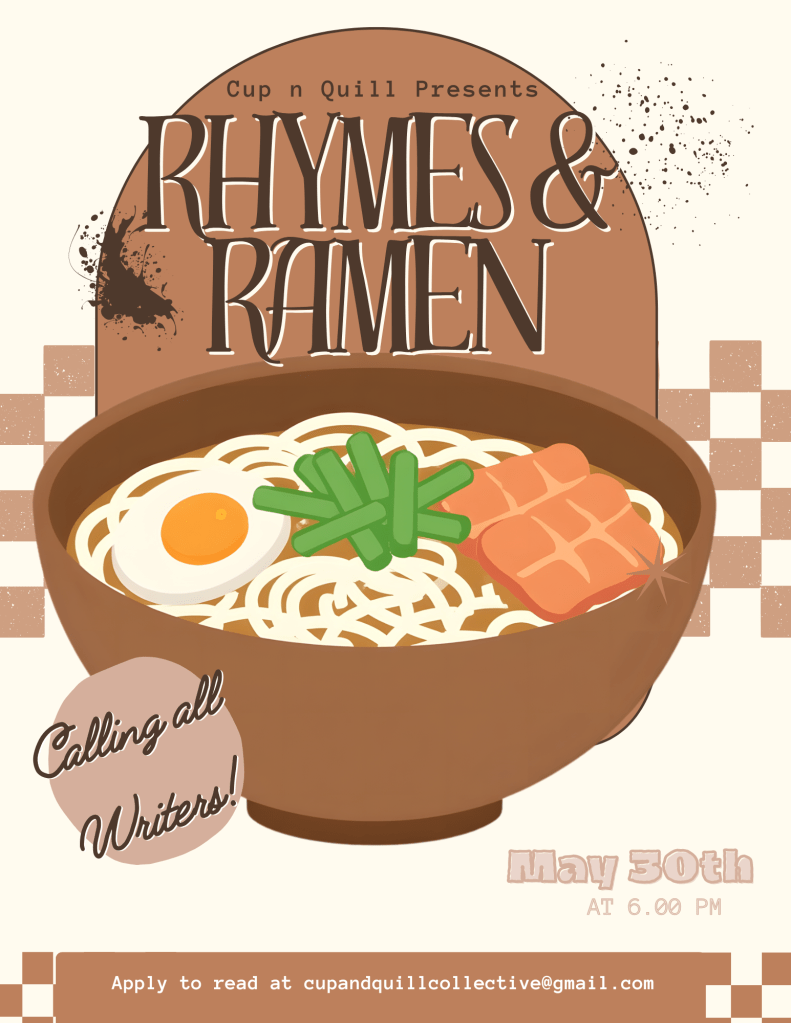
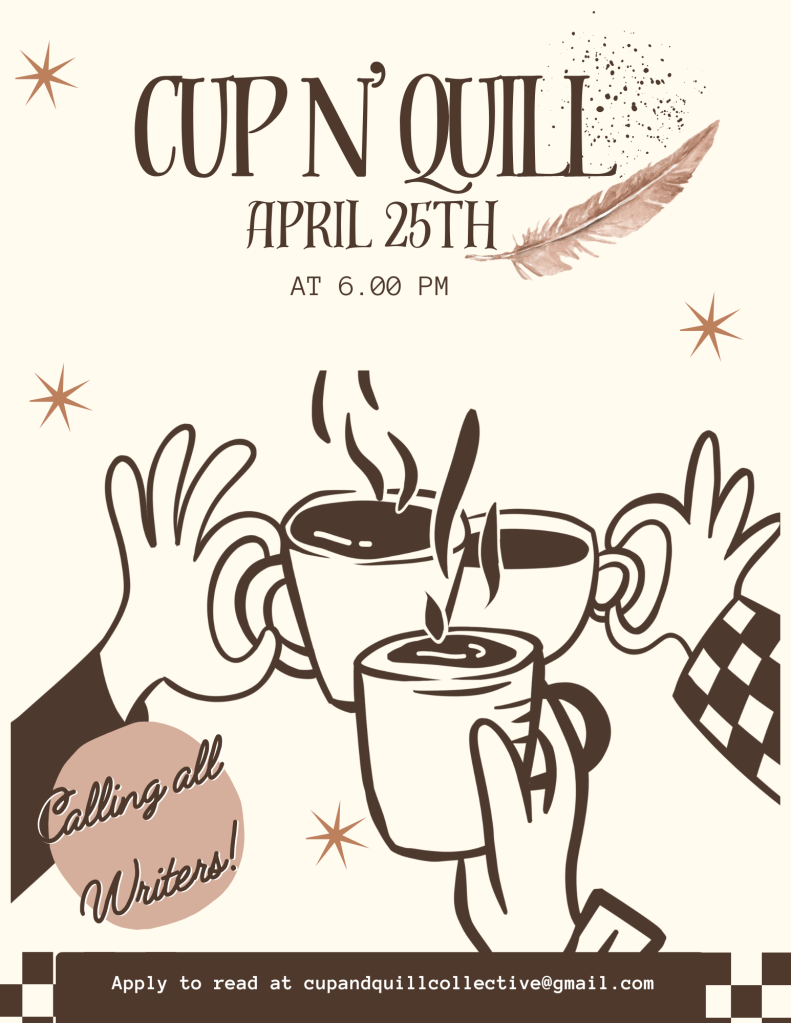
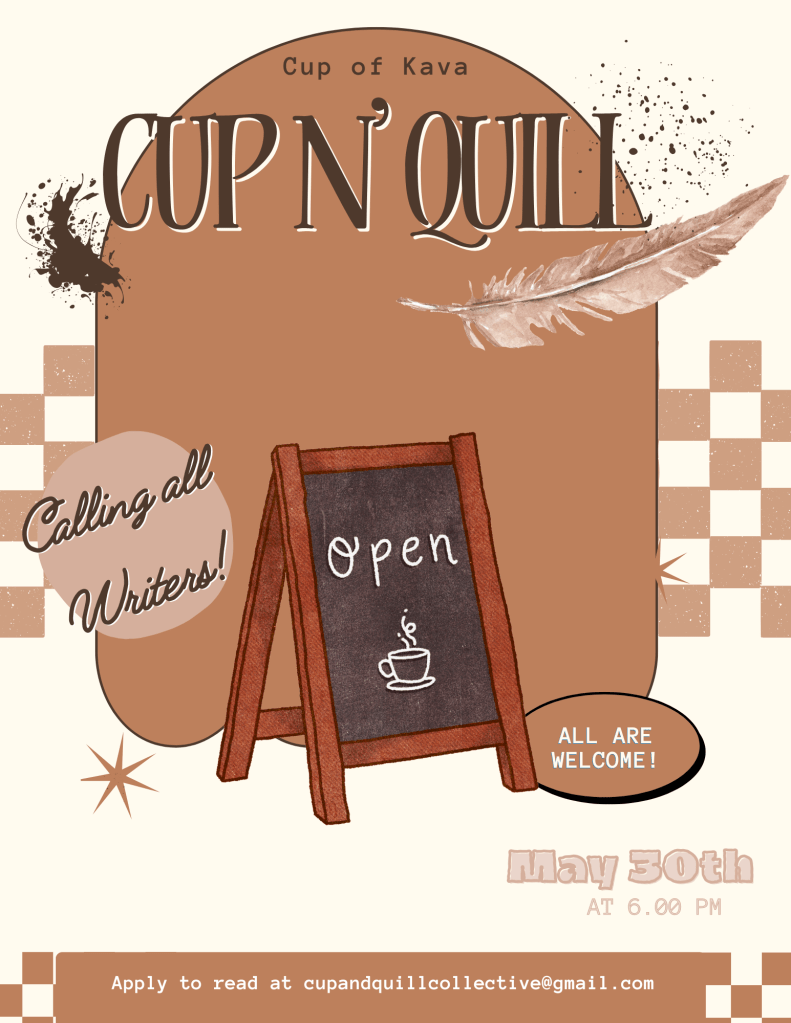
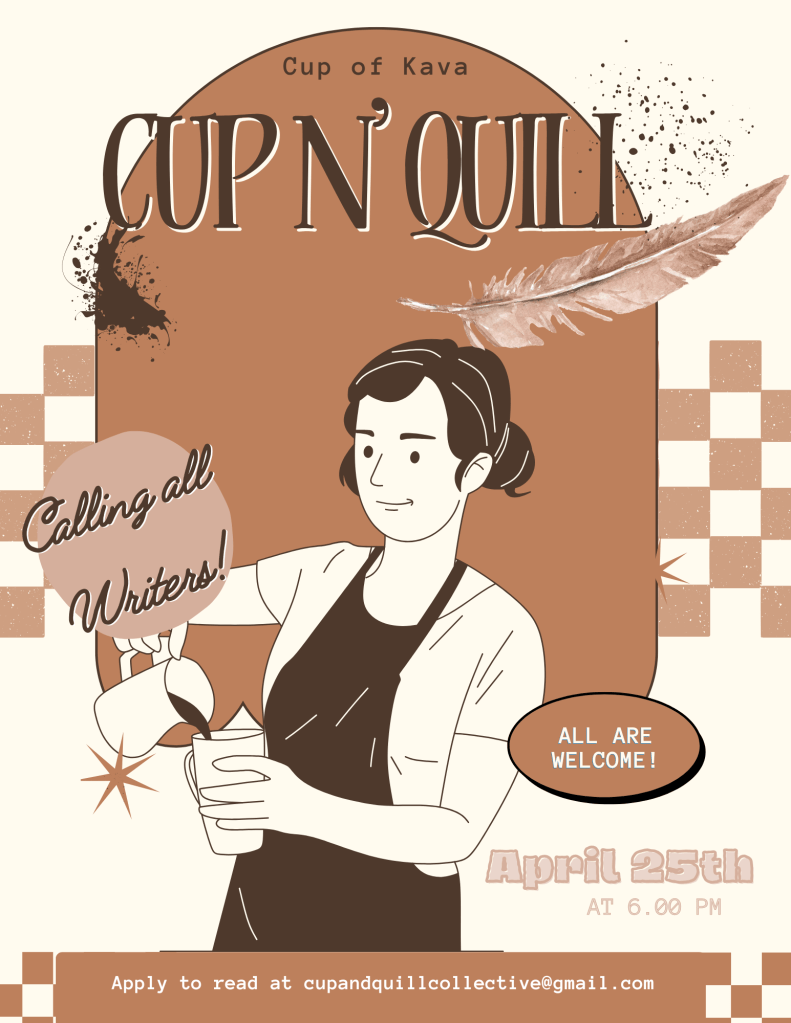
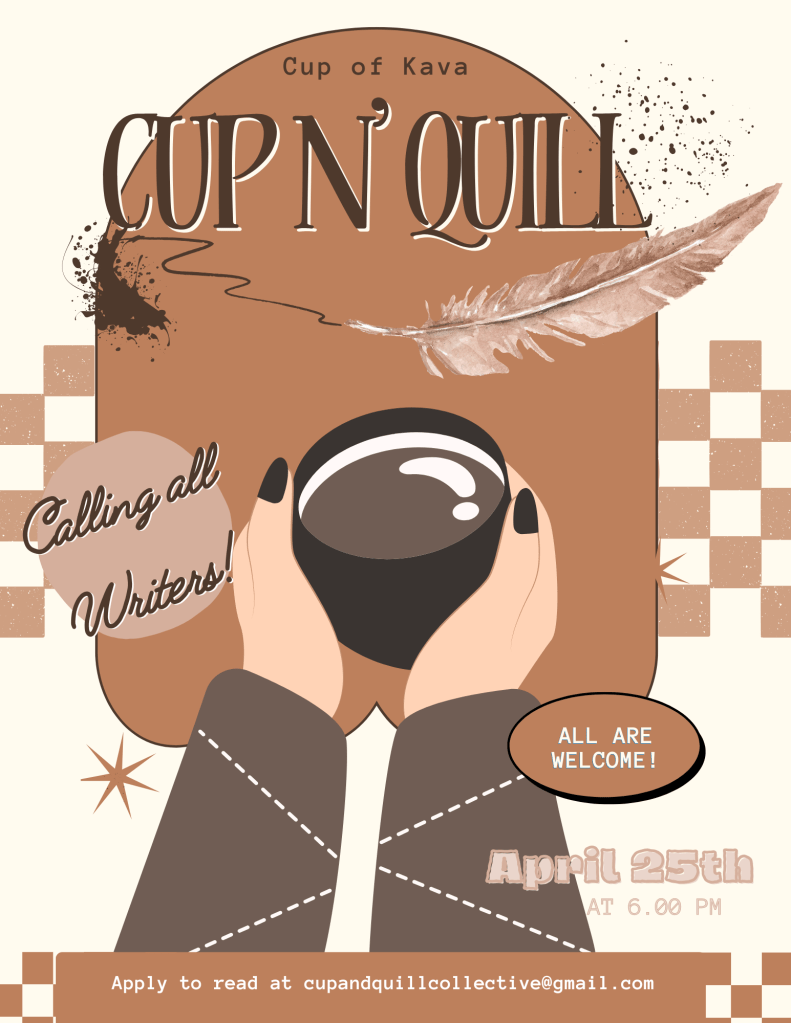
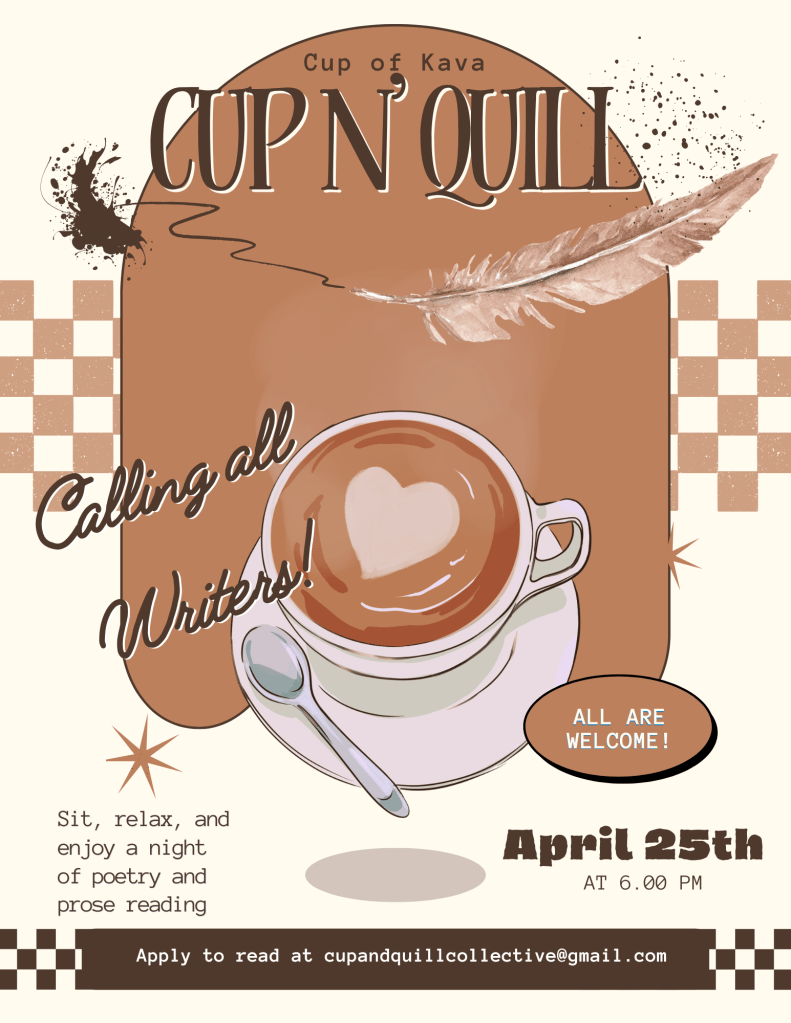
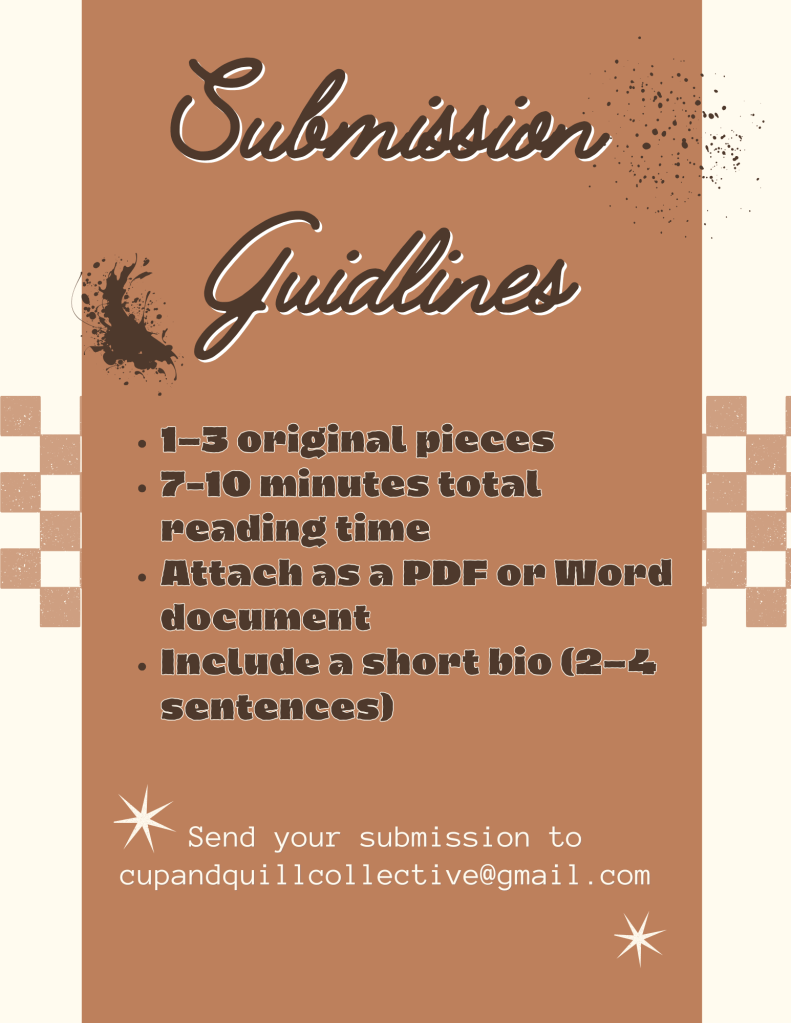
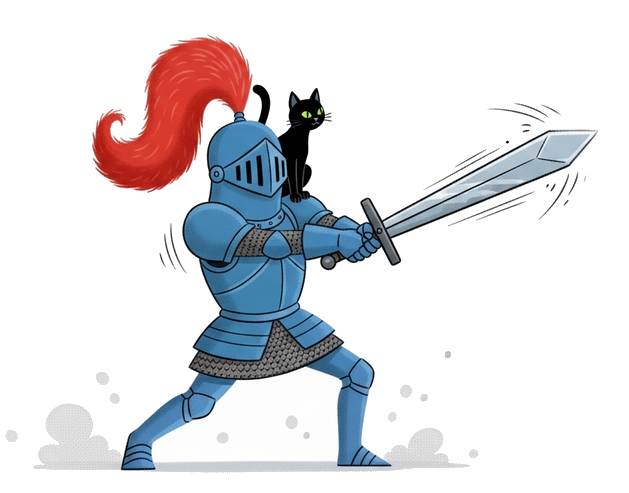
Final note: take a look at the flyers I so professionally designed with my free version of Canva! Take this as a sign that YOU too can make a cool event, make some cute posters, and people will attend!!

365 Days of being a Writer: Month 4

To recap, the last month was on observation! Hopefully, you found a variety of different inspirations from the day-to-day simple sitting and listening. Perhaps, in this month, you can put those observations to even more use as we shift the focus to dialogue. Observation month focused heavily on images and listening. This month, you can take what you heard and translate them into actual conversations between characters. Welcome to Dialogue Month!!

Also, a little sidenote- this month has less prompts to give you a bit of a break as we hit observation and character month pretty hard. The following months will have fewer and fewer prompts as we get into actual creative writing less creative journaling, and writing exercises. Let’s stay away from that ever-prevalent writer’s burnout!

Month 4 – Dialogue

  1. Write a conversation where someone hides the truth.
  2. Write a conversation with no dialogue tags.
  3. Write a conversation between siblings.
  4. Write a conversation between enemies.
  5. Write a conversation that happens over text messages.
  6. Write a phone call scene.
  7. Write a conversation interrupted by something unexpected.
  8. Write two characters arguing about something trivial.
  9. Write two characters apologizing.
  10. Write two characters flirting awkwardly.

Break:
94. Listen to people talking in public and jot down interesting phrases.

365 Days of being a Writer: Month 3

This month is going to be focused on observing! Writers are at their best when they are paying close attention to their surroundings. Writers can be inspired by anything but it really helps if you can pull inspiration from your own life (“writing what you know”). In order to do this, one must be observant. So! The prompts for month 3 are designed to help you step out of your own head and take a look at your surroundings! What do you see?

Month 3 – Observation

  1. Sit somewhere public and write what you see.
  2. Describe three strangers.
  3. Write about overheard conversation.
  4. Describe a shop window.
  5. Write about the weather like a character.
  6. Describe a tree in detail.
  7. Write about someone walking a dog.
  8. Describe the smell of a bakery.
  9. Write about the sound of traffic.
  10. Write about a quiet afternoon.
  11. Describe a cloudy sky.
  12. Write about a bird.
  13. Write about a river or creek.
  14. Describe the inside of a coffee shop.
  15. Write about someone reading a book.
  16. Write about someone on their phone.
  17. Write about a couple arguing quietly.
  18. Describe a cluttered desk.
  19. Write about something abandoned.
  20. Describe a bench in a park.

Creative break:
83. Take a walk and write down five things you noticed.

365 Days of being a Writer: Month 2

This month is character month! Last month was about getting started and building momentum, while this month will focus on building a character or characters plural and developing them one step at a time. Create one from scratch or work on a pre-existing one. These prompts are for you to do what you will.

Month 2 – Character

  1. Invent a character and write their daily routine.
  2. Write your character’s worst habit.
  3. Write your character’s biggest fear.
  4. Write about something your character regrets.
  5. Write a scene where your character lies to someone they love.
  6. Write about your character’s childhood home.
  7. Write about something your character collects.
  8. Write about a childhood memory your character can’t forget.
  9. Write about your character’s favorite meal.
  10. Write a scene where your character gets unexpected news.
  11. Describe your character’s best friend.
  12. Write about a scar your character has.
  13. Write about your character losing something important.
  14. Write about a small victory.
  15. Write a scene where your character feels embarrassed.
  16. Write about something your character envies.
  17. Write your character’s inner monologue.
  18. Write a scene where your character forgives someone.
  19. Write a scene where your character refuses to forgive someone.
  20. Write your character’s morning thoughts.
  21. Write a dream your character had.
  22. Write about your character’s favorite place.
  23. Write your character’s greatest hope.
  24. Write your character’s greatest mistake.
  25. Write a scene where someone misunderstands your character.
  26. Write your character’s personal motto.
  27. Write a moment of jealousy.
  28. Write a quiet moment alone.
  29. Write a confession scene.

Creative break:
61. Make a playlist for your character.
62. Describe the playlist in writing.

365 Days of being a Writer: Month 1

If you’ve ever wanted to write more but felt overwhelmed by huge projects, this challenge is for you.

The goal: 365 small creative actions over one year.

Some days you’ll write and some days you’ll observe. A mixing and matching of all sorts of creative outlets and exercises! So, without further ado, here is month 1.

Month 1 – Start Small

  1. Write about the room you’re currently in.
  2. Describe your morning routine as if it were a sacred ritual.
  3. Write 100 words about a character who is running late.
  4. Write about the smell of rain.
  5. Write a paragraph using only short sentences.
  6. Write a paragraph using one long flowing sentence.
  7. Describe a place from childhood.
  8. Write a conversation between two strangers.
  9. Write about a broken object.
  10. Write from the perspective of your coffee mug.
  11. Describe the sky today.
  12. Write a short scene set at a bus stop.
  13. Write a letter that will never be sent.
  14. Write about a secret.
  15. Describe someone entering a room.
  16. Write about the quietest place you know.
  17. Write a scene where someone lies.
  18. Write about a forgotten object.
  19. Write a 50-word story.
  20. Write a character description in five sentences.
  21. Describe a street at night.
  22. Write about someone waiting for news.
  23. Write about a sound that annoys you.
  24. Write about a smell that comforts you.
  25. Write about the weather changing suddenly.
  26. Write a short argument scene.
  27. Write about a locked door.
  28. Write about a memory that feels dreamlike.
  29. Write about someone finding something unexpected.
  30. Write a story in exactly 200 words.
  31. Take a break: read a poem and write one sentence about how it made you feel.

When Did Everything Become a Photoshoot?

Pre-warning: I am griping again

Everything now has this pressure to be aesthetically pleasing all the time thanks to the internet.

And listen, I get it. Trust me, ya’ll, I grew up during the golden age of Instagram. Pinterest is probably one of my MOST used apps, and yes, it is a problem sometimes.

Romanticizing your life and making things “pretty” can be fun. It can even be motivating. Lighting a candle before you write. Making your desk space whimsical. Using the good pen. Brewing coffee in your favorite mug. I’ve even written blog posts about fun ways to romanticize your writing process, so, in a way you could say maybe I’m guilty as well.

There is something lovely about being happy with your appearance and space.

But, recently, I’ve come to a weird sort of realization…

It feels like we’ve crossed from intentional beauty into constant performance.

There’s an overemphasis on aesthetics in general. Not just in writing alone, but in life in general. (I know, I know, I sound like a harpy old lady but hear me out).

Girls are expected to be pretty all the time. Self-growth is framed as “hot girl advice.” “Hot girls wake up at 5 a.m.” “Hot girls drink green juice.” “Hot girls don’t text first.” “Hot girls have spotless kitchens and perfect side profiles and somehow glowing skin while journaling about their boundaries.”

Since when did personal growth become a rebranding campaign? And what is this weird obessesion with being a “hot girl who x”?

It’s like the ultimate goal in life is to look amazing at ALL times. To have your life be this curated, aesthetically pleasing collage of neutral-toned items and sunlit corners. Your coffee has to look right. Your Bible has to be color-coded. Your gym outfit has to match. Even your healing has to be photogenic.

It’s ridiculous.

The internet is a highlight reel and we all know that. It captures moments in time. A split second. A perfectly framed sliver of someone’s day. We are not designed to line up and look exactly like these captured moments in time at all times. We are not still images.

We are messy, moving, complicated beings.

Now we are ebbing into looks over substance in every area of our lives. We spend way too long taking an aesthetically pleasing desk picture or finding the perfect angle to show off our cup of coffee beside our journal. And somewhere in that process, the coffee gets cold and the journaling becomes secondary.

The writing — the actual writing — becomes less important than how it looks to be writing.

And that’s where the fun starts to drain out.

Because the substance is the point. Not the proof of it.

There’s nothing wrong with beauty. There’s nothing wrong with liking nice things. There’s nothing wrong with enjoying an aesthetic. I am not anti-whimsy. But when aesthetics become the main goal instead of the byproduct, it begins to feel like everyone is now encapsulating the brand of being a writer. I feel like we’re losing a lot of authenticity in general. Again, I don’t want to sound like I’m grouching about everyone else, this is something I’m guilty of as well. My whole instagram page is color coordinated.

Really, I’m just sort of ranting to the void and maybe myself. Maybe it’s time we get back to the basics.

And if it happens to look pretty? That’s a bonus.

Maybe it’s time to become a writing minimalist. No routine, no coffee, no pretty desk space. Just writing.

If I were to write a romantasy novel…

This is my way of announcing that I’ve begun writing on a new project. Will I finish it? Who knows? Is it fun though? Absolutely. So I’m going to share it with you guys against your will! The door is locked and the powerpoint-er, I mean the synposis is prepared! Read along, and you may just get a sneak peak of what I’ve written so far…

The Synopsis:

To end a generations-long war, a marriage is arranged between a charmingly naive prince and a dreamy but equally oblivious princess. Neither is thrilled, both long for true love, but duty comes first. Behind the scenes, however, the true powers are at play: the prince’s brilliant and calculating gentleman-in-waiting, and the princess’s cunning and fiercely loyal lady-in-waiting. Each is the secret strategist behind their monarch’s success, and each is deeply committed to their own kingdom. When tradition demands that they too be wed, to symbolize the uniting of the households, they are less than thrilled. But strategy has a funny way of turning into something else when hearts get involved.

Meanwhile, in the shadows of court, two rival assassins, one from each kingdom, are given a single directive: kill the monarch of the enemy side. As their deadly missions cross again and again, a reluctant chemistry sparks between them, even as they try to finish the job and stay alive. The lady and gentleman-in-waiting, ever alert, play a high-stakes game of wits to keep their monarchs alive, all while navigating their own slow-burning, inconvenient romance.

As alliances shift and true affections deepen, three love stories unfold: between the idealistic prince and princess who unexpectedly fall for each other, the wary advisors who find love in the midst of rivalry, and the assassin enemies whose mutual respect may just turn to something more.

As this all unfolds, will the true enemy come to light?

The Preview:

Chapter 1: The Lady-in-Waiting

The throne room was suffocating. Courtiers pressed close in their jeweled silks, whispering beneath the vaulted ceiling as the King rose from his throne. Sage held her breath, watching every movement. A hush finally fell over the crowd. His voice carried like a trumpet blast, proud and commanding:

“Today, I announce a union that will bind two kingdoms. My daughter, Princess Lotus, shall be wed to His Grace, the Scarlet Prince.”

A ripple spread throughout the court. Some gasped, others exchanged quick, calculating glances. Sage, standing a respectful pace behind her mistress, felt her stomach twist and drop. She wanted to look at Lotus with the unspoken question, Did you know?

She dared not. She was the Lady-in-waiting. She was to be still, respectful, and quiet. So she stared ahead, focusing instead on the fountains lining the throne room perimeter, willing herself to focus on the way the light shimmered through the spray of water and the refractions that danced along the wall.

Still, from the corner of her eyes, she could see the princess keeping her chin lifted, her face calm as carved marble. Sage’s heart ached.

The King sat again, dismissing the assembly with a wave of his hand. This evening, his glittering silver crown set with sapphires seemed uncomfortably heavy upon his head. Sage noted the red around his eyes. He had spoken with such regality, and yet, up close, Sage could see him clearly: a tired, older man, with silver beginning to show. A weary man who had seen years of war and felt his only ploy for peace was to marry his own daughter off to a monster.

Courtiers bowed low, murmuring congratulations as they filed out. Sage remained rigid until the chamber emptied, then hurried to Lotus’s side. From there, Lotus and Sage bowed low to the King and Queen before they were dismissed as well.

As they did so, Sage tried to sneak a peak at the Queen. What were her thoughts on all this? Had she also known? Did she even support this mad decree?

But Lotus had learned her steely face from the best, and the Queen’s expression revealed nothing. She only inclined her head ever so slightly before turning with to take her husband’s arm, silks rippling around her like an ocean.

~*~

“You knew?” Sage whispered, unable to keep the edge from her voice.

Lotus finally exhaled, the careful mask slipping. Her eyes were watery but no tears fell. “Only last night. When we were having tea after dinner. My father told me as though he were announcing the weather.”

Lotus moved to sit on her bed, head shaking. Beads braided into her raven hair clicked and clacked as she did so, but she said nothing more, shoulders sagging in resigned defeat.

Sage’s throat tightened with shame, cheeks hot. I should have seen this coming. I should have anticipated.

“It isn’t your fault,” Lotus said gently, as if reading her mind. She motioned her friend closer to lay a comforting hand on Sage’s arm. “None of us could have predicted it. Father has been playing his cards close to his chest lately. He is a King at the end of it all.”

But he is also a father, Sage thought but refrained. Guilt did not rest solely on his shoulders.

Sage could not forgive herself. It was her duty to see every threat before it arrived, every storm on the horizon. And for the first time in her many years at the Azure Palace, she had failed.

Her mind spiraled backward, to the day she had been bound to this role. The day she made an oath. A promise never to be broken.

~*~

Sage was fourteen when the Queen summoned her. She recalled it all as if it were yesterday. She remembered the long path through the garden to reach the pavilion where the Queen sat, enjoying the golden summer sun. And though it was a beautiful afternoon, Sage remembered that the guards’ silence brought a chill upon her, faces gray in the midday.

The Queen sat on a blue velvet chair, appearing to be deep in thought. Her crown rested on a small side table beside her, though her gaze was sharp as a blade.

“My daughter,” the Queen began without preamble, “is good of heart. She loves our people, and she is beloved in turn. But she is…not made for the rigors of politics. She has little taste for diplomacy, little head for stratagems.”

Sage, young as she was, lowered her eyes. She had known this truth too, though she never dared voice it. She could see it every day during the Princess’s tutoring sessions. The girl could never quite recall the sequence of battles, or who had signed which treaty, or why it mattered in the first place. She would wrinkle her nose in confusion, or laugh lightly at her own mistakes, as if history were nothing more than a jumble of names tumbled together in her head. Dates slipped away like water through her fingers, and more often than not she confused one monarch with another, sometimes even her own ancestors. The tutors would grow red with frustration, but the Princess only smiled, unbothered, certain that someone else would always be there to remember what she could not.

Mathematics fared no better. Columns of numbers left her wide-eyed and blinking, as if they were written in some foreign tongue. She counted on her fingers long past the age when most had stopped, and when asked to recite her tables, she would hum under her breath to buy time, cheeks pink with embarrassment.

It was at the age of nine when Sage began to do Lotus’s homework for her. At first, she attempted to teach the Princess herself, certain that, someday, it would all come together and click into place. It never did. So, Sage kept up with her Lady’s work while she tended to less “boring” matters.

The Queen rose and crossed the room. Her hand came to rest firmly on Sage’s shoulder.

“You, however,” the Queen said, “have always been clever. I have seen how you watch. How you notice. I’ve seen you poring over her books and lessons far more than she ever has.” The Queen began to smile, but it quickly faded as she continued. “The world will try to outwit her, to corner her. I will not let that happen.”

Her voice softened. “So I charge you, Sage of Rosehall, to be her mind when her own fails her. To stand beside her when I no longer can. She will be the heart of this kingdom, and you must be her reason.”

Sage’s knees nearly buckled under the enormity of it. But she bowed her head and whispered the vow that had bound her ever since:

“I swear it, Your Majesty. My loyalty is hers. My life is hers. I will not fail her.”

~*~

The echo of that oath still rang in Sage’s mind as she looked at Lotus now, her eyes burning.

She was sleeping now. She always did so easily. She had lain down on her bed only for a moment before she was snoring quietly. Even in the face of such an announcement that sealed her fate, she slept.

Sage beheld her with pale skin and blushed cheeks. Her sleek dark hair was half done now, the style not arranged for rest. Her sky-colored gown was rumpled and wrinkled. She was small, and gentle, and perfect. A lamb of the Azure court.

Sage’s fingers curled into fists. The King might throw his daughter to the wolves of politics. The Scarlet Prince might come to devour her. To devour her future kingdom, but Sage would not accept her friend’s fate. She would sharpen her mind as to a blade. She had sworn once that she would not fail Lotus, and she meant to keep it. By her life, she would keep it.

Alternatives to AI (In Writing that is)

Hey, everyone! Hope you’re doing well and this winter is treating you kindly. Just thought I’d hop on here and make a quick post about something that has been on my mind recently…

We’ve talked to AI a bit on this blog. We’ve mostly stayed away from the environmental impact (that gets a little too complicated for me) and have mostly just discussed the concerns with the increase of AI “slop” that is flooding the writing world. AI books are now prevalent on Amazon and are overshadowing real writers in an already oversaturated market, where it’s challenging to make any money, let alone earn a living. It’s concerning, you all know it.

But another concern on the horizon is its impact on your brain and creativity. In short, it is making us mentally LAZY. Can you imagine that? Science shows that creativity (or more accurately, our brains) arer muscle that needs to be worked out periodically in order to stay sharp. What do you think happens to this muscle when the only writing you do is typing in a badly worded prompt into chat gpt?

AI is becoming a crutch for modern writers. Whether you believe the statement that “AI is destroying the environment” or you’re more open-minded to the robots taking over (A smarter grammarly would be nice…), this effect shouldn’t be ignored or pushed aside. This is a very real concern that doesn’t have to be overly political in any sense. Our brains can get lazy. If we don’t use them enough, they turn to mush. Simple.

So what’s the alternative then? In short, your brain, but that wouldn’t make for a very short blog post if I just stopped at that. I’ve compiled a list below of various ways you can come up with your own ideas organically, without involving the use of any chatbot. Protect your brain, dear writer! It’s your greatest resource. Use it.

1. The Word Jar Method
Write nouns, verbs, adjectives, settings, emotions, and random objects on slips of paper. Toss them in a jar (or several jars, if you’re feeling Type A). Pull 3–5 at random and make it work.
Example pull: porch swing, jealousy, February, apology, river.
Your brain now has a job. Let it complain and then get to work.

2. The Frankenprompt
Create columns on a page:

  • Character archetypes
  • Locations
  • Conflicts
  • Objects
  • Constraints (must take place at night, must include a lie, must end unresolved)

Close your eyes, point at one from each column, and stitch them together. No optimizing. No rerolling until it’s “good.”

3. Alphabet Abuse
Pick a random letter and force yourself to generate:

  • 10 nouns
  • 10 verbs
  • 10 adjectives
    All starting with that letter.
    Then write something using at least five of them. This is shockingly effective and slightly infuriating, which means it’s working.

4. The Bad Idea Generator
Set a timer for five minutes and intentionally come up with the worst possible story ideas. Lean into cliché. Lean into melodrama. Lean into nonsense.
Then circle one thing in the list that secretly has potential. That’s usually where the gold is hiding.

5. Sentence Autopsy
Open a book you love. Pick one random sentence.
Now:

  • Rewrite it in a different genre
  • Rewrite it from another POV
  • Rewrite it with the emotional tone flipped
    You’re not stealing. You’re studying how sentences breathe.

6. The Overheard Thought Exercise
Write down fragments of thoughts you have throughout the day. Not polished ideas. Just scraps. String them together into a coherent tale.

7. Constraint Dice
Assign constraints to numbers (you can use real dice, a random number generator, or scraps of paper).
Examples:

  • POV
  • Time period
  • Emotional tone
  • Length limit
  • One forbidden word
    Roll and obey. Creativity thrives when it’s boxed in.

8. The Mundane Remix
Take an ordinary task (making coffee, folding laundry, driving to work) and write about it as if it’s:

  • Sacred
  • Sinister
  • Mythic
  • Absurd
    This trains your brain to reframe, which is one of the most valuable creative skills there is.

9. Sensory Isolation Prompts
Write a scene where you remove one sense entirely.

  • No sight
  • No sound
  • No touch
    Your brain has to compensate, and in doing so, it stretches. Conversely, you can write a story only employing the use of a SINGLE sense.

10. The Question Pile
Instead of prompts, write questions.

  • What does this character want but refuse to admit?
  • What would ruin this ending?
  • What’s the most inconvenient truth here?
    Questions keep your brain engaged longer than answers ever will.

11. Use a generator Website

Springhole.net, fantasy name generator.com, etc. They don’t use AI, they just randomly jumble stuff up. Nothing complicated. OR you can visit my generators tab on this very blog. 😉

Ok, rapid fire round…

  • Tarot Pull Prompt
    Pull one card for character, one for conflict, one for outcome. Ignore the “official” meanings if you want. Let the imagery do the heavy lifting.
  • Pinterest Roulette
    Search one vague word like “world,” “winter,” “kitchen,” or “blue.” Use the first image that appears as your setting. No scrolling. No refining.
  • Bookstore Spine Stare
    Stand in front of a shelf, read titles only, and mash two together into a new premise. Bonus points if they absolutely shouldn’t coexist.
  • Dictionary Dare
    Open a dictionary to a random page. First word is the theme. Second word is the tone. Third word must appear verbatim in the piece.
  • Song Title Alchemy
    Shuffle a playlist, pause randomly, and use the song title as your opening line or emotional arc. Do not listen to the song fully. Fill in the blanks where you lack knowledge.
  • Weather Report Writing
    Write a scene that emotionally mirrors today’s weather. Not literally. Vibes only.
  • Object With a Past
    Pick up the nearest object and write its backstory like it has lived three different lives before you.
  • First Line Theft (Ethically)
    Take the first line of a public-domain book and write a completely unrelated story from it.
  • Constraint Countdown
    Give yourself ten minutes, 250 words, and one absolute rule (no adjectives, no dialogue, no first person). Stop when the timer ends.
  • Google Autocomplete Confessional
    Start typing “why do I” or “I’m afraid of” into Google and use the suggestions as poem or essay titles.

The “Don’t Save the Sticker” Theory: There’ll never be a perfect time for anything

This concept is not novel, but I was thinking about it in specific terms the other day. When you were a kid, did you have save stickers to wait for the perfect time and perfect surface to use them on? But, surprise, surprise, that perfect moment never came? Circumstances were never quite right enough.

I logically know that life is imperfect by nature and most things are hard to begin but the seriousness of decision paralysis hit me in a special way when I considered this childhood lens. Those stickers I hoarded? I have no CLUE where they are now. The window for using them ended at some point, unbeknownst to me. A theory very similar to this one that I’ve dubbed the “don’t save the sticker” theory (so official sounding, I’m really breaking new ground over here) is the Fig Tree analogy. The idea is that in life, you are presented with a branch of figs which represent opportunities. These figs tend to serve as a metaphor for different careers and life paths one could pursue BUT you only have so much time to choose your figs as they will eventually rot. You have to choose one or you essentially choose none.

This theory is a bit hyper-focused in career paths and “roles” one could play in life so, to a degree, I disagree with it. I think you can be a successful artist who is also a horse-back rider. An accountant can go home and write novels. We are limited by time, yes, but I don’t think it’s quite so dire that we can only choose one singular fig. I think we can be many things in life and it’s never too late to try pivoting.

That’s why I like the concept of the “Don’t save the sticker”. It really emphasizes simply taking what opportunities you can, even if they’re not what you perceive as “perfect” circumstances. This is theory is in line with the saying of “do it tired” or “do it scared”. Just do it. (Oh look, I’m Nike now).

I think the real tragedy of saving the sticker isn’t that we might use it “wrong,” but that we quietly accept inaction as neutrality when it’s actually a choice. Not choosing is still choosing. I have to remember that not making a decision is often me choosing comfort, familiarity, or the illusion that I’ll be more ready later. And later is SUCH a slippery concept. It feels infinite right up until it isn’t.

Maybe the goal isn’t to use every sticker wisely, but to use them at all. To slap them onto notebooks that get scuffed, water bottles that eventually crack, or moments that aren’t Instagram-worthy but are real and lived-in. A sticker on a scratched surface still did its job: it existed.

I don’t want a life where everything stays pristine because I was too afraid to commit. Let things be temporary, flawed, and unfinished if that’s the cost of letting them exist at all.

After all, unused stickers don’t become more valuable with time. They just disappear.