Evening Poems: Ending

Like feathers falling on fresh snow. 

It’s the price we all pay. 

Don’t shield your eyes. 

From the oncoming day. 

You are now empty-you can see it in your eyes.

They are now singing 

For a new soul shall rise. 

All must pass, my darling. 

This much is true. 

And they are all so happy to meet 

Someone as lovely as you. 

They say this is death. 

The sad, sad ending. 

But they are wrong. 

This is the healing-this is the mending. 

My Beginner Writing Mistakes

So recently I came across an old USB drive of mine when cleaning my desk. Upon plugging it into my computer, to my delight, I found that it contained tons of my old writing and stories that I had written awhile back. And while I was happy to stumble across this little piece of my writing history, I was hit with a realization: my writing sort of sucked.

This didn’t bother me mind you; I was like 11 writing the majority of these stories, but I also couldn’t help but notice a few writing mistakes that I tended to make consistently. Some of these I still struggle with and some of these I have moved past but regardless I found it beneficial to note them and state them in this blogpost in hopes that someone else making these same errors could get some advice or find this constructive to their own writing.

Enjoy my analysis of my flaws.

Not utilizing paragraph breaks.

Or if I did, I used them incorrectly. I think this just comes with more practice where you get a better feel for when it is the correct time to press “enter”, but at this time in my life, I did not have such a sense. I either do not utilize paragraph breaks enough, resulting in long, sprawling pages of text or I used them awkwardly where it didn’t even seem to fit. The rule, as I’m sure you’ve heard, is to press enter and use a paragraph break every single time the “camera” changes in your story. This means someone else begins to speak, an unrelated action occurs, or a new line of thought comes into play.

Too many dialogue tags.

My writing didn’t flow for a lot of reasons, but one of the main reasons it all felt so janky was I used waaaaay too many dialogue tags when writing. This caused the conversations to feel choppy and jilted and not at all natural.

“He said.” “She said”. “They said.”

Too many saids. Sometimes you should omit the tag and simply write what the character is saying only. Besides, a good writer makes characters that you can tell is speaking, simply by how they talk, not just by the “said” that the writer tacks on at the end.

Not enough dialogue tags.

There were a few times however, that I omitted the tags entirely too much. Certain stories I guess I simply didn’t care enough about and barely added any tags at all. In some cases, as I’m sure you can imagine, this became all too confusing and it was hard to keep track of who exactly was talking at times, especially when the conversation involved more than two characters and it wasn’t a sort of back and forth exchange.

Pro Tip:

Read your writing out loud, but especially the dialogue bits to make sure they flow.

Being overly flowery in my writing.

Another error of mine was just being plain pretentious in my writing style. How did I do this? By overly describing EVERYTHING and utilizing long (but admittedly fun) words. While I do remember finding this a fun way of writing, feeling almost like I was writing the script of a nature documentary for a British dude to read, it admittedly did not make for great story telling. My writing felt fluffy and long winded. So unless you’re specifically going for that pretentious vibe, I’d try and avoid it.

Being redundant (failing to expand my vocab when it came to words I use a lot)

There are just some words I struggle to find stand-ins for but it would have definitely benefited me to look up a list of synonyms for the word “smiled” before I ever wrote ANYTHING. My advice to you is know the words you tend to regurgitate and before you even start writing, look up or compose a list of alternatives to resort to later when you feel you’re repeating yourself way too much.

And that’s it! Those are all the main issues I found with my earlier writing. And while I’d love to say the stuff I put out now is WORLDSSSS better, I would venture to say it isn’t. Despite having written for 6 more years, I still find myself struggling with much of the same stuff, especially when it comes to the issue of redundancy. This goes to show that we will never be perfect as writers but that still doesn’t mean we can’t improve. And we do that by knowing our downfalls and, probably most importantly, continuing to practice and hone our craft.

Happy writing!

Writing Prompt: How to Train Your Cryptid

A group of teens find themselves at a very odd summer camp… 

The woods nearby are teeming with odd wild life and the counselors tell then tales at night about the beautiful beasts that once roamed the earth that were forced into hiding.  

The second week of camp it is revealed that this is a camp where teens are trained to house and protect different cryptids, choosing one specifically as their own companion.  

The campers are arranged into “cabins”:

Nessie 

Sasquatch  

Yeti 

Thunderbird 

Jackalope  

Kraken 

Writing Cheat Sheets You Should Know About

Writing can be really hard sometimes. Some days the words flow seamlessly from my finger tips and there other days where I get stuck on every little thing. One things that I have found that has helped me with these mini challenges and road blocks is having a few choice writing cheat sheets on hand that can help me when I’m stuck on how to write a specific scene or character. And so I would like to share these little cheat sheets with you.

Emotion Cheat Sheets

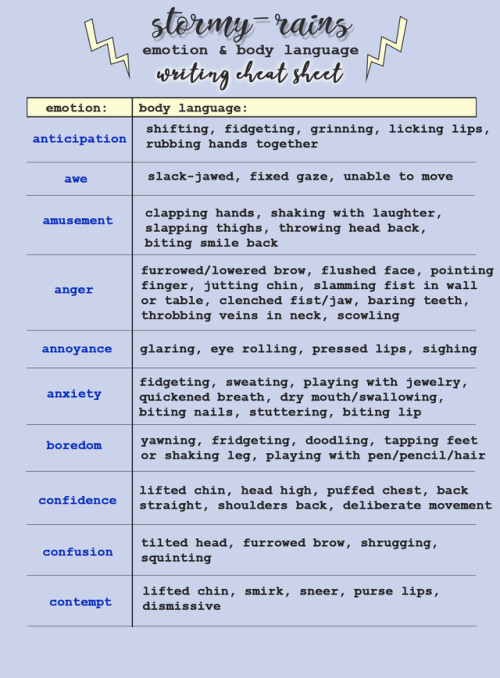
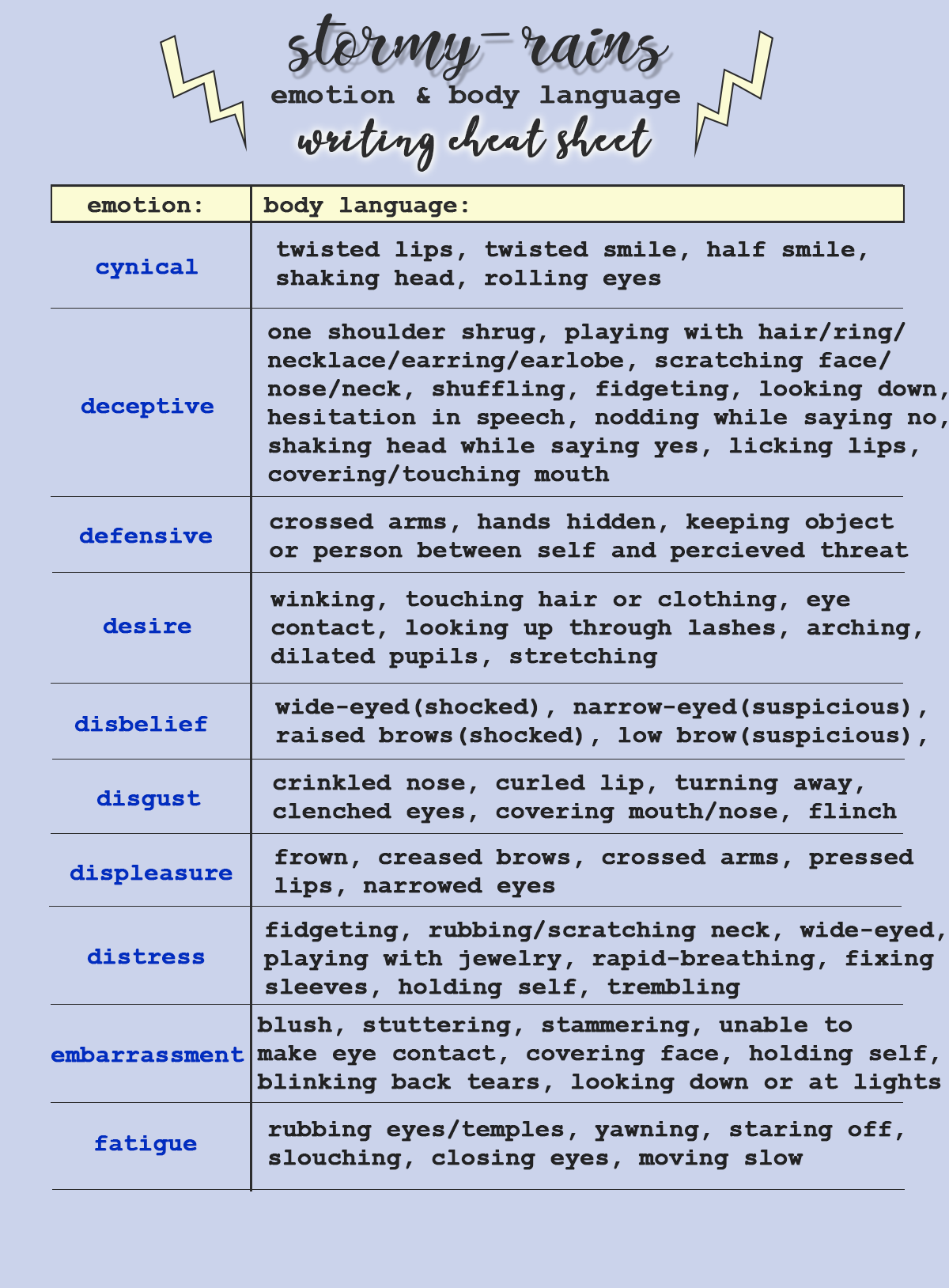
Writing certain emotions are harder for me than others. Especially when writing more obscure emotions that go beyond “happy” and “sad” and “angry”. This is because, sometimes, I can only recall one or two actions that reflect that specific emotion and I don’t want to sound like a broken record when writing their non-verbal cues. “She shook her head”, “She grit her teeth”, “He smirked”, “She smirked”. It can get pretty redundant.

These emotion cheat sheets help me with that. They each give me an emotion and a brief list of mannerisms and reactions associated with that emotion that one can integrate between the dialogue.

cheat sheet 1

cheat sheet 2

cheat sheet 3

Conciseness

This might be more helpful for essay writers or article writers but it can be useful for story writer’s as well. If you have a bad habit of writing overly wordy phrases that could be replaced with a more condensed version of the phrase for clarity, then this cheat is for you. It goes through a few commonly used wordy phrases in writing and suggests replacements.

clarity of writing cheat sheet

Actions that don’t sound repetative

I have a bad habit of over using specific actions in writing.

Look. Walk. And smile.

These are three actions that happen quite a lot in a book. But I personally struggle to find other words that convey the same meaning to avoid sounding redundant. So here are a few cheat sheets I use to help me “dress up” and better describe these actions.

Words to replace “look”

Words to replace “walk”

Words to describe a smile

Various ways to integrate “smiling”

The Replacement of very

Yet another cheat sheet that can help you specifically combat the redundancy of overusing the word very.

A Very Helpful Cheat Sheet

The Death of Said

Aaaaand here is the last one. And probably the one I struggle the most with. Said. Now contrary to what you might have read online, said is not dead. Let’s not overlook the danger of getting to flowery with our writing. There are still places for simple versions of words. Said will always have a place in writing, But again, this is cheat sheet is made simply for when you fear you’re sounding tedious and like you’re repeating the same word over and over and over and over and over and over again. And sometimes these words and phrases can better describe the tone with which an action is done much better than “said” can.

Said Cheat Sheet

Evening Poems: Anger

Anger is a feeling you should feel 

But never house.  

When his stay is over, 

Know when to take his coat from the closet, 

And let him go.  

Some make the mistake of letting him overstay his welcome  

Offer him a bed to rest.  

For anger is a distant relative you can let in only for a time or he will eat you out of house and home.  

Let him sit at the table but not the head.  

Let him only once sip the wine and break the bread.  

But when the clock strikes late 

Send him on his way.  

Anger is only a feeling that is felt- 

But should never stay.   

Evening Poems: To be an Artist

I romanticize my suffering, 

And then I call it art.

Pathetic is now pretty,

Because it is from the heart. 

Cutting words are poetry,

Because now they rhyme .

Beats that flow perfectly.

Words that read in time. 

Bleeding is now beautiful.

The pain to be a creator. 

This is my written world,

And I am the dictator.

And so I will write them,

To any who will listen. 

But little do they know,

The words I weave are my prison. 

Evening Poems: Anxiety

Anxiety is man, 

He tells earnestly 

For what I should worry 

But as I focus on his features 

He seems to be blurry 

So I’ve come to find out 

He thinks he knows best 

In his well trimmed suit 

With a velvet vest. 

But his words are empty 

A spiral of care. 

Obsession dressed in good intentions

To hide the nightmare.

The 7 deadly writing sins that ruin your productivity

Good morning! Long time, no blog post? With that in mind, I think it’s either befitting or ironic that I am sharing a little list of comprised of some of the most common “Writing Sins” that totally mess with my writing productivity. Little things that mess with my best of intentions to write buuuut I could just refresh my pinterest feed one more time, right?

Having your phone nearby and not silenced.  

Is it no surprise that I’m a super distracted writer? Generally I don’t see myself as an easily distracted person but there is something about sitting down that makes my wonder from whatever I am supposed to be doing and search for something else. And, often, that something else, is my phone. Phones basically give you instant engagement and gratification. I’m sure we’ve all heard the studies done on this. The tiny dopamine rush we get from the stimulation of entertainment (this rush being small but effective in wiring our brains to seek it out more or “refresh” the page). But, because of this, having my phone nearby, can often be a distraction waiting to happen. Especially if I don’t silence it. These days, for many reasons, I have my notification completely off nearly 100% of the time, and I will say, it really, really helps.

Having too many tabs up. 

I’ll often find myself wanting to clarify this one “thing” in my writing so I open up a new tab, to research said “thing” and one rabbit hole of research later, here I am with 1000 tabs up and no writing actually done. So, for my benefit, I limit the amount of “tabs” I’m allowed to have open. In fact, it has to be really important for me to minus my word document and look up because I know my own tendencies. This is why I recommend that if you ever need to further research something for clarification in your writing,  insert a filler word and move on. The filler word should be weird like “pink elephant” for its easily searchable in a word document and found. Come back to it later.

Getting a little to caught up in music

I feel there’s a common theme of distraction here. I cannot write with music really. I end up humming along and just getting way to into it and Oh! Look! Now I’m distracted. Again. If I do happen to be in a focused mood, instrumentals often work best. Chill instrumentals. And even then, it’s probably best I don’t recognize it so I’m not tempted to hum or sing along.

Being too perfectionistic and getting too bogged down in getting everything just right.  

Hmmm… distractible AND perfectionistic? What a great combo! This is more of a mind thing. If I’m ever to get any writing done, I have to tell myself over and over again “you can’t edit a blank page, just keep writing”.

Not having a snack nearby.  

I’m just repeating myself at this point. This is yet another gateway to distraction. Take my word, have food nearby, unless you have a specifically planned break for food.

Not knowing your productivity pitfalls or strengths.  

Hence this list. But it can be different for everyone. It’s simply a matter of knowing yourself and your own unproductive tendencies and having specific ways to counter them. Not only that, but try and play to your strengths as well. If music really helps you picture the ambiance of a story, by all means, utilize that. If it is nothing more than a source of distraction (like it is for me), then maybe resort to some other background noise like ambiance sounds.

Getting too caught up in word counting.  

If I am struggling to pump out some writing, I find I have a huge problem with typing, and then checking the word count like I’m writing an essay for school. This is because I have a word goal I hope to meet every day, and while this does me good, on bad days, I find myself way too caught up in meeting the quota. I haven’t really found a way to combat this if I’m honest. I feel that if I don’t force myself to write at least a little everyday, it is easy to get out of the habit and oh! Now I haven’t written for a month. Yay. But I definitely feel like my writing suffers when I am just checking a “list”. My only tip on this specific tendency is just know, that we all have bad writing days. But I think I ascribe to the idea that something, even if its a bit forced on this particular day, is better than nothing. Really I think that’s the ideology that’s at the heart of productive writing.

“Something is always better than nothing”.
Miscellaneous Dialogue Prompts

“Thanks for underestimating me; I needed the motivation.”

“Tell me, if our hearts were replaced with clocks, would love more?”

“Someone here has to be hollow; might as well be you.”

“I dont remember your face but I remember I love you.”

“Follow close- there’s no telling what’ll be waiting for us.”

“If you were made to mend broken hearts, you would have been born with a needle and thread.”

“Knowledge and understanding are two totally seperate things I’m afraid.”

“I deserve to be loved, not merely considered.”

“You fell so many by the sword yet you cannot save yourself.”

“Please don’t look away.”

“The problem with people who take down giants, Is they end up thinking they’re giants themselves.”