I have taken a brief break from my writing related posts to bring you this statement:
There are jellyfish who have been to space.
The fact that this statement is true makes me happy as well as utterly curios, as I am sure you are (and a little bit jealous now that I think about it. These little creatures have been to space and somehow I haven’t? The injustice!).
So, why exactly did we, as a human race, decide to send jellyfish to space? Don’t we already have enough weird hobbies?
The answer is actually quite simple: for science.
Funnily enough, this occurred all the way back in the 1990’s (and I’m only just now finding this out! My education has failed me!)
The long answer is it was for a project NASA came up with to launch a load of 2,478 jellyfish polyps. These creatures were contained within flasks and bags that were filled with artificial seawater. Another fun little sub-fact about this experiment is the species they sent into space were called “Moon Jellyfish”.
They then reproduced to where there were near 60,000 jellyfish orbiting our little planet. A whole giant sub group of space jellyfish had been born without any knowledge of Earth’s gravity.
Which was the point.
Scientists did this bizarre experiment to figure out how a jellyfish that developed in space would respond to earthly gravity, because, despite the sea creatures not having legs, they do have a sensitivity to gravity. Turns out a space jellyfish has more issues getting used to earth’s gravity when they were raised in space, implying that a creature raised space’s inner ear and overall body’s sense of gravity is impeded when they are raised in space with 0 gravity. In short, jellyfish, when raised in space, were found unfit for life on Earth.
So what does this prove?
Well it implies the effects being raised in space might have on a person and may mess up their sense of gravity as well. This is important for people to know if we ever want to pursue a space colony of sorts or what would happened if a child were raised on a space expedition.
Hi everyone! And welcome to my blog post where I rate all of NASA’s cute lil mechanical astronauts on their missions, hardwork, and how adorable they are. Are you ready?
Robonaut
This guy was designed to be about as humanoid as scientists dared to make a robot in the 1970s. Robonaut was designed to replace humans in space exploration. While its very hard to make a human-like robot and duplicate our emotions and the way our minds work, scientists manage to give this guy fourteen degrees of freedom and touch sensors at the tips of its fingers.
According to the very reliable source of Wikipedia, “There are currently two working robonauts, R1 and R2. R1 and R2 are both highly capable robots and are able to handle a wide range of tools and tasks. Robonaut 2 or R2 was flown to the space station as part of STS-133 mission and was the first humanoid robot in space.”
In the future, legs will hopefully be added.
So, now onto the rating.
While I give this robot my upmost respect, I cannot deny he looks a bit creepy. But given the importance of his work, I think I will give him a solid 6/10
2. Spidernaut
I’m not going to lie, Spidernaut scares the living crud out of me. A mechanical spide that is not only strong but HUGE. Sign me up, you do not. But, I will say, this design is really cool. The problem scientists have been having with our upcoming generation of space science platforms and vehicles are too large and too fragile to launch and deploy as self-contained payloads. They are breakable, present us challenges whenever we want to send them somewhere.
Spidernaut is supposed to remedy this.. The multipoint stance of an arachnid’s eight legs, with as many as 7 down during a step, allows simply-supported footholds that spread climbing loads more evenly across a space structure and impart no torques.
However, as of right now, it is simply a concept, theory, and an unlaunched model.
5/10
3. SPHERES
What are those large D&D looking dice things you might ask? Well, you probably won’t ask as this is a list all about robots and you can use deductive reasoning, BUT let me just pretend for a moment that you actually DID ask.
These are called SPHERES. The Synchronized Position Hold Engage and Reorient Experimental Satellite (SPHERES). They are a series of miniaturized satellites.
Too, quote and article, their exact purpose is this:
” to be used as a low-risk, extensible test bed for the development of metrology, formation flight, rendezvous, docking and autonomy algorithms that are critical for future space missions that use distributed spacecraft architecture, such as Terrestrial Planet Finder and Orbital Express.”
Each SPHERES satellite is an 18-sided polyhedron, with a mass of about 4.1 kg and a diameter of about 21 cm. So they’re small, compact, and super useful. In short, they are used for a wide diversity of experiments, basically functioning as a space lab partner.
These satellites get all my love.
8/10
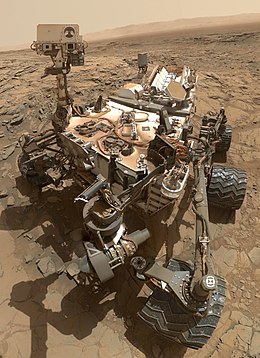
4. Curiosity Rover
How could we even make such a list as this and not include our loyal Curiosity.
Originally Rover was sent to Mars to a explore a crater. A simple mission, right? But in December 2012, Curiosity‘s two-year mission was extended indefinitely. He remains operational and to this day, collecting samples for scientists to analyze.
8/10
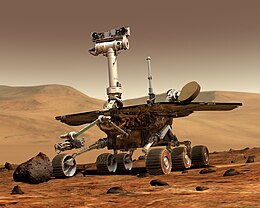
5. Oppy Rover
You probably already know the extensive tale or Opportunity Rover, effectionately nick named Oppy for short. Part of NASA’s Mar’s exploration program, Oppy landed on the Planet on January 25, 2004, three weeks after its twin Spirit (MER-A) touched down on the other side of the planet. Rover spent its days on the planet doing various tasks for scientists, being powered by its solar panels and hibernating during dust storms. This careful operation allowed Opportunity to exceed its operating plan by 14 years, 46 days (in Earth time), 55 times its designed lifespan. However, Oppy did not reboot after a dust storm in 2018, suggesting to scientists that it had some sort of failure, or that, perhaps, the machines solar panels got too covered by dust to operate. Scientists hope to go back soon and reactive this little machine. But until this, this little machine occupies a little space in our hearts.
“More than 835 recovery commands were transmitted since losing signal in June 2018 to the end of January 2019 with over 1000 recovery commands transmitted before February 13, 2019.[16][31][32] NASA officials held a press conference on February 13 to declare an official end to the mission. NASA associate administrator Thomas Zurbuchen said, “It is therefore that I am standing here with a deep sense of appreciation and gratitude that I declare the Opportunity mission is complete.”[33] As NASA ended their attempts to contact the rover, the last data sent was the song “I’ll Be Seeing You” performed by Billie Holiday.”





 By the Brooke