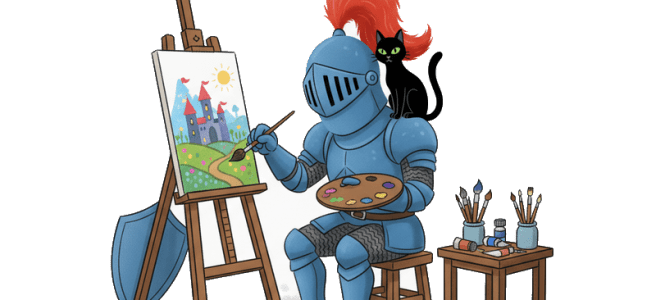
Whimsical Brainstacking: How to Make Keeping Your Mind Sharp a Little More Magical

Our brains can turn into mashed potatoes as time gets away from us and if we don’t keep it active.

You might have seen the recent trend of brainstacking or habit stacking, where people combine a handful of little habits into one dedicated sitting. Instead of trying to find separate pockets of time for journaling, reading, doing a crossword puzzle, writing, or practicing a skill, you stack them all together into one little routine. Maybe you spend five minutes journaling, ten minutes working on a Sudoku puzzle, and another five minutes reading or writing. Before you know it, you’ve spent half an hour doing things that keep your mind active without having to schedule half a dozen separate activities throughout your day.

I love this idea if I haven’t made it clear yet. I think it’s brilliant. But I also think there’s a way to make this practice even more fun.

Fantasy-Inspired Brainstacking

I like the idea of giving yur brainstack a theme depending on what you want to focus on. Then I started thikning about how to make a fantasy-inspired or whimsical brainstack of activities. Where you can spend twenty minutes a day becoming the sort of person who knows how to identify mushrooms, decipher riddles, analyze Renaissance paintings, and speak a little Latin.

You don’t necessarily need to become an expert in any of these things. The point is to learn something new, practice a skill, engage your imagination, or follow a thread of curiosity you might not otherwise have explored.

I think there’s something lovely about being a person who knows a little bit about a lot of things. You never know when a random fact, an old superstition, a line of poetry, or a strange little piece of history might come in handy. And even when it doesn’t, you’ve still made your world a little bigger and that’s definitely worth something!!

Here are some ideas to get you started!

Whimsical Brainstacking Activities

Become a Keeper of Knowledge

These activities are for collecting little pieces of knowledge about the world, especially the sorts of things that make you feel like you belong in a fantasy library.

  • Read a Fairytale: Read one short fairytale every day. Explore traditional folklore, lesser known fairy stories, or a collection of fairytales from around the world.
  • Solve a Riddle: Give your brain a little puzzle to untangle. Keep a book of riddles nearby or find a new one each day.
  • Learn a Latin Phrase: Learn a new Latin phrase, what it means, and how it was used. Bonus points if it sounds like something a wizard might mutter before casting a spell.
  • Discover a Fantasy Beast: Learn about a new mythical creature, monster, or fantastical beast. Where does it come from? What does it look like? What does the folklore say about it?
  • Study a Superstition: Pick an interesting superstition and learn where it originated. Why do people consider black cats unlucky in some traditions but lucky in others? Why do we knock on wood? There’s often a fascinating story behind these little beliefs.
  • Learn a Naturalist’s Skill: Learn to identify a new mushroom, plant, or tree. Start building your own little field guide of the natural world around you.
  • Explore a Constellation: Learn to recognize a new constellation and discover the mythology associated with it.
  • Learn One Tiny Historical Fact: Pick a historical figure, ancient civilization, strange medieval custom, or obscure historical event and learn one new thing about it.

Practice Your Wizardly Arts

Not every activity needs to involve memorizing facts. Some can be little practices that help you develop a skill over time.

  • Practice Calligraphy: Spend a few minutes practicing a letter, a word, or a beautiful phrase. Over time, you’ll build a collection of handwriting that looks fit for a royal decree.
  • Memorize a Line of Poetry: Choose a line from a poem and commit it to memory. Eventually, you might build a whole collection of verses you can recall without needing a book.
  • Learn Chess: Practice a new chess move, solve a chess puzzle, or learn one small strategy. You don’t need to become a grandmaster overnight.
  • Analyze a Painting: Choose a different painting each day. Who created it? What is happening in the scene? Where does your eye go first? What mood does it create? What details might you have missed at first glance?
  • Listen to a New Piece of Music: Find a new soundtrack piece, orchestral composition, or instrumental work. Listen closely and notice how the music creates a sense of place, emotion, or movement.
  • Learn a New Word: Collect an unusual word, learn its meaning, and practice using it in a sentence. Your vocabulary can become its own little treasure chest.
  • Practice a Drawing Skill: Spend five minutes learning to draw a leaf, a mushroom, a bird, a castle tower, or something else that catches your attention.

Follow the Rabbit

Sometimes the best kind of learning happens when you don’t know exactly where you’re going.

These activities are for the curious people who click one link, discover something interesting, and suddenly realize they’ve spent forty minutes learning about an obscure historical mystery.

  • Press Google’s “I’m Feeling Lucky” Button: Let the internet choose your next rabbit hole. Follow whatever comes up and spend a few minutes learning about something completely unexpected.
  • Research One Strange Question: Write down a question you’ve always wondered about and investigate it. Why do certain animals glow? How did people tell time before clocks? Who decided which mushrooms were edible?
  • Follow a Wikipedia Rabbit Hole: Start with a topic that interests you and follow the links wherever they lead. See how far you can travel from your original question.
  • Learn About an Unusual Tradition: Find a holiday, ceremony, or cultural tradition you’ve never heard of before and learn about its history and meaning.
  • Investigate an Old Mystery: Explore an unsolved historical question, a strange archaeological discovery, or a puzzling event from the past.
  • Study Something Beautiful: Pick a building, garden, piece of jewelry, antique object, or architectural detail and learn about its design and history.

The goal isn’t to spend hours scrolling through the internet. Set a little time limit if you need one, and write down the most interesting thing you learned before moving on.

Build a World of Your Own

This might be my favorite category because it involves not just learning about the world, but actively creating one.

Instead of consuming someone else’s fictional universe, you can build your own a little bit at a time.

  • Create a Fictional World: Invent a kingdom, magical forest, island, or entire fantasy world. Each day, add one new detail. It could be a custom, a creature, a landmark, a historical event, or a strange local superstition.
  • Design a Fantasy Creature: Invent a new beast and decide where it lives, what it eats, how it behaves, and what makes it magical.
  • Create a Kingdom’s History: Add one event to your fictional world’s history every day. Maybe a queen disappeared, a war changed the borders, or a mysterious plague caused an entire village to be abandoned.
  • Invent a Magical Plant: Decide what it looks like, where it grows, and whether it has any unusual properties. Is it used in medicine, potions, cooking, or something more sinister?
  • Develop a Fictional Culture: Create a tradition, holiday, greeting, superstition, or coming of age ceremony for the people in your imaginary world.
  • Write a Page From a Wizard’s Grimoire: Collect imaginary spells, potion recipes, magical observations, and notes about strange creatures. You can even make it look like an old field notebook.
  • Create a Map: Add a new location to your fictional world. Give it a name, a history, and a reason someone might want to visit it.

The beauty of this practice is that you don’t have to write a novel or finish a grand creative project. You’re simply adding a little something to your world every day. One day, you might look back and discover that you’ve built something surprisingly detailed.

How to Build Your Own Brainstack

You certainly don’t need to do every activity on this list. In fact, I think the best approach is to choose a few that appeal to you and build a routine around them.

For example, your daily brainstack might look something like this:

The Little Wizard’s Morning Routine

  • Five minutes of journaling
  • Five minutes practicing calligraphy
  • One riddle to solve
  • One line of poetry to memorize
  • Five minutes adding a detail to your fictional kingdom

Or perhaps you’re more of a wandering scholar.

The Curious Naturalist’s Brainstack

  • Read a short fairytale
  • Learn to identify a plant, mushroom, or tree
  • Study one constellation or mythical creature
  • Research one random question
  • Record your favorite discovery in a notebook

Or maybe you want something that feels like a cozy evening in a wizard’s tower.

The Wizard’s Evening Study

  • Listen to a new piece of orchestral music
  • Analyze a painting
  • Learn a Latin phrase
  • Solve a riddle or chess puzzle
  • Write down one interesting thing you learned that day

You can even keep a dedicated notebook for your brainstacking adventures. Make a list of the activities you want to try, record the things you learn, and track the little skills you’re developing.

And remember, the activities are meant to make your life more interesting, not turn your evenings into another productivity competition. If you only have ten minutes, that’s fine. If you skip a day, the wizard council is not going to revoke your license. Most likely anyways, don’t quote me on that.

Learning is Magic (as corny as that sounds)

I think one of the easiest things to lose in adulthood is the habit of learning things simply because they’re interesting.

When we’re children, we’re encouraged to explore. We collect facts about dinosaurs, invent imaginary friends, learn the names of flowers, and ask a truly unreasonable number of questions. As adults, learning can start to feel like something we only do for work, school, or some larger practical purpose (usually making money).

But we can learn things just because we want to.

So consider this your invitation to become a little more curious. Stack a few habits together, find a notebook you love, and spend a little time each day collecting knowledge like a magpie collecting shiny things. I mean, at the very least, you’ll have some excellent material for your next tavern conversation with your fellow adventurers. 🙂

Take care, everyone and keep learning!!

How to Tackle Test Anxiety

Welp, my winter break will be over next week, as much as it saddens me to say. So, in honor of that, I’ve decided to do yet another college/school related post to help all the students out there. If you’re like me, you struggle with a little bit of test anxiety so below I’m going to leave my personal tips on how you can tackle the little testing butterflies. Enjoy, readers & fellow students!

★Make a study plan.

Be prepared for this test. Know in your mind that you’re doing what you can. Don’t burn yourself out studying but definitely make a plan of attack so you can walk into your test feeling more confident in yourself and your abilities.

★Practice positive self talk.

Encourage yourself. Tell yourself that you are capable. But also remind yourself that your worth is not derived from your performance.

★Get plenty of sleep the night before.

This plays into your mindset going into the test. You will feel worse about yourself if your sluggish and exhausted from studying all night.

★Have a nice breakfast or meal before leaving for school in the morning.

You want your brain ready for this test. Plus, sometimes having something on your stomach can squelch that “pukey” feeling. Coffee on an empty stomach can sometimes make that feeling worse as it’s pretty acidic.

★Visualize Success.

Think about how good it will feel to have the test out of the way and, even better, making a good grade on it.

★Give yourself practice tests.

This will help you get used to the feeling of being tested on these things and will help you study the material itself.

★Separate your fears.

Some fears are ridiculous and sometimes you gotta recognize that. Some are founded and I would recommend talking those fears out with someone close to you or a teacher or even writing them down. But the fear that “everyone will think I’m a moron and a failure” is probably not a very realistic one. It definitely exists in your head sometimes as I know it can exist in mine, but it is vital to label these fears as lies that we agonize over.

★Let go of perfectionism

You’re not going to make all A’s all the time. That’s not realistic. Definitely study in hopes of getting an A, but please don’t put pressure on yourself to be perfect all the time. College is hard and can be even harder if we heap insane expectations upon ourselves.

★During the test, remember to breath and think positively

Take it one question at a time. Select the answers you know are correct first and then go back. If you find yourself spiraling into fear and self doubt, take a moment to take a deep breath and remind yourself of your past successes and that you can do this.

★Don’t obsess over questions

Agonizing over a question can often result in you changing the correct answer (your gut answer) to a wrong one as you second guess yourself. Check your answers but don’t obsess over them.

★Keep it in perspective.

Your life doesn’t hang in the balance here. This is a test. And while you want to do well, sometimes you’ve just gotta do your best and what will be will be. Besides, you’ll probably do worse on the test if you’re feeling rattled. It is in your best interest to keep it all in perspective and have a healthy mindset going into it.

Remember, you can do this!

Books to read in the Woods

Books to read in the woods by a creek or in a tree:

Poems by Robert Frost

A fairytale collection

The goose girl

The lion, the witch, and the wardrobe by cs Lewis

Caddie Woodlawn

Beowulf

The dark hills divide 

Any book by Beatrix potter really 

James Herriot collections 

An Agatha Christie mystery 

The hobbit by jrr Tolkien 

Peter Pan 

Norse Mythology 

The secret garden

Anne of green gables 

The princess bride

The adventures of Tom Sawyer 

The legend of King Arthur 

Aesop’s fables 

The cricket in time square 

The last dragon

The adventures of Sherlock Holmes 

Redwall 

A Lesson In Statistics

All throughout my high school career I have known two things: one, I was good at English. Two, I was not so good at Math. Not terrible mind you, just not good. But I was always able to “get by” as they say. I worked hard enough doing additional research on math concepts that I was able to get a “B” and move on. But this was not so by the time I reached my senior year. I had to pick my final math, and my options did not look good. Calculus? Sounds scary. Trigonometry? Sounds super scary. Statistics? Eh, I’ve never really thought about it. But how bad could it be compared to my other two options?
Turns out, pretty bad. At least for someone who was never really good at Math in the first place. I think it would have been a challenge for those who were average at it, but doable. I, on the other hand, was just trying to keep my head above water. All my life, I had never, ever failed a class (this was partially due to the fact that my parents had a pretty high standard as far as my grades went and a F, D, or even a C would never do). But as I forged onward in the course, my grade point average just got lower and lower. At this point, if I got a another single bad grade, it would lower my grade to a failing one. I was at a loss. I had done the worksheets, read the lesson slides, and watched the tutorials but for some reason or another, it just wouldn’t click.
I told my mom about this and she thought a moment before saying, “Have you tried reaching out to your teacher?”
In short, the answer was “no”. I had always managed to get by without help. I hated bothering people (even though this was literally their job). I just didn’t like asking for help.
But as I continued to struggle in my class, I thought about it more and more. And finally, I was struck with an epiphany.
I always found it weird that when baby animals were born, they learned so much quicker as compared to a human baby. Deer walked within minutes of birth, the same for cows. Ducklings within days of hatching could swim. Baby Chicks were pecking along side their mother’s within a weak. Humans? Well, we can’t even hold up our heads. Pretty much all we can do for a long time is cry. And that’s when I realized that babies learn the most important skills for survival first. For ducks, it’s swimming. For Deer, it’s running. For Chickens, it’s pecking. And for people, it’s asking for help.
And so I did.
I messaged my statistics teacher in a plea for help of any kind, and through a series of quick emails, he directed me to a resource folder that I didn’t even know existed. Inside, it contained tables that were detrimental to my course work. He also sent me links to various live-lessons and video clips that expounded upon my lessons.
And just like that, my grades started improving. And now whenever I don’t understand something, I know exactly where to go. I feel like even if I don’t understand something, I’m not at my wit’s end. I still have plenty of resources and tools that can help my understand a concept better and, eventually, help my pass the class, not just with a passing grade, but a good grade as well.
Now, thanks to my high school career I know two things: One, I am good at English. Two, I’m not a natural at Math. Three, that’s okay, because I should never be afraid to ask for help.

Diary of Weird Black Holes

Black holes are weird and little bit scary. When I was a kid and first learned about them, I was constantly fearing that our planet would be sucked away by one of inky vacuums. But, as I got older, I learned that objects in space are getting farther and farther apart. And I can’t say I’m disappointed considering these weird monstrosities. But, somehow, I can’t help but be morbidly fascinated with them.

Here are a few of my favorite terrifying, but oh-so-hungry space holes.

Lets start with The Biggest.

Now, defining how big a black hole is is kind of difficult concept in of itself. Because they are black (as the name suggests, duh) its kind of hard to see where they begin and end. But, we can see the effects of them. We call this area where black holes interact with the rest of the universe the event horizon. That is where the magic happens.

So, scientists have stumbled upon area of space with black holes whose event horizon is the biggest they have ever seen. The gravitational range, or “event horizon,” of these black holes is about five times the distance from the sun to Pluto. For comparison, these black holes are 2,500 times as massive as the black hole at the center of the Milky Way galaxy, whose event horizon is one-fifth the orbit of Mercury.

One of the biggest space suckers that they have found is 9.7 billion solar masses which is so huge that my little human brain is have trouble comprehending. I can’t really think of a comparison but let’s just say the word “big” falls very, very short as a descriptor. But this isn’t even the biggest one they’ve found. Scientists have found in NGC 4889, the brightest galaxy in the Coma cluster more than 335 million light years away, has a black hole of comparable or larger mass.

The Cannibalistic Black Hole

Black Holes aren’t picky eaters- they’ll consume pretty much everything. So it should be a little shock to scientists that when a bigger black hole encounters a smaller one, it won’t hesitate to consume it as well.

Using NASA’s Chandra X-ray Observatory, investigators detected two black holes at the center of a galaxy dubbed NGC3393, with one black hole about 30 million times the mass of the sun and the other at least 1 million times the mass of the sun, separated from each other by only about 490 light-years. Now that might sound like a lot, but in space, especially where black holes a concerned, that’s not a lot of elbow room.

Its a strange concept if you really think about it.

What happens when nothing collides with nothing?

Well, apparently, according to science, it makes a whole lot of nothing. A lot of violent confusing nothing, but nothing nonetheless.

Because Black holes are basically weird distortions of reality, when they merge, it’s really hard to say precisely when that moment is. As the colliding black holes become very close to one another, just seconds before the final merger, their gravitational fields and velocities become extreme and the math becomes far too complex for standard analytical approaches. 

However, we do know, that by the end of it, we’ve got one big space sucker that is a little bit less than the mass of the two holes added together.

The Black Hole that Spits Up

Sorry for the very un-cool wording, but when it comes to space, the english vocabulary becomes very lackluster I’ve found. But that’s neither here, nor there.

The point is, my human friends, that Astronomers have found a black hole that doesn’t just inhale, but exhales as well. While observing a black hole called H1743-322, which harbors five to 10 times the mass of the sun and is located about 28,000 light-years from Earth, scientists have found that it apparently pulled matter off a companion star, then spat some of it back out as gigantic “bullets” of gas moving at nearly a quarter the speed of light.

Basically spit up, right?

Rogue Black Holes

Hopefully this name makes up for the last because that sounds pretty cool.

So what is a rogue black hole exactly?

Well, when galaxies collide, black holes can get kicked away from the site of the crash to roam freely through space.

The first known such rogue black hole, SDSSJ0927+2943, may be approximately 600 million times the mass of the sun and hurtle through space at a whopping 5.9 million mph (9.5 million kph). Scientists think that hundreds of rogue black holes might wander the Milky Way.

How’s that for a scary bedtime story?

The Brightest Black Hole

Seems kind of silly doesn’t it? That something that is called a “Black Hole” can be bright? Oxymoron much. But black holes have never really been ones for obeying the physical laws of matter, energy, and so on.

As supermassive black holes at the centers of galaxies suck in surrounding gas and dust, they can spew out huge amounts of energy which can appear in the form of light. The brightest quasar we see in the visible range is 3C 273, which is roughly about 3 billion light-years away.

The Fastest Spinning Black hole

Sometimes the way illustrations in textbooks show black holes, is a model that resembles a spinning top. This actually isn’t super far from the truth as some black holes are actively spinning and at tremendous speeds. One black hole called GRS 1915+105, in the constellation Aquila (The Eagle) about 35,000 light-years from Earth, is spinning more than 950 times per second. This is an insane amount of speed. To give you an idea of how fast this is, an item placed on the edge of the black hole’s event horizon would spin around it at a speed of more than 333 million mph (536 million kph), or about half the speed of light.

All that to say, black holes are weird.