AI for Writers: How to Use it Ethically

In a world teeming with AI-generated essays, AI-written novels, and even AI poetry (which, let’s be honest, reads like it was composed by a very earnest but deeply uninspired toaster), creatives everywhere are understandably wary. The existential crisis among writers is real.

I, too, have had my moments of wild optimism. AI seemed like such a useful tool! An endless supply of writing prompts? An easy way to get revision advice? Blog post title suggestions so I don’t have to stare at a blank screen in despair? Sign me up!

Oh, how naive I was.

I didn’t fully comprehend the sheer scope of AI misuse. AI-written books clogging up Amazon? Students submitting entire AI-generated essays as their own? As I watched the chaos unfold, I started to wonder: is there a way to use AI ethically as a writer? Or am I a hopeless fraud for even considering it?

After much reflection, I’ve come to this conclusion: AI and computers exist to do the boring stuff. The soul-sucking, time-wasting tasks that drain the joy from creativity. But the actual creating? That’s the part I want to hold onto. Because honestly, why would I want to shortcut the best part of writing? AI writing is often as bland as a bowl of plain oatmeal. No sugar. No nuts.

AI feels less like a foe or friend and more like a really boring intern/writing assistant in my humble opinion.

So, in the interest of making peace with AI (and ensuring it remains a helpful assistant rather than an artistic overlord), I’ve compiled a list of ways writers can use AI ethically and usefully without sacrificing their creative souls.

1. Character Development

Stuck on how your main character would react in a specific scenario? Describe them to AI and ask how they might logically respond. Or, better yet, throw them into a random situation and see what AI suggests and then tweak it until it actually feels like your character. Develop it. Run with it. Think of it as a digital version of those acting exercises where you “become” your character so to speak.

2. Synonyms: Because “Thingamajig” is too vague I guess

We’ve all been there: that word is right there on the tip of your tongue, but your brain has checked out for the day. AI can help you find the perfect synonym without forcing you into a three-hour thesaurus rabbit hole (which somehow always ends with you reading about the etymology of “spork”).

3. World-Building Without the Headache

Need to develop a magic system? A fictional government? A convincing but totally made-up economy? AI won’t write it for you, but it will ask you logical, specific questions that help flesh out your world. Think of it as a world-building coach, but not a ghostwriter.

4. Writing Exercises: When Your Muse is on Vacation

AI is great for generating writing prompts and exercises when you need a little jumpstart. You can take what it gives you and twist it into something uniquely yours. Don’t use it to write the whole thing. Use it to springboard you into your own little writing project.

5. Helping You Tackle That One Problem Paragraph

Ever stare at a paragraph, knowing it’s bad but not quite sure why? AI can help you pinpoint what’s off. Whether it’s tense shifts, awkward phrasing, overuse of adverbs (my personal Achille’s heel). It’s something akin to a second pair of eyes giving your work a quick glance, minus the existential dread of asking another human for feedback. (Though, personally, a real human is needed to fully help you realize the full potential of your work but maybe I’m just stuck in the stone age.)

6. Titling: The Worst Part of Writing (Fight Me)

I am a “working title” kind of person. If left to my own devices, all my drafts would be titled “Ugh, I’ll Fix This Later.” AI helps me generate blog post and chapter title ideas so I can get back to the fun part—actually writing the thing.

Final Thoughts

AI isn’t evil, but it also isn’t a replacement for creativity. It’s a tool. It’s a tool that, when used wisely, can make writing easier without making it soulless. Let’s not let it take over. After all, writing is about creating, not just generating words.
Harvest’s End: A Little Autumn-y short story

I realize this isn’t the correct season to post this but I found it perusing my post archives and realized I never posted it. So, here’s a little bit of Halloween in March. Hope you enjoy! ❤

~*~

“Look, it’s a full moon tonight,” said Tim, holding the freshly carved pumpkin.

“Yep,” replied his sister, Emma. “It’s perfect for Halloween.”

Tim placed the pumpkin on the porch, the candlelight flickering through the carved eyes and mouth. He stepped back and admired his handiwork. The pumpkin looked alive, eager to be part of the night’s festivities.

“What should we name him?” asked Tim.

Emma examined the pumpkin’s toothy grin. “He looks like an Evan.”

Tim wrinkled his nose. “That’s too human.”

“Well, Jack is too cliché,” Emma sighed. “How about Casper? That sounds Halloween-y.”

“Casper was a ghost,” Tim objected. “This pumpkin is orange.”

The twins thought hard until Tim suggested, “What about Rusty?”

This satisfied them both. “Rust it is,” Emma conceded with a nod.

And so his name was Rusty. Rusty felt fortunate to have a name, unlike the smaller pumpkin stationed on the other side of the door, which had been carved by their parents. The twins didn’t even seem to notice the other pumpkin before going back inside to work on their Halloween costumes. It didn’t bother the other pumpkin; both knew they had a job to do.

As the evening fell, Rusty began to feel the warmth of the candle inside him. The flame grew stronger, casting eerie shadows across the porch. The nameless pumpkin had told him about the children dressed in costumes that would soon arrive, looking for treats. Rusty was ready to shine his light and help them find their way their way to the candy bowl.

The first group of trick-or-treaters appeared at the end of the driveway, their eyes lighting up at the sight of Rusty’s glow. They approached the porch, chattering amongst themselves. Rusty felt his heart swell with joy as they exclaimed over his grinning face. One little girl, dressed as a fairy, reached out to touch his carved cheek, her eyes wide as the warmth felt the candle’s warmth against her fingers.

“This one’s got a nice smile,” she told her mother before turning her attention to the selection of candy bars that was being offered. It would be the most important decision of the night after all.

The twins had gone all out with the decorations this year, with spider webs stretching from the porch railings and a scarecrow standing guard over the pumpkin duo. Rusty watched as the children made their selections from the candy bowl, comparing their choices to the others’. The nameless pumpkin was silent beside him, a comforting weight as the night grew darker. Rusty promised himself he’d remember this night forever.

But, like everything, Halloween came and went, and the night passed.

The trick-or-treaters had thinned out, leaving only the occasional straggler to knock on the door. Rusty felt the chill of the night as the candles inside them began to die out, leaving him in darkness. As the warmth of the flame disappeared, he felt strangely hollow, missing its warmth.

In the days that followed, Rusty noticed his smile wasn’t as bright anymore. The edges of his eyes began to sink, and his cheeks grew less plump. When the children passed by without a second glance, he felt a heaviness settle in his chest. He no longer had the joy of trick-or-treaters tromping by but now had to content himself with watching the twins leave for school. Quietly, Rusty hoped the twins would remember him and reignite his candle once more. They did not.

One morning, Rusty mustered the courage to ask the nameless pumpkin next to him, “Why am I changing?”

The nameless pumpkin looked at him with a knowing gaze. “It’s called ‘rotting,’ my friend,” he said gently.

“What’s rotting?”

The nameless pumpkin took a deep, slow breath, his expression calm and tone even. “It’s what happens to all of us after Halloween. We were picked from the patch, carved, and filled with light to bring joy to others. But now, our purpose is fading.”

Rusty’s heart sank. He didn’t want to fade. He enjoyed being the beacon on the porch, the focal point of the twins’ Halloween wonderland. “Can’t we do something to stop it?” he asked.

The nameless pumpkin’s wrinkled eyes looked sad. “This is the natural cycle of our existence. After we’ve served our purpose, we return to the earth. It’s the way of things.”

Rusty stared into the night, the flickering memory of his flame bright in his mind. But what happens after? Will anyone remember us?  The idea of disappearing into the ground frightened him, but each day, he could feel his form softening, his grin losing shape, and his light growing dimmer.

One evening, Emma came out to the porch with a sad look on her face. She picked up Rusty, examining him closely. “You’re not looking too good, buddy,” she said as she examined his softening smile and dark moldy spots. Tim joined her, and together they decided it was time to say goodbye to the pumpkins that had served their purpose and brought joy to many children.

They carried Rusty and his companion to the backyard, where they had a small compost pile, placing the two pumpkins gently onto the soft mound. “This is where we go when we’re done,” whispered the nameless pumpkin. “This is our graveyard.”

Rusty felt the cool earth beneath him, in stark contrast to the warmth of his candle—a memory now distant. He watched as the twins’ footsteps faded into the house, leaving him and the nameless pumpkin to the quiet night and the cold ground.

Days turned into weeks, and the porch grew quieter. The decorations were packed away, and the only visitors to the backyard were squirrels and birds. Rusty felt a strange kinship with his silent companion as they softened and shrank together. Just as he felt his form begin to disappear, the nameless pumpkin whispered, “Look.”

Beside him, a tiny sprout pushed its way through the soil, unfurling a pair of delicate green leaves. “We’re not gone. We’ve just changed. Our light has dimmed, but we’re giving way to life.”

Rusty stared at the sprout, a mix of confusion and wonder filling him. The idea of being part of something bigger brought him comfort. He watched the plant grow stronger, its green tendrils weaving through the remnants of their former selves.

As the days grew shorter and the air crisper, Rusty felt his body softening more, his shell collapsing inward. Yet, his friend’s words remained clear in his mind. “Even in our end, we are the beginning.”

Rusty felt his essence seeping into the soil. The thought didn’t scare him as much anymore. He surrendered to the earth at last, watching the fall leaves drift around him in a flurry of color. It was a peaceful end.

Winter turned to spring, bringing sunshine, birds, and blossoms.

One warm autumn afternoon, Tim and Emma found a tiny pumpkin sprout stretching up from their compost pile. Over the course of summer, this sprout grew into a small pumpkin plant, its vines stretching out, claiming the space that had once belonged to Rusty and the nameless pumpkin. By October, it bore small, round pumpkins—a miniature reflection of those before.

When Halloween came, the twins selected the largest pumpkin from the patch. “This one,” Tim said, holding it up. “Nice and plump.”

Emma nodded in agreement. They carried it inside and laid out their carving tools. That night, as they finished their work and placed a candle inside, the pumpkin’s grin grew wide as the flickering flame filled him with warmth. It was an almost familiar warmth.

A Review of Logseq: Is it a Valid Obsidian Alternative?

So, I heard all the hype about Obsidian. Yaknow, the digital brain-builder everyone’s (or at least my side of the internet) raving about. Naturally, I was intrigued by the idea of weaving a web of my thoughts into an interconnected masterpiece. But then I saw the price tag. I wasn’t exactly thrilled to part with my money just yet.

So after a little googling I came up with Log Seq. It’s the free alternative that claims to do the same thing. By the same thing I mean build a network of your thoughts like some sort of mind-map wizardry. So, I took it for a spin for a week, all in the name of saving a buck (or several). Here’s how it went.

The Good Stuff

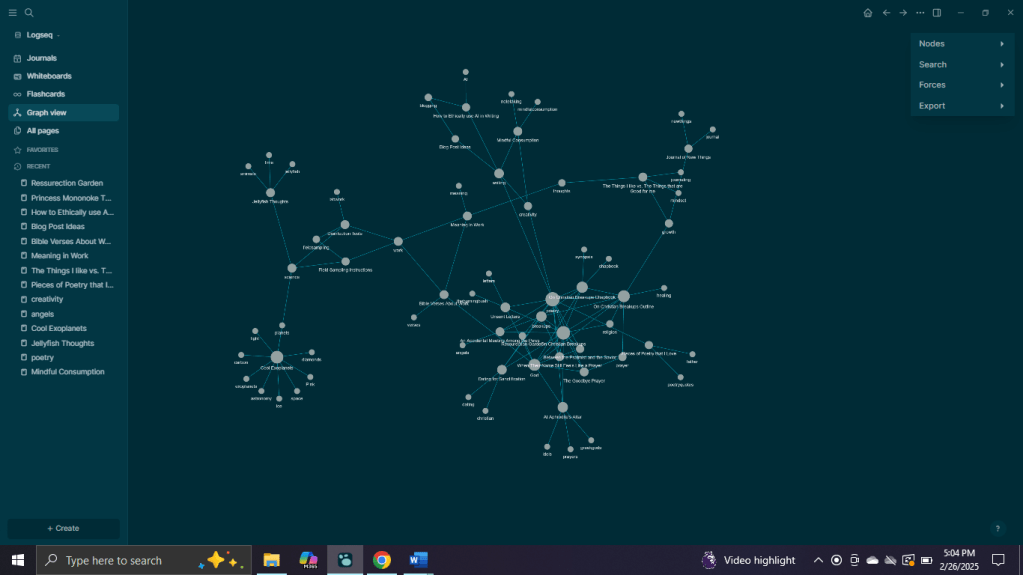
First off, Log Seq is phenomenal. Like, truly fascinating. The ability to link thoughts, ideas, and random musings into this complex web of information is seriously cool. I started from scratch, and by the end of the week, I had an impressive digital mind-map that was organized based off of tags. My main tags were #poetry, #science, #writing, #religion.

The Not-So-Good Stuff

There is only one thing that I really think hurts the log seq experience. Log Seq has no app. And while typing on my laptop is fine when I’m already sitting at it, capturing thoughts throughout the day? Not so much. I don’t know about you, but I have a knack for coming up with my best ideas at the most inconvenient times. Like, standing in line for coffee or pretending to listen during a meeting. Without an app to sync my thoughts, I was left trying to remember everything until I got back to my laptop… which is like trying to carry water in a colander. To well that’s reaaaally far away. An unneccessary metaphor I know. It’s just a funny mental image.

The Verdict

So, would I recommend Log Seq? Definitely. Especially if you’ve got the discipline to sit down and dump your brain at the end of the day. If not, you might be out of luck until they roll out an app. But overall, it’s an incredible tool with a ton of potential. I might just keep using it (at least until my wallet decides Obsidian is worth it).

Oh, and as promised, here’s my brain-web after a week of using Log Seq.

So, what do you think? Have you tried Log Seq or Obsidian? Do you have any other alternatives I should check out? Drop a comment below!

okay byeeee

Why You Need a “Second Brain” (And the Best Apps to Build One)

Look, my brain is a chaotic place. If I had to describe it, I’d say it’s like an overstuffed filing cabinet, but maybe one that got shook up in a move? Thoughts, ideas, grocery lists, and random existential crises. It’s all jumbled together, friends. I tried keeping track of everything in a planner, in my Notes app, and sometimes in an actual, physical notebook. Unsurprisingly, is still felt as if I was forgetting too much. Mostly writing ideas, maybe a grocery list item here and an appointment there.

That’s when I started doing some digging into the concept of a “second brain.” It’s basically a note-taking system where you offload all your thoughts, ideas, tasks (basically everything) into one organized digital space. The idea is to free up your actual brain for, you know, thinking, rather than frantically trying to remember where you wrote down that brilliant idea at 3 a.m.

I’ve only been looking into this for about a week and a half but here’s what I’ve found as far as notetaking/second brain apps go. I’ll give you a quick summary of each based off of my research and some quick clicking around and experimentation plus my personal opinion of each. Though, I WILL mention that I think each has it’s own strengths and may tailor itself to a different type of brain than mine. So, as cliche as it is, I’ll say to each their own.

Logseq: The Powerhouse for Outliners

If you’re a fan of bullet points, outlines, and linking your thoughts like a digital spider web, Logseq is your new best friend. It’s a free (this is the word that convinced me), open-source app that lets you create daily notes, build outlines, and interlink ideas like crazy. I love it because it’s local-first (meaning my notes are stored on my device, not in the cloud), and it uses plain text files, so I never have to worry about losing my data. Plus, the bi-directional linking lets me see how my thoughts connect over time—perfect for writing projects and organizing ideas. It is a little bare bones I will say and in using it, I definitely wish they had an app so I could sync all my ideas that I take on my phone to my software on my computer. Oh well, can’t have everything.

Why I Love It:

  • Local storage and privacy.
  • Bi-directional linking (think digital mind maps).
  • Outlining is its superpower.
  • It’s free!

Who It’s For:
People who love structure, outlines, and organizing their thoughts in a non-linear way. Writers, researchers, and obsessive list-makers. And for those of us who don’t want to spend money but want something like Obsidian minus the subscription. Which, speaking of which…

Obsidian: The Mind Mapper

Obsidian is the cool kid on the block that everyone’s talking about. It’s all about connecting your ideas with backlinks and visualizing them as a network of thoughts. If you’ve ever wanted to see how your ideas relate to each other like a digital conspiracy board (red strings and all), this is your app (MUCH like Log Seq, like I said).

Why It’s Popular:

  • Graph view to visualize your notes and their connections.
  • Customizable with a ton of community-made plugins.
  • Markdown-based (plain text files for the win).
  • Has an app with across device syncing.

Who It’s For:
Visual thinkers who like seeing the bigger picture. Great for creative projects, research, and anyone who likes to link ideas together. But, as mentioned before, you have to subscribe for this service. If you’re okay with dropping some cash, this one definitely looks the cleanest of all the network based notetaking apps.

Evernote: The Veteran with All the Bells and Whistles

Ah, Evernote. It’s been around forever, and for good reason. It’s toolbox is incredibly diverse. You can save text notes, voice memos, images, web clippings, and even PDFs. It syncs across all devices, so you can access your notes anywhere. But there’s a catch: the free version is pretty limited, and the premium version isn’t cheap (sorry to keep mentioning money but if you’re something like me, you might not have money to burn).

What It’s Good At:

  • Capturing everything—text, voice, images, web clippings.
  • Powerful search features, including text within images.
  • Easy syncing across multiple devices.

Who It’s For:
People who need an all-in-one digital filing cabinet. If you’re constantly gathering information from different sources and want it all in one place, Evernote is your go-to. Just be okay with spending money.

Notion: The All-in-One Workspace

With Notion you can take notes, manage tasks, build databases, and even design a personal wiki. It’s visually appealing and highly customizable, but it can be overwhelming at first because of how much it can do. I tried it for a while, but it felt like using a sledgehammer to crack a nut (just a bit overkill). That said, some people absolutely swear by it for its flexibility and diversity.

What Makes It Stand Out:

  • Highly customizable pages and templates.
  • Collaborative features for team projects.
  • Can be used as a note-taking app, project manager, and even a personal wiki.

Who It’s For:
Power users who want everything in one place. Probably really awesome for someone who does a lot of computer work for their job. If you like customizing workflows and want your notes, tasks, and databases all in one app, Notion is your playground.


Which One’s Right for You?

Choosing a second brain is, as most things are, up to your own personal taste and what type of record keeping jives with your brain. If you love outlining and linking ideas, give Logseq or Obsidian a try. Want a digital Swiss Army knife? Notion’s your best bet. Need a reliable all-in-one solution with easy syncing? Go for Evernote. And if you want something simple, there is definitely no shame in using your phone notes.

Personally, Logseq has caught my eye and I will probably make a whole other post based off of my experience with it. But, if any of the other apps or programs have caught your fancy, why not give ’em a go?

Maybe it’s time to give your brain a break and get yourself a second one. Just a thought. Or maybe mine’s the only one that needs a breather. Either way, thanks for reading!

Choosing the Right Web Builder for Your Blog

Choosing the Right Web Builder for Your Blog: My Honest Thoughts on WIX, WordPress, Blogspot, and Tumblr

When it comes to starting a blog, one of the first and most important decisions you’ll make is choosing the right platform to build it on. As a writer who’s tinkered with several web builders, I’ve learned that not all platforms are created equal. Each one comes with its own quirks, benefits, and, of course, irritations. Here’s my take on four popular web builders: WIX, WordPress, Blogspot, and Tumblr. Below you will find my opinions of each web builder and what it’s rightful ranking is (by means of a 5 star-system).

Alright, I believe this should be fairly straight forward, so let’s get on with it, shall we?

1. WIX – 3 Stars

WIX is often marketed as a “drag-and-drop” dream. And I’ll admit, the platform is visually appealing with its sleek templates and easy customization options. If you want your blog to look like an art gallery, WIX might seem like the perfect choice.

But here’s the catch: unless you’re willing to pay for their premium plan, good luck showing up on any search engines. SEO (search engine optimization) isn’t exactly WIX’s strong suit without opening your wallet. Plus, while the interface is simple, it feels almost too simple, like it’s holding back features you might need for a more robust blog.

For casual bloggers who aren’t worried about visibility, WIX could work. But if you’re looking to grow an audience organically, I’d suggest looking elsewhere. You may have a lovely site but one that no one sees (unless you want to pay a fair bit of moolah).

2. WordPress – 4 Stars

WordPress is the overachiever of web builders, and honestly, I’m impressed. With its detailed customization options and extensive plugin library, WordPress has everything you need to make a blog that feels truly your own.

What really makes WordPress shine is that it (mostly) doesn’t penalize you for staying on the free plan. You can still drive traffic to your site and enjoy a surprising amount of creative freedom without feeling like you’re missing out. Personally, I’m not a premium user, and I’ve been more than happy with what the platform offers.

However, the learning curve can be a little steep for beginners. WordPress has so many options that it can feel overwhelming at first. But once you get the hang of it, the possibilities are endless. Unless you want to add plugins. In which case, you’re out of luck on that free plan. It loses at least a half of a star from this alone. But, overall, I really can’t complain too much. I mean, here I am!

3. Blogspot – 2.5 Stars

Blogspot, also known as Blogger, is like the plain vanilla of web builders. It’s fine. It’s functional. It does the job. But does it spark joy? Not really.

The platform is overly simple, which isn’t necessarily a bad thing if you’re looking for a no-frills blogging experience. However, it can feel limiting compared to other platforms. Also, unless you’re willing to pay for a custom domain, you’re stuck with a URL that looks like it was generated by a cat walking across a keyboard.

If you’re just dipping your toes into blogging and don’t want to overthink it, Blogspot might be worth a try. Just don’t expect it to wow you. It’s basic. It’s fine.

4. Tumblr – 3.5 Stars

Ah, Tumblr. The home of fandoms, memes, and chaotic energy. If you’re planning to use Tumblr as a blog builder, it’s important to understand the platform’s culture. Unlike other web builders, Tumblr relies heavily on its algorithm and community engagement to drive traffic.

This means you can’t just sit back and hope people will find your blog—you’ve got to get involved. Reblog posts, follow similar accounts, and interact with your followers. It’s a bit of a commitment, but it can be fun if you’re already familiar with Tumblr’s vibe.

The downside? Tumblr isn’t exactly a professional blogging platform. It’s more suited for casual, niche interests than for polished, professional blogs. That said, if you’re blogging for fun and want to connect with a specific community, Tumblr might surprise you.

Final Thoughts

Every platform has its pros and cons, and the right one for you depends on your goals. If you’re serious about growing your blog and don’t mind a bit of a learning curve, WordPress is the way to go. For those who value aesthetics and simplicity, WIX might be worth a shot (just keep SEO in mind). Blogspot is fine for beginners, and Tumblr is a unique option for those who want to blog within an existing community (works great if you have a very specific niche or media-based lean).

At the end of the day, blogging is about sharing your voice and connecting with readers. Choose the platform that feels right for you and start creating. After all, the best blog is the one you actually create.

New Year’s Mantras for a New Season

Every year, I’ve set goals, made resolutions, and tried to will myself into change. I will add that sometimes it works! (And sometimes it doesn’t.) But this year I wanna do something a tad bit different. Instead of adding more to-do lists and lofty goals, I am instead going to (attempt to) ground myself with a few simple mantras: words I can carry with me into this next chapter of my life.

1. Learn, Learn, Learn

I started my career as an environmental scientist this year, and let me tell you, it’s a humbling experience to realize how much I don’t know. There’s training to complete, processes to understand, and a whole world of knowledge to absorb. But instead of letting the learning curve overwhelm me, I’m going to try and embrace it.

“Learn, learn, learn” isn’t just about my job too. It’s also about staying curious in everything. It’s about asking questions, making mistakes, and knowing that growth doesn’t happen overnight. Additionally, I want it to serve as a gentle reminder that I don’t have to be perfect. The learning process involves failure and it is impossible to skate around. While this concept hurts my perfectionistic, failure-fearing soul, it is something I simply need to continue to work towards getting past.

2. Do the Thing

This one’s for my poetry and my perfectionism. For too long, I’ve held back. (Camera cut to me editing endlessly, second-guessing myself, and letting fear keep me from sharing my writing). But this year, I’m done waiting for the perfect moment or the perfect version of anything.

“Do the thing” is about action. It’s hitting “publish” on that blog post. It’s sharing a poem without worrying how it will be received. It’s letting creativity flow without overthinking it. Fear might still be there, but this year, it doesn’t get to win.

3. Enjoy the Life Phase

If there’s one habit I know I have, it’s looking forward into the future. I do this in every possible way. I look to the next step, the next milestone, and the next season of life. I’ve always been someone with one eye on the future, dreaming of what’s to come. But in doing so, I often miss what’s right in front of me.

“Enjoy the life phase” is my reminder to slow down. To appreciate the small joys of where I am: my new job, my cozy home, my two cats (who are as chaotic as ever). I don’t want to rush this time just because it feels like a stepping stone to something bigger. I want to look back and remember how full and good this season was—even with its growing pains.

4. Show Up for Yourself

This is a mantra I’m adding to the list because I think we all need it. “Show up for yourself” means being your own cheerleader when things get hard. It’s about taking care of your mind, your body, and your heart. Showing up looks different every day. Some days it might mean eating a real lunch instead of chips from the pantry, going for a walk, or saying no to something you don’t have energy for. Whatever it is, it’s a promise to treat yourself like someone worth showing up for.

5. Let Life Be Messy

I’m someone who loves a plan. I like knowing what comes next, how it’ll happen, and where it’s all leading. But if there’s one thing I’ve learned, it’s that life rarely fits neatly into plans.

“Let life be messy” is permission to let things unfold as they will. It’s accepting that some days will be chaotic, some dreams will take longer, and some journeys will twist and turn in unexpected ways (and, again, that’s okay!). The messy parts are often where the magic happens, right?

These mantras are my anchors for the year ahead. They’re reminders to take things one step at a time, to be brave, to be present, and to let life happen as it comes.

If you’re feeling inspired, I’d love to hear what mantras you’re carrying into the new year. What words or phrases will guide you through this next season? Share them in the comments!

xoxo,

Brooke F.

Would You Join a Cozy Writing Forum?

Hello, lovely readers!

I’ve been thinking a lot about how writers connect with each other online. Over the years, platforms like WordPress have been an amazing way to share thoughts, stories, and tips. Most of you drop by to read, and every now and then, someone leaves a comment that warms my heart. Honestly, I love this dynamic, and it’s perfectly fine if reading and moving on is your vibe.

But lately, I’ve been wondering: is there interest in something more community-oriented?

I’ve scrolled through countless writing forums, and while some are thriving, they tend to have huge memberships. That’s awesome for activity, but for me (and maybe for you?), it’s easy to feel lost in the crowd. I started thinking about what it would be like to build a smaller, more personal writing space—something cozy where everyone has a seat at the table.

Since I’m not ready to spend $300 a year upgrading my WordPress just to test this idea, I did a little digging and found freeforums.net, a platform that lets you create forums for free. It was so easy to set up (seriously, 10/10 recommend if you’ve ever thought about this yourself), and now… I have a forum ready to go! Here’s a quick preview:

I’ll introduce you to the spaces I’ve set up so far:

🪑 The Coffee Shop
This is the general hangout spot. Think casual chats, checking in on how everyone’s doing, and sipping virtual lattes while talking about anything and everything.

✍️ The Writing Lab
For technical discussions about writing. Need feedback on sentence structure? Want to debate the merits of first vs. third person? This is the place.

📚 The Library
Here, we’ll share what we’re reading or watching—whether it’s the latest bestseller, a nostalgic TV show, or an indie book you can’t stop thinking about.

🛍️ The Bookstore
A space to celebrate writing achievements, share self-published works, and recommend tools, resources, or books you love.

🏛️ The Town Hall
Where announcements, updates, and fun events (think writing challenges or contests) will live.

📌 The Bulletin Board
Looking for beta readers? Want to collaborate on a project? This is where networking happens.

🌳 The Park
A lighthearted zone for creative writing games, prompts, or exercises to spark inspiration. Also For those tough days when writer’s block hits or imposter syndrome creeps in. A safe place to vent, seek support, and remind yourself you’re not alone.

I’m genuinely curious—does this sound like a space you’d want to join? Or do you prefer to keep your writing life separate from structured communities? Either way, there’s no pressure!

I’ll include a poll below to get a feel for interest, but feel free to drop a comment, too. I’d love to hear your thoughts.

Poll: Would you join a cozy writing forum?

Whether the forum takes off or not, I’m just happy to keep connecting with you all here. Thank you for always making this space feel so welcoming.

Cheers!


The Art of Letting Go: When It’s Time to Move On from a Story Idea

As writers, we probably like to think of our ideas as precious gems, sparkling with potential and promise. But what happens when those gems start to feel like rocks weighing us down? Moving on from a story idea can feel like a betrayal. It can feel like we’re giving up on something that might have been great if only we’d tried harder. But, sadly, sometimes, letting go is the most freeing, productive decision we can make.

Recognizing When a Story Isn’t Serving You

Every writer knows the thrill of starting something new. It’s like falling in love—the endless possibilities, the bursts of creativity, the “this is going to be amazing” energy. But over time, that spark can dim.

Here are a few signs your story idea might not be serving you anymore:

  1. You’re Avoiding It: If you constantly find excuses to work on anything but your story, it’s worth asking why. Is it fear of failure, or are you genuinely uninterested? I will say the difficulty of this step comes from knowing the difference between writer’s block, intense procrastination, or a sign to actually quit.
  2. It Feels Like a Chore: Writing isn’t always fun, but it should bring some sense of purpose or joy. If working on your story feels like dragging yourself through quicksand, it may no longer align with your creative goals. Unfortunately, I reached this point editing down my second draft of my YA novel that was once so dear to me in high school. It no longer felt inspired and became just another task to chug through.
  3. The Idea No Longer Resonates: Maybe it felt groundbreaking when you first thought of it, but now you find yourself bored or disconnected from the concept. That’s okay—people grow, and so do creative tastes. Maybe you’re no longer writing the type of book you would read? Maybe it’s time to expand to something different (maybe even a different genre??).
  4. You’re Forcing It to Fit: If you’ve twisted your story idea so many times it feels unrecognizable, it might not be the right project for you at this moment. This also might be a sign that you’ve lost focus and you don’t know what you’re going for with this idea.

The Emotional Weight of Letting Go

For years, I told myself I’d go back to that first draft of a novel I finished in high school. It sat on my computer like a ghost of a dream—haunting me with the promise of what could have been. But every time I opened the document, I felt dread, not inspiration. The characters no longer felt like mine. The plot felt shallow. Worst of all, working on it felt like an obligation, not a passion.

I clung to it for far too long because I thought letting go meant failure. It took me years to realize that setting it aside wasn’t a sign of giving up—it was a step toward making space for stories I actually wanted to tell.

Gracefully Setting a Project Aside

Letting go doesn’t have to be dramatic or final. You don’t need to delete files or burn notebooks (unless you want to; dramatic gestures are valid). Here’s how to set a project aside with intention:

  1. Acknowledge Its Place in Your Journey: Every story idea, no matter how unfinished, has taught you something. Reflect on what this project gave you—new skills, insight, or even just a fun creative spark when you needed it.
  2. Give Yourself Permission: It’s okay to say, “This isn’t for me right now.” Writing is a personal journey, and it’s better to move on than to force yourself into creative misery.
  3. File It Away: You don’t have to toss the idea forever. Save your notes, drafts, and outlines. You might come back to it someday with fresh eyes—or never at all, and that’s fine too. Again, speaking from experience, I deleted way too many old drafts out of shame and now wish I had them on hand. I’d love to see how far I’ve come.
  4. Celebrate the Space You’ve Made: By letting go, you’re freeing yourself for new, exciting projects that align with who you are now, not who you were when the idea first came to you. The possibilities are endless!

Moving Forward

Writing is an ever-evolving process. Just because an idea didn’t work out doesn’t mean you’re a bad writer or that you wasted time. It means you’re growing.

So if you’ve been holding onto a story that feels more like a burden than a joy, ask yourself: Is this serving me? If the answer is no, it might be time to let go. And when you do, know that you’re not giving up—you’re moving forward.

What about you? Have you ever had to let go of a story idea? What did that process look like for you? Let’s chat in the comments—I’d love to hear your thoughts!

Take care friends & Happy Thanksgiving!

The Over-acceptance of Introversion: When to Know When You’re Just Being a Bad Friend

This post is a little different from my usual topics. It’s not some big epiphany, just a thought that’s been bouncing around in my head for a while. As someone who enjoys overthinking (a core introvert trait, we all know it), I couldn’t shake this idea. So, here we are. Let’s talk about introversion, friendships, and whether some behaviors we attribute to being “introverted” are actually… kind of selfish.

This train of thought started when I stumbled across one of those relatable memes. Yaknow the type. Something that went along the lines of : “I don’t want to go, but I do want to be invited. Lol, introverts, am I right?” At first, I chuckled, because I could relate. But then I started reflecting on what it’s really saying. Is this just a funny nod to introverted tendencies, or does it normalize putting minimal effort into our friendships? Cue the over thinking due to a relatively harmless online post.

The more I thought about it, the more it reminded me of a situation from my late high school and early college years. Back then, my close friend and I loved organizing activities for our friend group. Bowling nights, game days, holiday parties—you name it, we planned it. We weren’t just trying to have fun; we genuinely enjoyed bringing everyone together.

But more often than not, it ended up being just the two of us. Our friends, though kind and fun in their own right, rarely showed up. The reasons varied. Some excuses were totally valid—homework, work shifts, family obligations. But over time, it became clear that many simply didn’t prioritize showing up. A few even admitted they “liked being invited” but never had any intention of coming.

At the time, it was frustrating. We’d put in all this effort, only to feel like the rest of the group didn’t care enough to reciprocate. It stung, but life moved on, and so did we. Now, years removed from those memories, I look back without resentment. Those friends weren’t bad people—they were just young, busy, and maybe a little unaware of how their actions came across.

Still, that experience planted a seed in my mind only to be watered by a random Instagram post on a random Tuesday. The memes and “relatable” posts about introverts avoiding plans or ghosting their friends in the name of self-care make me pause. Are we glorifying a healthy need for recharge time, or are we excusing bad friendship behaviors?

Here’s the thing: self-care is important. Recharge time is vital. Life gets busy and overwhelming, and sometimes, skipping plans is the right choice for your mental health. But if every plan becomes your recharge time, you’re not just protecting your peace—you’re neglecting your friendships.

Good friendships require effort. Showing up matters. And showing up only when the whim strikes you? That doesn’t make you a good friend. Sure, you have the right to set boundaries. But if you consistently flake, cancel, or avoid participating, maybe it’s time to reassess what you can realistically give to your friendships. I maybe it’s significantly less than it once was?

If that’s the case, the kinder thing to do is to be honest with yourself—and with your friends. Let them know if your capacity to maintain the friendship has changed. It’s far better than leading someone on to believe you want to stay close, only to repeatedly let them down when it comes time to show up.

Here’s the plot twist (that almost everyone knows): I am an introvert. A big one. I thrive on alone time, I love my cozy evenings at home, and I sometimes dread leaving my bubble. I’ve canceled more plans than I care to admit. But I’ve also been on the other side of this equation—the one doing the planning, hoping people will show up. And that’s given me a deep appreciation for the balance between respecting my own needs and respecting my relationships.

It’s not about guilt-tripping yourself into saying yes to every invite or sacrificing your mental health for others. It’s about being intentional. Being an introvert doesn’t give us a free pass to neglect the people who care about us. If anything, it challenges us to communicate better, show up when it counts, and be honest about what we can give.

So, the next time you’re tempted to laugh off a missed gathering with, “Lol, introverts, am I right?” take a moment to think about what that really means. Are you protecting your peace, or are you unintentionally letting your friends down? Because the truth is, being an introvert doesn’t mean we don’t care about our friendships. It just means we have to work a little harder to show it.

Hopefully you found this post useful in some way. I suppose in some ways, it could be considered a little mini-rant. More than anything, I think it’s a reflection and I hope it makes you reflect too, whether you’re an introvert like me or a big planner who relates to the feelings of disappointment when no one shows. Just know you’re not alone!

Take care, friends, and thanks for reading!

The Great Writing Recalibration: Navigating the Role of Writing in Adulthood

For many young writers, the identity of “writer” takes root early. In grade school or high school, it’s easy to dream big and write even bigger. Stories pour out effortlessly between homework assignments, and the dream of publishing a novel or becoming the next great poet feels within reach. Writing becomes a cornerstone of self-expression, a part of who you are. Then, adulthood arrives like an unexpected plot twist, and suddenly, the words stop flowing.

I like to call this phenomenon The Great Writing Recalibration. It’s not just writer’s block in the traditional sense—the frustration of not finding the right words or ideas. It’s the struggle of figuring out where writing fits into the bigger picture of your life. Is it a fleeting phase? An on-and-off-again hobby? A consistent passion? A side hustle? Or is it the full-time job you’ve always dreamed of?

You’re not a failure, okay? We’re all having a hard time here….

The Great Writing Recalibration often begins when you hit the gauntlet of adulthood—new responsibilities, time constraints, and a world that demands practicality. Suddenly, writing no longer feels effortless or essential. The hours you once spent dreaming up stories might now go to a 9-to-5 job, errands, or simply catching your breath. Writing gets pushed to the back burner, and for some, it’s a bitter pill to swallow.

I know, because I’ve been there. For years, I felt like a writing failure. I had proudly finished the first draft of my novel, only to let it sit and collect dust for three years. I’d talk about how I was “working on it” or how I was “so close to finishing,” but deep down, I didn’t want to work on it. It felt like a chore. Each time I sat down to write, it was as though I was forcing myself to relive a version of me that no longer existed—the high school writer who poured her heart into this draft.

Looking back, I realize part of the problem was that I hadn’t considered the possibility that I simply needed a break from writing or that my old stories didn’t speak to me anymore. I didn’t give myself permission to grow beyond them. I was holding onto an idea of what writing “should” be in my life, instead of asking myself what I actually wanted it to be.

The key realization here is that a lack of time reveals priorities. This is not a bad thing—it’s simply life asking you to reassess what matters most. If you’ve always defined yourself as a “writer” but now find that writing has slipped down your list of priorities, that’s okay. It doesn’t mean you’re less creative or that you’ve “lost” something. It means you’re growing up, figuring out who you are, and redefining what you want.

The tricky part is coming to peace with this recalibration. For many, it feels easier to cling to the idea of being a writer and blame an ongoing “writer’s block” for not producing anything. But if months—or even years—pass without the drive to write, it’s worth asking yourself: What role does writing truly play in my life?

If it’s a hobby you love but don’t feel the need to commit to, that’s perfectly valid. If you still dream of making writing a central part of your career, then finding time to nurture it—even in small ways—is essential. And if it’s something that fades from your life entirely, only to resurface years later, that’s okay too. Writing doesn’t demand permanence; it only asks for honesty.

The truth is, adulthood is full of recalibrations. We struggle to define not only writing’s place in our lives but also our very sense of self. And in that process, the role of writing might shift, expand, or contract. Embracing that change—rather than resisting it—can help you move forward without guilt or regret.

The Great Writing Recalibration isn’t a sign of failure. It’s a chance to reflect on your passions, priorities, and evolving identity. Writing will always be there, waiting for you, in whatever role you choose for it. So take the time to decide, and remember: it’s okay if the words come and go, as long as you’re at peace with what you’ve written into the story of your life.

Keep writing, friends! Or don’t! It’s all okay!