Goblin Girl

It’s been a minute since I’ve published Poetry on this blog so perhaps it’s time. In fact, maybe even overdue! So here’s a quick poem I wrote called Goblin Girl.

I think I have always been a goblin.

Not the sort that lives beneath bridges,
though I suppose I have collected enough strange little things
to qualify.

I mean the kind with bright eyes
and a sack over her shoulder,
always looking down the road
for the next glint.

A house, perhaps.

A good one.
With a little room for books
and a kitchen where I can make pasta
so much pasta

As a kid, I thought how nice it must be as an adult

to have as much pasta as you wanted, with noodles as LONG as you wanted

and your mother would no longer cut them up

A kitchen big enough to hold a husband in

A job where someone pays me
to put words in a particular order,
which is a thing I once wanted so badly
I thought wanting it might break me.

And look

there it is.
The house.
The husband.
The job.
The pasta.

Little treasures,
all of them.

I put them carefully into my bag
and kept walking.

Because there is always something else
Sparkling.

Another place to see.
Another book to read.
Another version of myself
I might become.
Another little life
I might be able to carry home.

I did not hear the first thing fall.

It was that friendship

That frayed as we began to no longer dance in time

Something dear enough
that I had once assumed
dear things simply stayed.

It was the sound
of my sisters laughing
in the next room.

It was the nearness
of my friends
the easy certainty
that someone could be across town
and somehow still feel close.

They’re only a phonecall away but

never a street, neighborhood, or room

Perhaps it was my mother and father,
young enough that I did not understand
I was looking at a version of them
I would never see again.

Perhaps it was the world itself.

How big it used to be.

How every road seemed to lead
somewhere I had not yet been.

I kept walking.

I kept collecting.

And then I turned around
to admire what I have gathered
and realized there is a hole in my bag.

I cannot put my hand through it
and retrieve everything.

I cannot walk backwards
and gather the pieces from the road.

And I do not want to.

That is the strangest part.

I love the house.

I love my husband.

I love my little job
and the pasta
and the books
and the coffee
and all these ridiculous, beautiful things
I propelled myself towards via wishes and work

I am happy.

But I did not know
this Goblin Girl met life with a limited inventory.

I did not know
that while I was busy asking,
what can I have next?

the world was whispering,

do you know what you will lose?

So I suppose I am still a goblin.

Still peering toward tomorrow
for the next glimmer.
Still tempted by every little treasure
the future holds out its hand to offer.

Still carrying my bag.

Only now,
sometimes,

I stop.

I turn around.

I check the bottom.

And there is the hole.

And there are the empty spaces
where things used to be.

And I stand there
with my hands full of everything
I ever asked for,

atop a pile of treasures

glinting in the morning sun

grieving
what I never knew
I would leave behind.

Creative Writing Prompts for Beginners

Happy November, dear readers!

Have you ever wanted to get into creative writing but had absolutely no idea where to start? Maybe you haven’t written a story since your middle school English class. Or, I’m sure there’s plenty of people in the world who have always wanted to write but never quite knew what to put on the page. Either way, getting started can be the hardest part!

Sometimes we get so caught up in everyday life that we forget to exercise our imagination. We spend our days thinking practically, answering emails, checking off to do lists, and generally being responsible adults (how unfortunate). But creativity is something you can practice, and you don’t need to be an experienced writer to start.

So I’ve put together a collection of beginner friendly creative writing prompts designed to get you thinking, imagining, and playing around with ideas again. No experience necessary and definitely no expectations. There is absolutely no pressure to write the next great American novel here. Just pick a prompt and see where your imagination takes you! And remember to remind yourself that it’s ok if you don’t feel like you wrote something very “good”. It doesn’t have to be perfect, it should just exist. The fast pace of our modern world has made it seem that the results are all we should aim for and those results should be immaculate. But in writing, creating is the joy. The work itself is the fun. Embrace sucking and being a beginner and this can apply to more than just writing.

Alright, I’ll get off my little soap box now. Onto the prompts!

1. Everyday imagination

These are especially good for people who haven’t exercised their creative muscles in a while.

  1. Describe your perfect day if you had absolutely no responsibilities.
  2. Imagine you find a mysterious envelope in your mailbox. What does it say?
  3. Write about a place you’ve never visited but have always wanted to see.
  4. Describe your childhood bedroom as though you’re introducing it in a novel.
  5. Invent a small shop you’d love to visit. What does it sell? Who owns it?
  6. If your pet could talk for one day, what would they tell you?
  7. Write about an ordinary object on your desk as though it has a fascinating history.
  8. Imagine you wake up tomorrow with a completely different daily routine or job as a different person. What does your life look like?

2. Let your imagination run wild

  1. What if you discovered a tiny door in the wall of your house?
  2. Imagine that every person receives a letter on their 25th birthday predicting one event in their future.
  3. You discover that your hometown has a secret that everyone knows about except you.
  4. What if you could visit one fictional world for an afternoon?
  5. Imagine a world where people can bottle and sell their dreams.
  6. You find a map tucked inside an old library book. Where does it lead?
  7. What if the moon disappeared for one night?
  8. Imagine that mythical creatures are real but have learned to live among humans.

3. Create a character

  1. Invent a person who has a very unusual hobby. What is it, and how did they get started?
  2. Describe someone who always carries a mysterious object in their pocket.
  3. Create a character who is terrible at keeping secrets.
  4. Imagine someone who has lived in the same little town their entire life but has never left their house.
  5. Invent a character who receives an unexpected inheritance. What did they inherit?
  6. Describe a person based entirely on the contents of their bedroom.
  7. Create two characters who are complete opposites but become unlikely friends.

4. Practice storytelling

These give beginners a little more direction without requiring a complicated plot.

  1. Write a story that begins with: “I knew something was wrong when the birds stopped singing.”
  2. Someone accidentally sends a very personal letter to the wrong address. What happens next?
  3. Two strangers are stuck waiting together somewhere. What brings them there?
  4. A character returns to a place they haven’t visited in ten years. What has changed?
  5. Write about a person who makes a seemingly insignificant decision that changes their entire day.
  6. Someone knocks on your character’s door at midnight. They weren’t expecting company.
  7. Write a story in which the main character gets exactly what they wished for, but not in the way they expected.

5. Little creative writing exercises

These are less about writing a complete story and more about getting comfortable putting imaginative thoughts on paper.

  1. Describe a rainy afternoon without using the words rain, wet, or clouds.
  2. Write a conversation between two objects sitting on your kitchen counter.
  3. Describe a fictional place using all five senses.
  4. Write a short story in exactly 100 words.
  5. Invent a holiday that doesn’t exist. What do people celebrate?
  6. Describe a memory. Any memory. Now alter it ever so slightly.
  7. Write a paragraph about a color as though it were a person.
  8. Make up the first and last sentence of a story. You can figure out what happens in between later!

I’m sure you’ve done wonderful work! And wonderful doesn’t mean perfect and that’s alright, friends! Keep writing and see where it takes you! Take comfort in knowing you’ve made yourself just a little more imaginative today. 🙂

See ya in the next post!

Whimsical Brainstacking: How to Make Keeping Your Mind Sharp a Little More Magical

Our brains can turn into mashed potatoes as time gets away from us and if we don’t keep it active.

You might have seen the recent trend of brainstacking or habit stacking, where people combine a handful of little habits into one dedicated sitting. Instead of trying to find separate pockets of time for journaling, reading, doing a crossword puzzle, writing, or practicing a skill, you stack them all together into one little routine. Maybe you spend five minutes journaling, ten minutes working on a Sudoku puzzle, and another five minutes reading or writing. Before you know it, you’ve spent half an hour doing things that keep your mind active without having to schedule half a dozen separate activities throughout your day.

I love this idea if I haven’t made it clear yet. I think it’s brilliant. But I also think there’s a way to make this practice even more fun.

Fantasy-Inspired Brainstacking

I like the idea of giving yur brainstack a theme depending on what you want to focus on. Then I started thikning about how to make a fantasy-inspired or whimsical brainstack of activities. Where you can spend twenty minutes a day becoming the sort of person who knows how to identify mushrooms, decipher riddles, analyze Renaissance paintings, and speak a little Latin.

You don’t necessarily need to become an expert in any of these things. The point is to learn something new, practice a skill, engage your imagination, or follow a thread of curiosity you might not otherwise have explored.

I think there’s something lovely about being a person who knows a little bit about a lot of things. You never know when a random fact, an old superstition, a line of poetry, or a strange little piece of history might come in handy. And even when it doesn’t, you’ve still made your world a little bigger and that’s definitely worth something!!

Here are some ideas to get you started!

Whimsical Brainstacking Activities

Become a Keeper of Knowledge

These activities are for collecting little pieces of knowledge about the world, especially the sorts of things that make you feel like you belong in a fantasy library.

  • Read a Fairytale: Read one short fairytale every day. Explore traditional folklore, lesser known fairy stories, or a collection of fairytales from around the world.
  • Solve a Riddle: Give your brain a little puzzle to untangle. Keep a book of riddles nearby or find a new one each day.
  • Learn a Latin Phrase: Learn a new Latin phrase, what it means, and how it was used. Bonus points if it sounds like something a wizard might mutter before casting a spell.
  • Discover a Fantasy Beast: Learn about a new mythical creature, monster, or fantastical beast. Where does it come from? What does it look like? What does the folklore say about it?
  • Study a Superstition: Pick an interesting superstition and learn where it originated. Why do people consider black cats unlucky in some traditions but lucky in others? Why do we knock on wood? There’s often a fascinating story behind these little beliefs.
  • Learn a Naturalist’s Skill: Learn to identify a new mushroom, plant, or tree. Start building your own little field guide of the natural world around you.
  • Explore a Constellation: Learn to recognize a new constellation and discover the mythology associated with it.
  • Learn One Tiny Historical Fact: Pick a historical figure, ancient civilization, strange medieval custom, or obscure historical event and learn one new thing about it.

Practice Your Wizardly Arts

Not every activity needs to involve memorizing facts. Some can be little practices that help you develop a skill over time.

  • Practice Calligraphy: Spend a few minutes practicing a letter, a word, or a beautiful phrase. Over time, you’ll build a collection of handwriting that looks fit for a royal decree.
  • Memorize a Line of Poetry: Choose a line from a poem and commit it to memory. Eventually, you might build a whole collection of verses you can recall without needing a book.
  • Learn Chess: Practice a new chess move, solve a chess puzzle, or learn one small strategy. You don’t need to become a grandmaster overnight.
  • Analyze a Painting: Choose a different painting each day. Who created it? What is happening in the scene? Where does your eye go first? What mood does it create? What details might you have missed at first glance?
  • Listen to a New Piece of Music: Find a new soundtrack piece, orchestral composition, or instrumental work. Listen closely and notice how the music creates a sense of place, emotion, or movement.
  • Learn a New Word: Collect an unusual word, learn its meaning, and practice using it in a sentence. Your vocabulary can become its own little treasure chest.
  • Practice a Drawing Skill: Spend five minutes learning to draw a leaf, a mushroom, a bird, a castle tower, or something else that catches your attention.

Follow the Rabbit

Sometimes the best kind of learning happens when you don’t know exactly where you’re going.

These activities are for the curious people who click one link, discover something interesting, and suddenly realize they’ve spent forty minutes learning about an obscure historical mystery.

  • Press Google’s “I’m Feeling Lucky” Button: Let the internet choose your next rabbit hole. Follow whatever comes up and spend a few minutes learning about something completely unexpected.
  • Research One Strange Question: Write down a question you’ve always wondered about and investigate it. Why do certain animals glow? How did people tell time before clocks? Who decided which mushrooms were edible?
  • Follow a Wikipedia Rabbit Hole: Start with a topic that interests you and follow the links wherever they lead. See how far you can travel from your original question.
  • Learn About an Unusual Tradition: Find a holiday, ceremony, or cultural tradition you’ve never heard of before and learn about its history and meaning.
  • Investigate an Old Mystery: Explore an unsolved historical question, a strange archaeological discovery, or a puzzling event from the past.
  • Study Something Beautiful: Pick a building, garden, piece of jewelry, antique object, or architectural detail and learn about its design and history.

The goal isn’t to spend hours scrolling through the internet. Set a little time limit if you need one, and write down the most interesting thing you learned before moving on.

Build a World of Your Own

This might be my favorite category because it involves not just learning about the world, but actively creating one.

Instead of consuming someone else’s fictional universe, you can build your own a little bit at a time.

  • Create a Fictional World: Invent a kingdom, magical forest, island, or entire fantasy world. Each day, add one new detail. It could be a custom, a creature, a landmark, a historical event, or a strange local superstition.
  • Design a Fantasy Creature: Invent a new beast and decide where it lives, what it eats, how it behaves, and what makes it magical.
  • Create a Kingdom’s History: Add one event to your fictional world’s history every day. Maybe a queen disappeared, a war changed the borders, or a mysterious plague caused an entire village to be abandoned.
  • Invent a Magical Plant: Decide what it looks like, where it grows, and whether it has any unusual properties. Is it used in medicine, potions, cooking, or something more sinister?
  • Develop a Fictional Culture: Create a tradition, holiday, greeting, superstition, or coming of age ceremony for the people in your imaginary world.
  • Write a Page From a Wizard’s Grimoire: Collect imaginary spells, potion recipes, magical observations, and notes about strange creatures. You can even make it look like an old field notebook.
  • Create a Map: Add a new location to your fictional world. Give it a name, a history, and a reason someone might want to visit it.

The beauty of this practice is that you don’t have to write a novel or finish a grand creative project. You’re simply adding a little something to your world every day. One day, you might look back and discover that you’ve built something surprisingly detailed.

How to Build Your Own Brainstack

You certainly don’t need to do every activity on this list. In fact, I think the best approach is to choose a few that appeal to you and build a routine around them.

For example, your daily brainstack might look something like this:

The Little Wizard’s Morning Routine

  • Five minutes of journaling
  • Five minutes practicing calligraphy
  • One riddle to solve
  • One line of poetry to memorize
  • Five minutes adding a detail to your fictional kingdom

Or perhaps you’re more of a wandering scholar.

The Curious Naturalist’s Brainstack

  • Read a short fairytale
  • Learn to identify a plant, mushroom, or tree
  • Study one constellation or mythical creature
  • Research one random question
  • Record your favorite discovery in a notebook

Or maybe you want something that feels like a cozy evening in a wizard’s tower.

The Wizard’s Evening Study

  • Listen to a new piece of orchestral music
  • Analyze a painting
  • Learn a Latin phrase
  • Solve a riddle or chess puzzle
  • Write down one interesting thing you learned that day

You can even keep a dedicated notebook for your brainstacking adventures. Make a list of the activities you want to try, record the things you learn, and track the little skills you’re developing.

And remember, the activities are meant to make your life more interesting, not turn your evenings into another productivity competition. If you only have ten minutes, that’s fine. If you skip a day, the wizard council is not going to revoke your license. Most likely anyways, don’t quote me on that.

Learning is Magic (as corny as that sounds)

I think one of the easiest things to lose in adulthood is the habit of learning things simply because they’re interesting.

When we’re children, we’re encouraged to explore. We collect facts about dinosaurs, invent imaginary friends, learn the names of flowers, and ask a truly unreasonable number of questions. As adults, learning can start to feel like something we only do for work, school, or some larger practical purpose (usually making money).

But we can learn things just because we want to.

So consider this your invitation to become a little more curious. Stack a few habits together, find a notebook you love, and spend a little time each day collecting knowledge like a magpie collecting shiny things. I mean, at the very least, you’ll have some excellent material for your next tavern conversation with your fellow adventurers. 🙂

Take care, everyone and keep learning!!

What Can I Write When I’m bored?

What should you write when you’re not sure what to do? You don’t want to work on any of your big projects but you don’t want to not write. So, where to start? You’re bored and want to hone your craft but the next step isn’t entirely clear and, maybe if you’re honest with yourself, you’re feeling a little creatively lazy. You don’t feel like writing a gazillion words tonight (yes, that is definitely a real number).

Well, I get it, dear writer! And, I promise, I’m not judging you. I have found myself in a similar position more often than I’d like to admit. So, I’ve collected a few tips and lists to get your creative juices flowing. I implore you, read on!

1. Little writing side quests

For when you want to write something just for the fun of it, without worrying about whether it’s good.

  • Write a letter to your future self about the very specific details of your current life.
  • Describe your ideal cottage, including what’s in the cupboards, what grows outside, and who visits.
  • Write a page from the journal of a village witch who has had a very inconvenient Tuesday.
  • Invent a holiday that your fictional kingdom celebrates. What are its traditions?
  • Write a list of things you would collect if you were a goblin.
  • Describe your dream life as though it were a location in a fantasy novel.
  • Write a dramatic review of the last ordinary thing that mildly inconvenienced you.
  • Invent a little shop that sells things nobody actually needs but everyone secretly wants.
  • Write a conversation between two people who have completely different ideas of what makes a good life.
  • Document an ordinary day as if you were the protagonist of a fantasy novel.

2. Short stories you can write in one sitting

You don’t need to start a novel. Give yourself a character, a problem, and a little room to play.

  • The Unclaimed Letter: A postal worker discovers a letter that has been arriving at the same abandoned house every year for fifty years.
  • The Witch’s Day Off: A village witch tries to spend one peaceful day doing absolutely no magic. Unfortunately, the village has other plans.
  • The Last Bookshop: A woman discovers that the bookshop she inherited only stocks books that its customers need, rather than books they want.
  • The Dragon’s Hoard: A dragon has collected thousands of objects, but its favorite treasure is a completely ordinary item that nobody else understands.
  • The Borrowed Memory: A young woman buys a beautiful old locket and begins remembering someone else’s happiest moments.
  • The Village Matchmaker: A matchmaker in a small fantasy village is excellent at finding everyone else’s soulmate and completely hopeless at recognizing her own feelings.
  • The Ghost’s Complaint: A ghost submits a formal complaint to the afterlife because the new owners of its house have renovated the kitchen.
  • The Girl Who Stayed: In a world where everyone receives a magical calling at eighteen, one girl receives nothing. Years later, she discovers why.

3. Poetry prompts for when you don’t feel like writing prose

Try writing just 8–16 lines. No need to produce a polished poem.

  • Write about repairing something that you thought was beyond saving.
  • Describe the feeling of autumn without mentioning a single color or weather condition.
  • Write a love poem about an ordinary task or item.
  • Write about a childhood memory as if it were a place you could physically revisit.
  • Describe faith as a tiny light that someone keeps tending.
  • Write an ode to something mundane: your favorite mug, a grocery store, a blanket, or the first sip of coffee.
  • Write about the strange grief of outgrowing a version of yourself that you once loved.
  • Write a poem in which each stanza begins with “I used to think…”
  • Write about a home you haven’t found yet.
  • Write a poem that reads like a prayer or song.

4. The 10-minute writing game

Just set a timer and go! Whatever comes to mind! Write it down. It could read like a story or a journal entry but don’t stop!

5. Get a Random Image or Song and Run with it!

Go to pinterest and the FIRST image you get that isn’t text based is what you need to write a story on! Alternatively, put your playlist on shuffle and write inspired by the first song that comes up!

Hopefully that’s all enough to get you started for now! Let me know what you make below in the comments or feel free to leave your tips for what you write when you’re bored if you’re willing to share! 😉

My Fantasy-Inspired Style Theory

Happy July afternoon, dear readers!

Lately, I have fallen down a very specific rabbit hole.

And by rabbit hole, I mean the kind where you open Pinterest to find outfit inspiration and suddenly you are three hours deep analyzing whether a dress belongs to your woodland fairy Pinterest board, an enchanted princess board, or a wizard board.

(As one does.)

I have always been fascinated by personal style. Not just trends or what is popular, but the deeper question behind style:

Why are we drawn to the things we are drawn to? Why do certain outfits, rooms, colors, and objects immediately feel like “us”? Why can two people wear the same trend but somehow look like they belong to completely different aesthetics or have totally different vibes?

Recently, I came across Ellie Jean’s Style Theory and I was immediately intrigued.

I really loved the idea behind it: that personal style is not just about finding clothes that look good, but about understanding the patterns behind what we naturally gravitate toward.

I like to think that style is storytelling. Our closets, homes, and Pinterest boards are often little collections of the worlds we wish we belonged to.

However, while I really appreciated Ellie Jean’s theory, I never fully found myself fitting into it. Not because I thought it was wrong or anything, just to be clear. Actually, I think it is a really creative and thoughtful way to approach style. But I realized that my brain approaches aesthetics a little differently and has a bit of a different lean. I don’t just look at an outfit and think, “I like that dress.”

My brain immediately goes:

“That looks like a fairy’s ball gown!”

“That looks like a Wizard’s casual fit.”

“If I were a knight, I would wear THAT.”

(Yes, this is how my brain works. No, I cannot turn it off.)

I realized that I didn’t just connect with style through categories. I connected with style through stories. Specifically, fantastical creatures and characters that are associated with these stories that we often see in popular media. And that is where my fantasy-inspired style theory came from.


The Fantasy Style Theory

The idea is simple:

Your personal style can be understood through seven fantasy archetypes.

These archetypes are not meant to tell you who you are as a person. They are not necessarily personality tests. Instead, they are a fun way to describe the themes, feelings, and imagery that you are naturally drawn toward.

The seven primary archetypes are:

👑 Princess — Beauty

The Princess is drawn to elegance, romance, softness, and things that feel special.

🌿 Goblin — Nature

The Goblin loves the organic, handmade, collected, and earthy.

🛡 Knight — Structure

The Knight values craftsmanship, practicality, order, and strength.

🔮 Wizard — Wonder

The Wizard is curious, imaginative, and drawn toward mystery, knowledge, and magic.

🐉 Dragon — Power

The Dragon embraces confidence, intensity, drama, and richness.

🧜 Mermaid — Flow

The Mermaid loves movement, elegance, emotion, and things connected to water.

😇 Angel — Peace

The Angel is drawn toward serenity, harmony, spirituality, and lightness.

Rule One: Primary Archetypes

Most people will not fit into only one archetype. Actually, I think the fun comes from mixing them together.

Maybe you are mostly Princess with a little Wizard. Maybe you are a Goblin who loves Knight structure. Maybe you are even a Dragon who secretly loves soft Angel details.

Your style is a recipe in a sense. And these seven main archetypes are the ingredients. Now, onto rule number TWO!

Rule Two: Child Archetypes

When two archetypes combine, they create a new expression.

Examples:

👑 Princess + 🌿 Goblin = Fairy

👑 Princess + 🔮 Wizard = Enchantress

🌿 Goblin + 🔮 Wizard = Druid

🛡 Knight + 😇 Angel = Paladin

🔮 Wizard + 🧜 Mermaid = Sea Witch

These combinations create smaller aesthetics that blend the qualities of both archetypes.

Rule Three: Major Aesthetics

When three archetypes combine, they create even more specific aesthetics.

Examples:

👑 Princess + 🧜 Mermaid + 😇 Angel = Venus

🌿 Goblin + 🔮 Wizard + 😇 Angel = Cottagecore

🛡 Knight + 🧜 Mermaid + 🐉 Dragon = Lighthouse Keeper

👑 Princess + 🔮 Wizard + 😇 Angel = The King’s Seer

These combinations are where the storytelling really starts to happen. You can also go HIGHLY specific from here.

Rule Four: Emphasis Matters

This is one of the most important rules. The recipe matters, but the proportions matter too (Just like with baking!).

Two people can have the same archetypes and create completely different aesthetics depending on what they emphasize.

For example:

🌿 Goblin + 🛡 Knight + 😇 Angel

With more Angel:
A peaceful pilgrim aesthetic. Soft, simple, spiritual, serene.

With more Knight:
A forest guardian aesthetic. Practical, protective, structured.

With more Goblin:
A woodland caretaker aesthetic. Earthy, handmade, collected.

Same ingredients, but you can end up with a totally different “flavor”.

Rule Five: Modifiers

Sometimes someone resonates with more than three archetypes.

Those extra archetypes become modifiers. It is important to note, however, that modifiers do not replace your main aesthetic. They add another fun little layer to the overall aesthetic.

For example:

A Princess + Wizard + Angel might be a King’s Seer.

Add a Dragon modifier, and suddenly the aesthetic becomes richer, darker, and more mysterious.

Add a Goblin modifier, and it becomes more nature-focused and earthy.

Think of modifiers like adding spices to a recipe. (Yes, I know I keep comparing style to cooking. I stand by it. Also, I’m not a great baker so let me have this.)

Rule Six: Distillations

Each archetype also has a pure expression. (Still workshopping these tbh)

👑 Princess → Muse

🌿 Goblin → Forager

🛡 Knight → Champion

🔮 Wizard → Alchemist

🐉 Dragon → Sovereign or Empress

🧜 Mermaid → Tidekeeper or Leviathan (Still thinking about this one)

😇 Angel → Saint

These are the strongest expressions of each individual archetype.

The Purpose of the Theory

At the end of the day, this is not about putting yourself into a box. I want it to be about giving yourself more language to understand what you already love. You can be a Princess who wears combat boots, A Knight who loves pink, A Dragon who collects flowers, and even a Wizard who lives in a cottage.

The point is not to follow the rules. Or box youself into a highly specific category. The point is to discover the story you are already telling.

Because, in this theory, personal style is not just about what we wear. Maybe it is about tapping into the little fantasy world we create around ourselves. Pretty cool, huh?

ANYWAYS, sorry for the info dump, and thank you for making it all the way through this post. Feel free to leave your thoughts below!

I Started a Writing Event! (and the importance of a Writing Community)

Happy, June! Just wanted to give everyone on here a fun little update on what’s going on in my creative life!

The answer, shockingly, is not writing. It’s ok to gasp. I know my posts paint the picture of someone who is soooooo consistent (insert eye roll here)

I’m actually NOT currently buried in a novel draft that has turned into a continuous hell to edit, nor am I working on a poetry collection (though I have a few half-finished ones in my drafts somewhere). I’ve been doing something actually quite different from my usual projects…

I started a writing event! I guess that isn’t a super big reveal since you read the title in big ‘ol letters. I think its pretty exciting though.

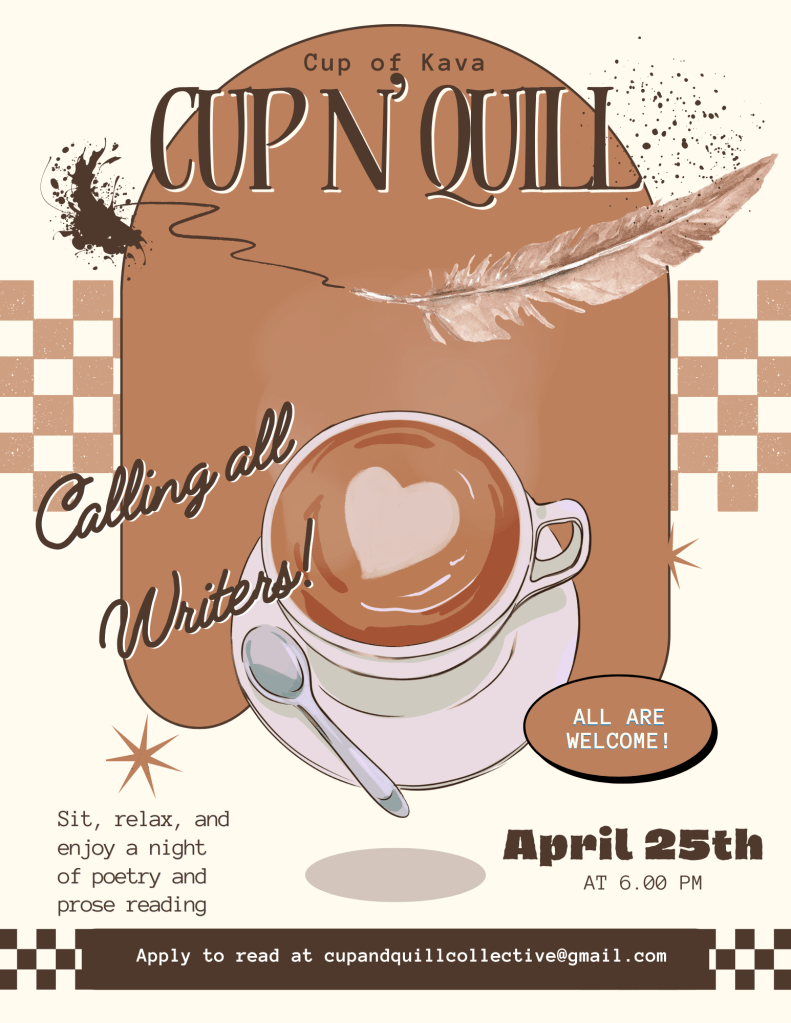
Instead, I’ve spent the last several months organizing a little community called Cup & Quill Collective.

It’s become one of the most rewarding creative things I’ve ever invested my energy into.

The idea started simple enough. I wanted a place where people could share their writing without the pressure of publication, social media algorithms, or trying to become the next literary sensation. I wanted a room where someone could read a poem they wrote last week, a chapter from a novel they’ve been working on for years, or even a resurrected long dead project that they just want to pay homage to before setting it aside.

I was also highly motivated by my own lack of creative community. After leaving college, that outlet was gone whereas before, I signed up for writing workshops and classes to fill that void. Even though they had NOTHING to do with my major (hello writing minor!)

Couple this with a SUPER supportive encouraging and amazing friend who also knew a person and the ball began rolling.

I reached out to a local coffee shop owner and their event manager and asked if they’d be interested in hosting a literature and poetry night.

To my surprise, they said yes.

So it began! I started creating sign-up forms, answering emails, making flyers, posting on social media, coordinating readers, arranging themes, introducing speakers, and occasionally wondering if anyone would show up at all.

Fortunately, people did.

One of the biggest things I’ve learned is that there are far more writers around us than we realize. They’re sitting in coffee shops, working office jobs, attending church, raising families, and carrying notebooks filled with stories nobody has heard yet.

Many of them aren’t looking for that big publishing deal though that would be fabulous, admittedly. But, like me, I think they’re just looking for a few ears to listen.

Cup & Quill has given me the chance to meet people from all kinds of backgrounds who share one thing in common: they love words. Some are seasoned writers. Some are reading their work aloud for the first time. Some come just to listen and enjoy a cup of coffee while hearing local creativity.

All of them make the room feel a little more alive.

Ironically, while I haven’t been producing as much new writing lately, I feel more connected to writing than ever. AND THE MOTIVATION.

Nothing is more motivating than knowing that you have an outlet to share your work with. You don’t have to “sell” yourself. You just show up and read. Not to mention how incredibly inspiring the talent of the other readers is. I walk away feeling delighted every time. And I always walk away ready to write.

It reminds me how absolutely pivotal a writing community is for the average creative. At least that’s how its been for me. Burn-out is a lot more likely to stay away when you have others to vent and share your work with. It becomes a fulfilling cycle of creative inspiration. Reminder for myself and maybe you too: creativity does not exist in a vacuum. Make sure you’re consuming work, too!

Sometimes the most creative thing you can do isn’t write another page. Sometimes it’s inviting other people to share what they’ve been working on with you!

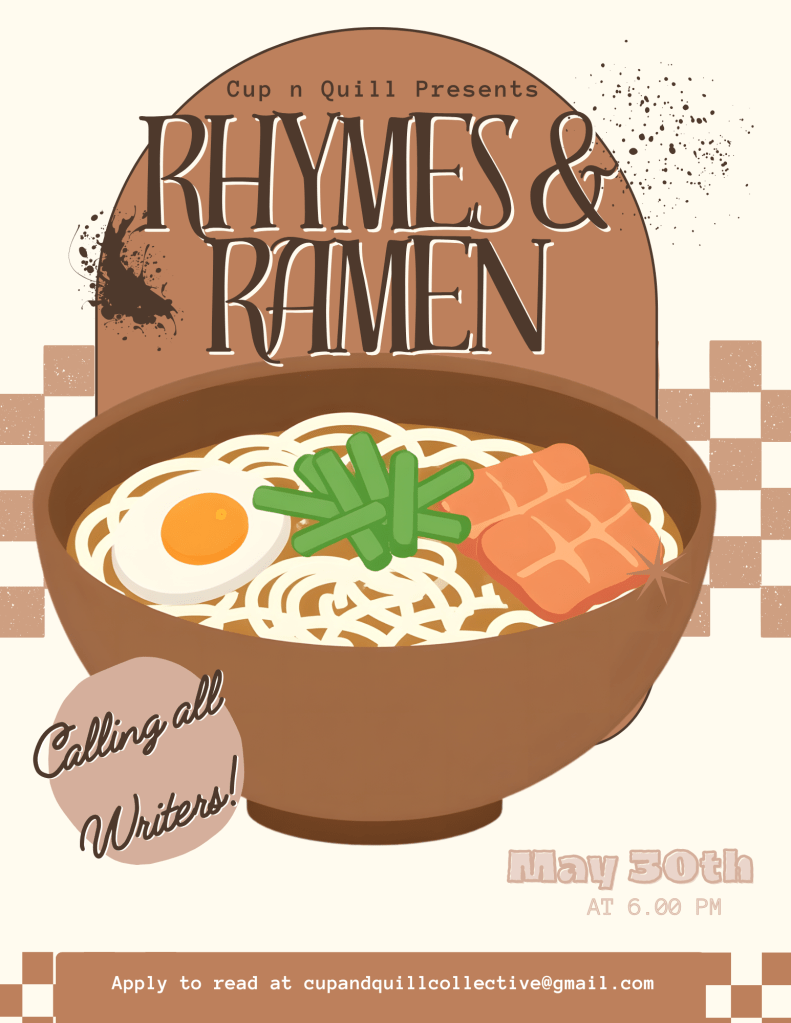
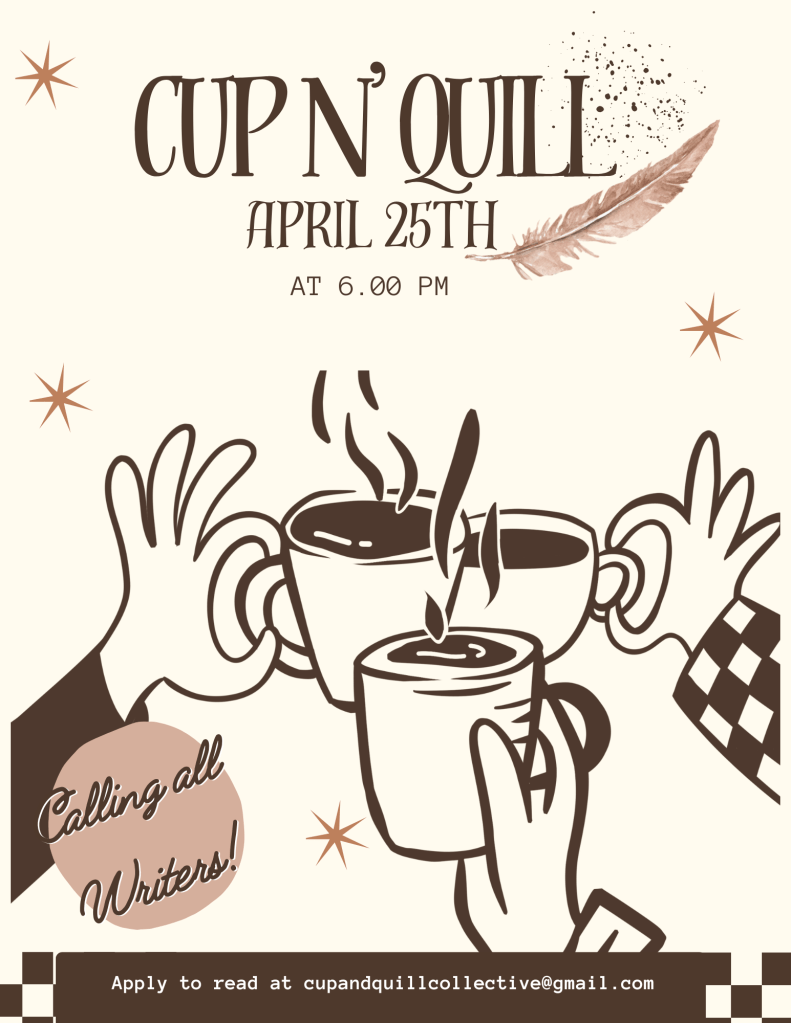
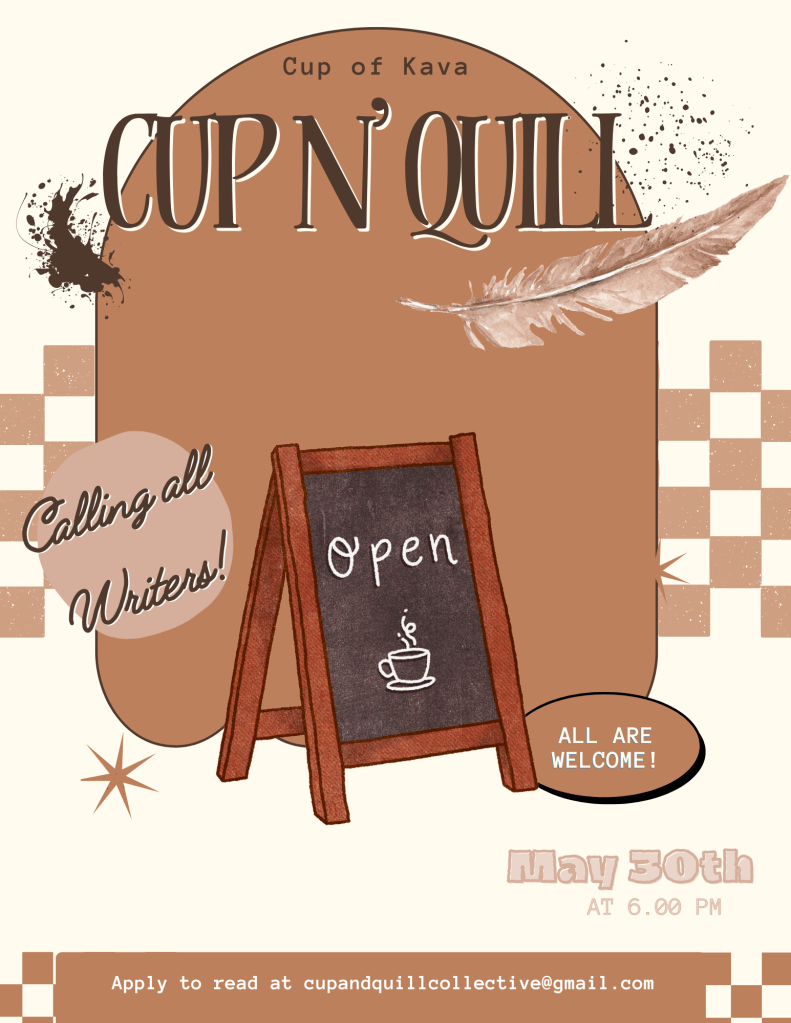
Final note: take a look at the flyers I so professionally designed with my free version of Canva! Take this as a sign that YOU too can make a cool event, make some cute posters, and people will attend!!

How to be a Writing Minimalist

The other day (yesterday), I shared my general frustrations with the internet’s ability to emphasize aesthetics over substance and how this also extends to writing. So, to piggy back off THAT post, I’m going to share some general thoughts and tips I have for simplifying the writing process if you’ve found yourself like me, and overcomplicate EVERYTHING and maybe have begun focusing on the wrong thing when it comes to your creative process. So, let’s go.

Mayhaps, skip the perfect playlist search…

You don’t have to write in dead silence. HOWEVER, maybe consider spending less time picking the perfect ambience video or music and more time…writing…I’m calling myself out here too, I swear. This isn’t a direct attack. Just a thought. Also, silence isn’t the worst thing sometimes. Perhaps give it a try? Let your thoughts be the only thing going on in a room for once.

Words First. Vibes Later.

If you have 20 minutes to write, use 18 of them writing.

Not 12 minutes building ambiance and 6 minutes staring at a blinking cursor.

You do not need:

  • A fresh notebook.
  • A themed drink.
  • A perfect Instagram caption about “slow mornings.”

You need words on a page. That is the only requirement here and we’re gonna HONE IN on that.

Open the document first. Type one ugly or stupid sentence. Momentum is born from action, not aesthetic. I may have to get that tattooed to my forehead because the amount of times I’ve spent picking the perfect font….

Embrace the Ugly Draft

Aesthetic culture has tricked us into thinking even our process should look polished.

But real writing is clunky. It repeats itself sometimes. It says “thing” because you can’t find the right word or whatever code word you put in to signal you don’t know quite what to say in this portion.
It uses too many commas. (Guilty. So so so guilty).

Minimalist writing means allowing your first draft to be deeply unimpressive.

No one takes photos of a messy draft.

Good.

That means you’re probably doing it right.

Set Constraints on Purpose

Try:

  • Writing for 15 minutes without stopping.
  • Writing 300 words before you’re allowed to adjust your playlist.
  • No desk rearranging once you sit down.
  • No phone within arm’s reach. This one is so simple and yet, even while I’m writing this, my phone sits right beside me. Clearly I need to say it louder for myself.

Stop Documenting the Process of Writing

When you’re done, just close the laptop or let your computer screen go to sleep. And that’s it. Don’t tell anyone. Don’t take a picture of your space or your draft or ANYTHING. Leave it be. Be proud of yourself and then go take a nap or shower or something. Be happy with yourself. You wrote something, and you don’t have to prove it to anyone.

If I were to write a romantasy novel…

This is my way of announcing that I’ve begun writing on a new project. Will I finish it? Who knows? Is it fun though? Absolutely. So I’m going to share it with you guys against your will! The door is locked and the powerpoint-er, I mean the synposis is prepared! Read along, and you may just get a sneak peak of what I’ve written so far…

The Synopsis:

To end a generations-long war, a marriage is arranged between a charmingly naive prince and a dreamy but equally oblivious princess. Neither is thrilled, both long for true love, but duty comes first. Behind the scenes, however, the true powers are at play: the prince’s brilliant and calculating gentleman-in-waiting, and the princess’s cunning and fiercely loyal lady-in-waiting. Each is the secret strategist behind their monarch’s success, and each is deeply committed to their own kingdom. When tradition demands that they too be wed, to symbolize the uniting of the households, they are less than thrilled. But strategy has a funny way of turning into something else when hearts get involved.

Meanwhile, in the shadows of court, two rival assassins, one from each kingdom, are given a single directive: kill the monarch of the enemy side. As their deadly missions cross again and again, a reluctant chemistry sparks between them, even as they try to finish the job and stay alive. The lady and gentleman-in-waiting, ever alert, play a high-stakes game of wits to keep their monarchs alive, all while navigating their own slow-burning, inconvenient romance.

As alliances shift and true affections deepen, three love stories unfold: between the idealistic prince and princess who unexpectedly fall for each other, the wary advisors who find love in the midst of rivalry, and the assassin enemies whose mutual respect may just turn to something more.

As this all unfolds, will the true enemy come to light?

The Preview:

Chapter 1: The Lady-in-Waiting

The throne room was suffocating. Courtiers pressed close in their jeweled silks, whispering beneath the vaulted ceiling as the King rose from his throne. Sage held her breath, watching every movement. A hush finally fell over the crowd. His voice carried like a trumpet blast, proud and commanding:

“Today, I announce a union that will bind two kingdoms. My daughter, Princess Lotus, shall be wed to His Grace, the Scarlet Prince.”

A ripple spread throughout the court. Some gasped, others exchanged quick, calculating glances. Sage, standing a respectful pace behind her mistress, felt her stomach twist and drop. She wanted to look at Lotus with the unspoken question, Did you know?

She dared not. She was the Lady-in-waiting. She was to be still, respectful, and quiet. So she stared ahead, focusing instead on the fountains lining the throne room perimeter, willing herself to focus on the way the light shimmered through the spray of water and the refractions that danced along the wall.

Still, from the corner of her eyes, she could see the princess keeping her chin lifted, her face calm as carved marble. Sage’s heart ached.

The King sat again, dismissing the assembly with a wave of his hand. This evening, his glittering silver crown set with sapphires seemed uncomfortably heavy upon his head. Sage noted the red around his eyes. He had spoken with such regality, and yet, up close, Sage could see him clearly: a tired, older man, with silver beginning to show. A weary man who had seen years of war and felt his only ploy for peace was to marry his own daughter off to a monster.

Courtiers bowed low, murmuring congratulations as they filed out. Sage remained rigid until the chamber emptied, then hurried to Lotus’s side. From there, Lotus and Sage bowed low to the King and Queen before they were dismissed as well.

As they did so, Sage tried to sneak a peak at the Queen. What were her thoughts on all this? Had she also known? Did she even support this mad decree?

But Lotus had learned her steely face from the best, and the Queen’s expression revealed nothing. She only inclined her head ever so slightly before turning with to take her husband’s arm, silks rippling around her like an ocean.

~*~

“You knew?” Sage whispered, unable to keep the edge from her voice.

Lotus finally exhaled, the careful mask slipping. Her eyes were watery but no tears fell. “Only last night. When we were having tea after dinner. My father told me as though he were announcing the weather.”

Lotus moved to sit on her bed, head shaking. Beads braided into her raven hair clicked and clacked as she did so, but she said nothing more, shoulders sagging in resigned defeat.

Sage’s throat tightened with shame, cheeks hot. I should have seen this coming. I should have anticipated.

“It isn’t your fault,” Lotus said gently, as if reading her mind. She motioned her friend closer to lay a comforting hand on Sage’s arm. “None of us could have predicted it. Father has been playing his cards close to his chest lately. He is a King at the end of it all.”

But he is also a father, Sage thought but refrained. Guilt did not rest solely on his shoulders.

Sage could not forgive herself. It was her duty to see every threat before it arrived, every storm on the horizon. And for the first time in her many years at the Azure Palace, she had failed.

Her mind spiraled backward, to the day she had been bound to this role. The day she made an oath. A promise never to be broken.

~*~

Sage was fourteen when the Queen summoned her. She recalled it all as if it were yesterday. She remembered the long path through the garden to reach the pavilion where the Queen sat, enjoying the golden summer sun. And though it was a beautiful afternoon, Sage remembered that the guards’ silence brought a chill upon her, faces gray in the midday.

The Queen sat on a blue velvet chair, appearing to be deep in thought. Her crown rested on a small side table beside her, though her gaze was sharp as a blade.

“My daughter,” the Queen began without preamble, “is good of heart. She loves our people, and she is beloved in turn. But she is…not made for the rigors of politics. She has little taste for diplomacy, little head for stratagems.”

Sage, young as she was, lowered her eyes. She had known this truth too, though she never dared voice it. She could see it every day during the Princess’s tutoring sessions. The girl could never quite recall the sequence of battles, or who had signed which treaty, or why it mattered in the first place. She would wrinkle her nose in confusion, or laugh lightly at her own mistakes, as if history were nothing more than a jumble of names tumbled together in her head. Dates slipped away like water through her fingers, and more often than not she confused one monarch with another, sometimes even her own ancestors. The tutors would grow red with frustration, but the Princess only smiled, unbothered, certain that someone else would always be there to remember what she could not.

Mathematics fared no better. Columns of numbers left her wide-eyed and blinking, as if they were written in some foreign tongue. She counted on her fingers long past the age when most had stopped, and when asked to recite her tables, she would hum under her breath to buy time, cheeks pink with embarrassment.

It was at the age of nine when Sage began to do Lotus’s homework for her. At first, she attempted to teach the Princess herself, certain that, someday, it would all come together and click into place. It never did. So, Sage kept up with her Lady’s work while she tended to less “boring” matters.

The Queen rose and crossed the room. Her hand came to rest firmly on Sage’s shoulder.

“You, however,” the Queen said, “have always been clever. I have seen how you watch. How you notice. I’ve seen you poring over her books and lessons far more than she ever has.” The Queen began to smile, but it quickly faded as she continued. “The world will try to outwit her, to corner her. I will not let that happen.”

Her voice softened. “So I charge you, Sage of Rosehall, to be her mind when her own fails her. To stand beside her when I no longer can. She will be the heart of this kingdom, and you must be her reason.”

Sage’s knees nearly buckled under the enormity of it. But she bowed her head and whispered the vow that had bound her ever since:

“I swear it, Your Majesty. My loyalty is hers. My life is hers. I will not fail her.”

~*~

The echo of that oath still rang in Sage’s mind as she looked at Lotus now, her eyes burning.

She was sleeping now. She always did so easily. She had lain down on her bed only for a moment before she was snoring quietly. Even in the face of such an announcement that sealed her fate, she slept.

Sage beheld her with pale skin and blushed cheeks. Her sleek dark hair was half done now, the style not arranged for rest. Her sky-colored gown was rumpled and wrinkled. She was small, and gentle, and perfect. A lamb of the Azure court.

Sage’s fingers curled into fists. The King might throw his daughter to the wolves of politics. The Scarlet Prince might come to devour her. To devour her future kingdom, but Sage would not accept her friend’s fate. She would sharpen her mind as to a blade. She had sworn once that she would not fail Lotus, and she meant to keep it. By her life, she would keep it.
Romanticizing being an Author over actually Writing: A Discussion of Age of Scorpius

Tiktok being in my life has brought me very little positives if I’m being real. A time suck at worst, most days, an overwhelming source of writing tips and information I can barely process at best. That being said, it did make me aware of an interesting situation that was unfolding on the booktok side of the app. I’m going to give you a quick recap if you’re not aware of what has been going down, maybe because you are spending your time actually being productive and are NOT chronically online. Sooooo…. let’s get started.

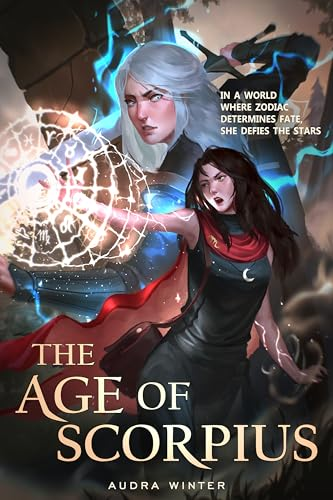
Ok. So. Our story begins with Audra Winter, an aspiring author who through her various tik toks promoting her book, amassed an audience eagerly awaiting the release of her first book, Age of Scorpius. Her world was based on a magic zodiac system that I will not be delving into at this time, but just know, people were excited. I think naturally, people love to sort stuff, especially when it comes to book factions. I think that’s one of the secrets behind the Hunger Games or Harry Potter success so perhaps the same thing was occurring here. It also didn’t hurt that she had an amazing team of artists on her side. She commissioned character artwork, helping people visualize the characters and the world and, as someone who has seen this artwork, it is GOOD.

So the stage is set. Everyone is pumped and she announces she’s going to be publishing her book. Pre-orders come flooding in. It’s a success before it has even found its way into the hands of readers. But then it did…

Age of Scorpius received overwhelmingly negative reviews for poor writing, plot, and editing, despite its viral marketing. Due to the backlash, Audra is reportedly re-editing the book for a new edition, as the first version is no longer available. Wow. Yeah.

So, what happened here exactly? Is the book that bad? According to the overwhelming majority of reviews, yes. And from the passages I have read, also yes. The book reads as a first, unedited draft. I’m not going to pretend I have not produced work similar to Audra. No one is really taking issue really with the work she has produced here, except for the fact that she chose to publish it, expected people to pay for this work, and then had a rather defensive reaction when negative reviews came flooding in. Honestly, her continual reaction to criticism seems to be single-handedly keeping the discussion surrounding this debacle going.

People got what they had paid money for, true, but as paying customers who were dissatisfied with the product, they had the right to leave their review, bad or good. End of story. I don’t think many people would disagree on this point so I’m not really interested in pursuing it further.

What I am interested in in this scenario is what Audra seems to represent here. Their social media illustrates someone very proud of their entrepreneurship and a desire to assemble a whole team and multimedia studio based around their work. All before their book actually came out, mind you. It seemed Audra had built in her head this idea of what her author status would lead to. That everyone would love her book and she would continue to see success… clearly she was getting to ahead of herself, though, because step 1 of the plan was fumbled. Step 1 being writing a good book!

Age of Scorpius read as rushed. It did not get the time, care, or attention the story truly needed. It seemed Audra’s eyes were so set on appearing to be a successful author that they forgot that in order to get there, they needed to make something worth reading. They liked the idea of having a end product more than actually writing. They lost sight of the craft. I think that’s something we can all learn from.

Social media commodifies everything. Everything gets reduced to an aesthetic and/or brand. This process can apply to our hobbies, and then suddenly we are “performing” our hobby and not actually DOING the hobby or enjoying it for that matter. In a world that is filled with terms like “hustle” and a “be your own boss” mindset, it’s easy to see any hobby as a business or a means to an end. We should not be focusing on this when it comes to true craft. Our main goal should simply be to get better. Improve our writing and maybe, at the end of it all, produce something worth other people’s time to read.

If you are interested in further deep dives on the Audra Winter controversy, I’m sure you can find plenty of videos on it on youtube (I should know, I’ve listened to multiple). Mostly the point I want to get across in this post is simple: We are all capable of this. Social media makes this mistake easier and even encourages it. Don’t give in. Get good. Get better. Slowly and steady wins the race.

Book Trends I’m Low-Key Hating Right Now

Look, I know reading is supposed to be fun. And if you love any of these tropes, that’s great. Truly. I’m not judging you. I promise, dear, reader. I’m directing my judgment towards the industry that keeps churning out the same lukewarm leftovers and calling it gourmet fiction. I know these tropes have a place in fiction somewhere but I have a few gripes as they become widespread…

So buckle up while I gently roast some beloved tropes. If I hit your comfort trope… I’m sorry. (I’m not sorry.)

Enemies to Lovers (I’m begging… please stop)

Look, I know this trope is BookTok’s golden child. But at this point, it’s been done so much that authors are scrambling to manufacture hostility out of absolutely nothing. Or worse…they’re romanticizing behaviors that go way beyond a mild red flag.

I’m tired. I want conflict with substance, not passive-aggressive banter and emotional constipation that magically becomes love in chapter 17.

Morally Grey / Redeemed Villain (Rarely Done Well)

It’s either:

legitimately abusive people who get a redemption arc because they’re hot

or

villains who are “morally grey,” except their actions are… actually just evil?

There’s a difference between “tragic complexity” and “this man kills entire villages but has one soft scene with a kitten so we swoon.”

BookTok, release him. I’m begging.

Every Brooding Love Interest, Ever

I’ve reached my broody quota for the decade. If has “shadows behind his eyes” one more time, I’m throwing the book.

Can we get more emotionally balanced romantic leads??? Men who communicate??? Men who don’t describe themselves as a monster but just… deal with it in other ways? They don’t even always have to be healthy, I just need a break from the “I treat X main character like crap because of the tragedy.” What if he deals with his feelings by cracking jokes all time? Trying to be liked and loved by everyone? A greed for money or power because it would have prevented his personal tragedy? Idk, I’ll even take a shopping addiction at this point. Please, just change it up sometimes.

Mythological Retellings

I’ve my breaking point. Every Greek myth, Roman myth, Celtic myth, minor footnote of a myth has been rewritten, gender-swapped, aestheticized, and thrown into a love triangle. You name it, its been done but with a twist!

I used to love these, but the market is so flooded I feel like I need a snorkel. Give the myths a nap. Let them rest.

Underdeveloped Magic Systems

I’m tired of magic that’s basically:

✨ vibes ✨

and zero rules.

Magic doesn’t need to be hard sci-fi level, but if plot problems are solved with “because the magic suddenly works this time,” then I’m checking out. I need a little structure here. Develop. Elaborate. Establish. Please.

Fantasy Formula Fatigue

A much more broader complaint but the BookTok effect is real. Something goes viral, sells 10 billion copies, and suddenly we get:

the same cover,

the same “aesthetic”,

the same plot beats,

the same protagonist with “fire in her veins” or whatever.

It feels like copy-paste culture. I want fresh stories, not reskinned bestsellers.

Childhood Friends Who End Up Together

This one is personal: I just don’t care for it.

Also applies to “the leads always end up together” no matter how incompatible, underdeveloped, or generically pleasant they are. Sometimes characters should just… not date? Sometimes the chemistry isn’t there?

And that’s okay!

Let them end the book with growth, not forced romance. Ghibli has been doing this right since forever.

Tragic Backstories (Especially the Last-Minute Ones)

Not everyone needs a traumatic fifteen-page flashback to be interesting.

And oh my goodness, can we PLEASE have more stories where the characters have loving, functional families? Actual parents? Actual siblings? Families that aren’t evil, dead, or conveniently absent so the protagonist can be “strong and independent”?

There is so much narrative potential in healthy, intact families.

Imagine:

an adventuring party that’s literally a family business

siblings questing together and bickering the whole time

a fantasy inn run by a chaotic family who’ve seen every hero, villain, and bard in the realm

a family cracking a mystery together and following clues

Tell me that wouldn’t slap.

Broody Mentors

Sorry if I’m repeating myself but this combo of tropes specifically gets under my skin. If the mentor is mysterious, brooding, evasive, emotionally stunted, and 500 years old… no thank you.

There is something inherently weird about that dynamic, and adding brooding on top of it makes my skin crawl. Give me wise, funny mentors. Give me competent, happy mentors. Give me mentors who aren’t one bad day away from a villain arc.

The Chosen One (I Don’t Hate It, But Please Cool It)

It started as a classic but hasn’t evolved much since.

I’d love to see more stories about the supporting character who never becomes the star, who chooses loyalty over destiny, who stays in the background and is okay with it.

There’s beauty in being the one who helps and not the one who saves the world.

Aaaand I think that about wraps it up! I could probably go on but that’s enough venting and negativity for the day. Hopefully you got some mild enjoyment from this post or at least related a little to some of my reading icks.

Hopefully see you in the next post, reader!