
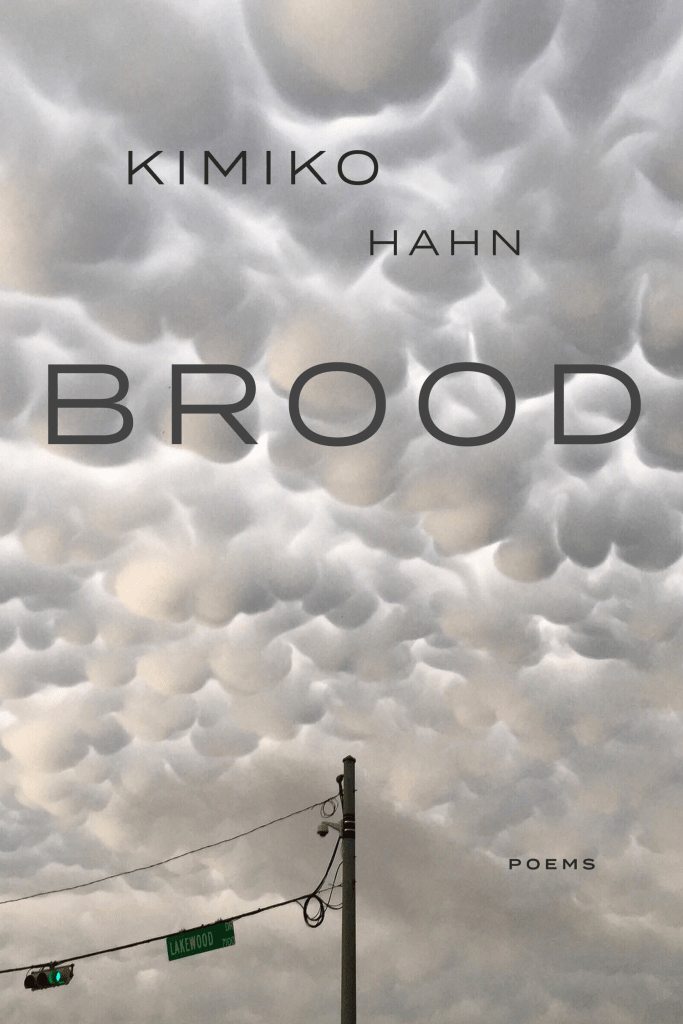
Nature, Childhood, and Brood

Childhood. It is something that is near all our hearts. I am sure many of us can recall summers spent outdoors. Bare are feet skimming the soft grass. The scent of freshly cut grass. The distant hum of cicadas. Fireflies blinking and winking at us from the dark. Fresh air that zips past us as we run and play and enjoy nature and childhood freedom.

Nature and childhood is often something that is connected in our minds, whether we realize it or not. It is this connection that Kimiko Hahn taps into in her chapbook titled “Brood”.  She explores this connection through a series of poems giving us a full sense of her childhood and nostalgia.

Hahn is a seasoned poet who is the author of a whopping 10 poetry books. This includes but it not limited to Foreign Bodies (W. W. Norton, 2020), Brain Fever (Norton, 2014), Toxic Flora (Norton, 2010), The Unbearable Heart (Kaya, 1996) which was the winner of the American Book Award, and Earshot (Hanging Loose Press, 1992), winner of the Theodore Roethke Memorial Poetry Prize and an Association of Asian American Studies Literature Award. Science and nature are common themes in her work and this chapbook is no exception when it comes to this.

Hahn grew up in New York and Tokyo. It makes one wonder if these urban backdrops caused her mind to wonder to what little nature there was in her childhood. Her chapbook “Brood” even opens with a little snapshot of a Damselfly caught in a web.

When you spot a damselfly

Caught in a spider’s thread

Blow gently…”

Early on, Hahn draws our attention to the delicate and intricacies of nature. But, these pictures are also contrasted with humanity and the modern. One such poem titled “Folding Fan Advertising Kikkoman Soy Sauce” exemplifies this while also introducing us to a memory and a person who has passed.

My kindergarten handprint in clay! Pearls! But you never belonged to me. I’m not sure I care, odd ephemera in the debris of my father’s home.

She does the same in the following poem titled “Noise”.

The neighbors teething baby wails, a grating cranks shut, a woman calls out, a man shouts back, the sanitation truck pulls to the curb with engine, men, and suction…

Overall, this contrast between nature and the modern creates a well-rounded experience as Hahn delves into feelings of loss, nostalgia, and family. Hahn masterfully weaves these thoughts and ideas together to give us a colorful picture of childhood and her specific upraising. It is just a small peak as the works are often brief, but they are rich with vivid imagery and beautiful scenes that pull us in from the first sentence.
Pssst! Hey! Thanks for reading! This post is a bit different from my usual blog posts but I read this chapbook and did a review on it for school so I wanted to share. I not only got to pick the book but I found it was fun to share my thoughts. If you’re into poetry, definitely check out Kimiko’s work!
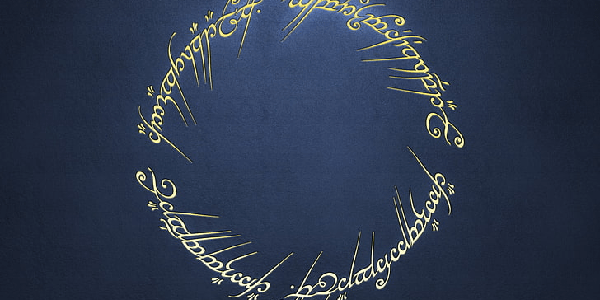

Tips on Writing like Tolkien

Know your world. Know it well. Explore every corner.

Immerse yourself in every type of writing. Especially poetry.

Take your time. Quality over quantity.

Take pride in your work.

Have inherit values that can shine through your work.

Write what you believe in.

Write about the magic of the mundane as well as the bigger events and ideas. Regular people and regular events occur even when something historical is taking place and don’t be afraid to focus on that every now and then.

Show the beauty of the world your hero is saving.

Seriously immerse yourself in your work. Pay close attention to the details.

Remember that no character is infallible.

Have a deep lore to your work that shines through, even if its not directly talked about or addressed. It is part of the backdrop of the story and will contribute to the depth of your world.

Take time to describe things in your story from buildings, to meals, to scenery. Don’t shy away from describing something in detail every once in awhile.

Have faith in your reader’s attention span.

Writing Prompt: Timeless

Everyone is born with a clock right over their heart. Inevitably, someday it will stop. And that moment will come one the clocks hands have made a full revolution. This is hard for people to handle as I’m sure you can imagine, nearly everyone is aware that one day the ticking will stop and it will be over.

You get into an accident. You’re fine but you wake to the doctors telling you with confusion that your clock has stopped but you are somehow still alive.

Excerpt From A Book I’ll Never Write: Submerged

The water lapped lazily at the sides of my small, sleek, wooden boat as it drifted through the clear blue water. The water departed before the hull, creating silky smooth waves on either side of the ship. The water glinted and sparkled in the midday sun, making easy to see into the depths below.

The New York City Skyline completely submerged loomed beneath the surface of the crystal water, its dark shapes giving it a ghostly and haunting look. Gazing down, it seemed so close I could touch it and feel the metal of the spires that jutted up from the one towering skyscrapers.


I gently allowed my hand to drag in the water, creating ripples as I did so. The water was cool and refreshing against my tanned hands. I withdrew my hand, knowing full well that the watery city lay hundreds of feet under. It would take an impressive scuba expedition to even touch the highest peaks of the tallest buildings, and even then, one never knew of the creates that lurked in the eerie hallways of old office buildings.
The bell hanging from my ship’s mast interrupted my thoughts with a clear and resounding clang! I jerked my head up momentarily startled. A gull sat upon the metal bell, tilting its head, giving me an almost questioning look.


“Hey, there,” I said to the feathered creature. “Looking for a handout?”
It let out a caw. Gulls were ALWAYS looking for handouts. But I knew better. Gulls were as bold as they were hungry and once one finds you have anything remotely edible in your grasp, they would not hesitate to throw themselves at you, nibbling at you with their curved beaks.


I shooed the creature away and it reluctantly flew off into the strikingly blue sky. I stared after, watching its white body disappear into the blinding light of the sun.
It’s been approximately one hundred and twenty years since the sea claimed the majority of the North American content, banishing most of its major city to the deep blue. I, of course, don’t remember this monumental event, being only 16, but my grandmother did.


“It was disastrous!” My Grandmother would tell me when I began questioning her about the event. “Or so the politicians wanted us to believe. Truth was, this flood saved us from an even greater disaster; greed.”

She then would go on and talk of the white house plunging beneath the ocean’s all too welcoming waves and how many people died and how that was but a great tragedy. But people rose from the waves, rebuilding their lives and cities above the water, creating “floating villages” and even cities that bobbed on the surface of the water. Our once organized government was in shambles as were many other countries. Old Japan was now nothing more than a memory. But New Japan was a sight to behold, at least according to the rumors. Humanity is remarkably resilient, and the Japanese people were no different. Truth being, they had more time to prepare, expecting the flood a little more early on than any of the other nations.


Some were not so lucky. Great Britain got the worst of it. Big Ben was now nothing more than an ornate home of fish and sea life.
But one thing remained without question; Many suffered at the hand of unforgiving the tide.

Excerpt From A Book I’ll Never Write: Death to Life

The Grim Reaper’s job is not a pleasant one. But is nonetheless necessary. Death people from all walks of life. The Rich, The Poor, The young, and the old. No one is immune. All lives must come to an end. And despite having such a grim occupation, the Reaper tries to make the best of it, asking if there are any last words and whatnot. But he can’t help but feel numb and mirthless about it all. It is a very draining job. But, as he would say, duty calls and SOMEBODY has to do the dirty work.
And so, one day, he was on a job in the slums. As he roamed the trashed cobblestone street, he saw the faint aura of death emitting from a small hovel. He sighed inwardly. Another soul to reap. The reaper adjusted his grip on his scythe and pulled his cloak closer around him and headed towards the hovel. Once inside, he found a woman buckled over on the ground.
“Sorry, lass,” he said emotionlessly. “Times up.”
She looked up at the sound of his voice and he noticed her forehead was beaded with sweat. Then she gasped.
“The baby’s coming.”
The reaper stood, mouth agape.
“What?”
“You must be a doctor!” she exclaimed. “How else would you know?”

Books to read in the Woods

Books to read in the woods by a creek or in a tree:

Poems by Robert Frost

A fairytale collection

The goose girl

The lion, the witch, and the wardrobe by cs Lewis

Caddie Woodlawn

Beowulf

The dark hills divide 

Any book by Beatrix potter really 

James Herriot collections 

An Agatha Christie mystery 

The hobbit by jrr Tolkien 

Peter Pan 

Norse Mythology 

The secret garden

Anne of green gables 

The princess bride

The adventures of Tom Sawyer 

The legend of King Arthur 

Aesop’s fables 

The cricket in time square 

The last dragon

The adventures of Sherlock Holmes 

Redwall