So recently I came across an old USB drive of mine when cleaning my desk. Upon plugging it into my computer, to my delight, I found that it contained tons of my old writing and stories that I had written awhile back. And while I was happy to stumble across this little piece of my writing history, I was hit with a realization: my writing sort of sucked.
This didn’t bother me mind you; I was like 11 writing the majority of these stories, but I also couldn’t help but notice a few writing mistakes that I tended to make consistently. Some of these I still struggle with and some of these I have moved past but regardless I found it beneficial to note them and state them in this blogpost in hopes that someone else making these same errors could get some advice or find this constructive to their own writing.
Enjoy my analysis of my flaws.
Not utilizing paragraph breaks.
Or if I did, I used them incorrectly. I think this just comes with more practice where you get a better feel for when it is the correct time to press “enter”, but at this time in my life, I did not have such a sense. I either do not utilize paragraph breaks enough, resulting in long, sprawling pages of text or I used them awkwardly where it didn’t even seem to fit. The rule, as I’m sure you’ve heard, is to press enter and use a paragraph break every single time the “camera” changes in your story. This means someone else begins to speak, an unrelated action occurs, or a new line of thought comes into play.
Too many dialogue tags.
My writing didn’t flow for a lot of reasons, but one of the main reasons it all felt so janky was I used waaaaay too many dialogue tags when writing. This caused the conversations to feel choppy and jilted and not at all natural.
“He said.” “She said”. “They said.”
Too many saids. Sometimes you should omit the tag and simply write what the character is saying only. Besides, a good writer makes characters that you can tell is speaking, simply by how they talk, not just by the “said” that the writer tacks on at the end.
Not enough dialogue tags.
There were a few times however, that I omitted the tags entirely too much. Certain stories I guess I simply didn’t care enough about and barely added any tags at all. In some cases, as I’m sure you can imagine, this became all too confusing and it was hard to keep track of who exactly was talking at times, especially when the conversation involved more than two characters and it wasn’t a sort of back and forth exchange.
Pro Tip:
Read your writing out loud, but especially the dialogue bits to make sure they flow.
Being overly flowery in my writing.
Another error of mine was just being plain pretentious in my writing style. How did I do this? By overly describing EVERYTHING and utilizing long (but admittedly fun) words. While I do remember finding this a fun way of writing, feeling almost like I was writing the script of a nature documentary for a British dude to read, it admittedly did not make for great story telling. My writing felt fluffy and long winded. So unless you’re specifically going for that pretentious vibe, I’d try and avoid it.
Being redundant (failing to expand my vocab when it came to words I use a lot)
There are just some words I struggle to find stand-ins for but it would have definitely benefited me to look up a list of synonyms for the word “smiled” before I ever wrote ANYTHING. My advice to you is know the words you tend to regurgitate and before you even start writing, look up or compose a list of alternatives to resort to later when you feel you’re repeating yourself way too much.
And that’s it! Those are all the main issues I found with my earlier writing. And while I’d love to say the stuff I put out now is WORLDSSSS better, I would venture to say it isn’t. Despite having written for 6 more years, I still find myself struggling with much of the same stuff, especially when it comes to the issue of redundancy. This goes to show that we will never be perfect as writers but that still doesn’t mean we can’t improve. And we do that by knowing our downfalls and, probably most importantly, continuing to practice and hone our craft.
A group of teens find themselves at a very odd summer camp…
The woods nearby are teeming with odd wild life and the counselors tell then tales at night about the beautiful beasts that once roamed the earth that were forced into hiding.
The second week of camp it is revealed that this is a camp where teens are trained to house and protect different cryptids, choosing one specifically as their own companion.
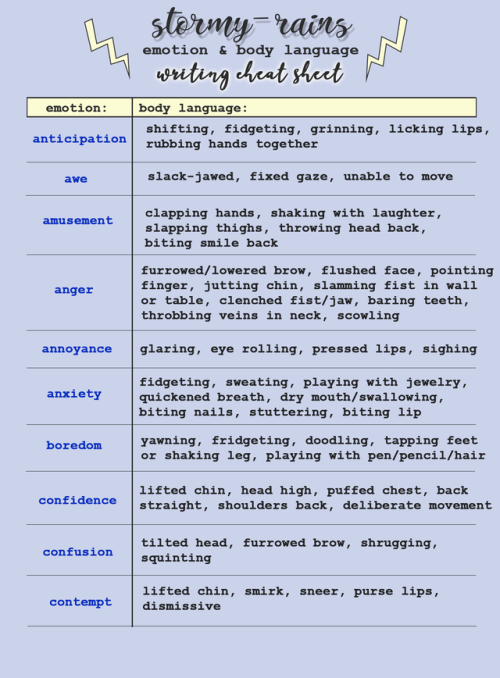
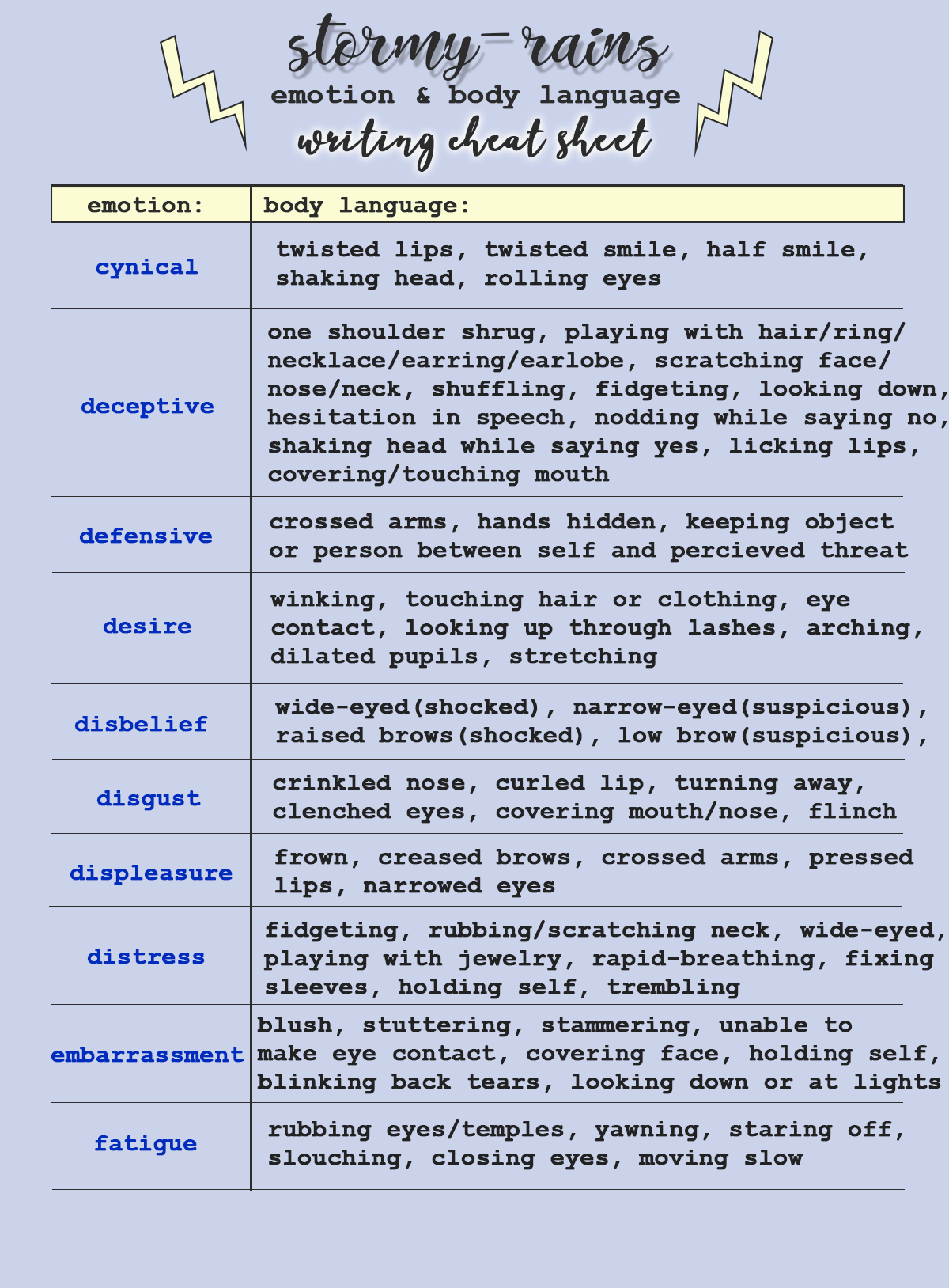
Writing can be really hard sometimes. Some days the words flow seamlessly from my finger tips and there other days where I get stuck on every little thing. One things that I have found that has helped me with these mini challenges and road blocks is having a few choice writing cheat sheets on hand that can help me when I’m stuck on how to write a specific scene or character. And so I would like to share these little cheat sheets with you.
Emotion Cheat Sheets
Writing certain emotions are harder for me than others. Especially when writing more obscure emotions that go beyond “happy” and “sad” and “angry”. This is because, sometimes, I can only recall one or two actions that reflect that specific emotion and I don’t want to sound like a broken record when writing their non-verbal cues. “She shook her head”, “She grit her teeth”, “He smirked”, “She smirked”. It can get pretty redundant.
These emotion cheat sheets help me with that. They each give me an emotion and a brief list of mannerisms and reactions associated with that emotion that one can integrate between the dialogue.
This might be more helpful for essay writers or article writers but it can be useful for story writer’s as well. If you have a bad habit of writing overly wordy phrases that could be replaced with a more condensed version of the phrase for clarity, then this cheat is for you. It goes through a few commonly used wordy phrases in writing and suggests replacements.
I have a bad habit of over using specific actions in writing.
Look. Walk. And smile.
These are three actions that happen quite a lot in a book. But I personally struggle to find other words that convey the same meaning to avoid sounding redundant. So here are a few cheat sheets I use to help me “dress up” and better describe these actions.
Aaaaand here is the last one. And probably the one I struggle the most with. Said. Now contrary to what you might have read online, said is not dead. Let’s not overlook the danger of getting to flowery with our writing. There are still places for simple versions of words. Said will always have a place in writing, But again, this is cheat sheet is made simply for when you fear you’re sounding tedious and like you’re repeating the same word over and over and over and over and over and over again. And sometimes these words and phrases can better describe the tone with which an action is done much better than “said” can.
Once, in the great land of Greece, there lived a man of great knowledge who was known to all the people as a great scholar. This man journeyed far and wide and dedicated his life to the gain of knowledge and answering life’s greatest questions. The Gods found his pursuit of knowledge honorable and invited him to dine with them at Mount Olympus. So the man accepted the invitation graciously and attended the great feast held there in the kingdom among the clouds. He sat at an immense table and dined seated next to the Athena, the goddess of knowledge and across from Hermes, the great messenger god. As they ate, they entertained intelligent and interesting conversation until the scholar posed a question to the goddess Athena that caused her to pause. “Forgiving me for asking,” said the scholar. “But since I have dedicated my life to the gain of erudition, I find no question impertinent.” “Please, ask,” said the wise one. The man continued. “Philosophers and scholars alike have asked and argued over this question for many years so please answer me this,” Then he breathed in sharply before posing the question. “How do you kill a god?” Athena was silent for a moment before giving the scholar an answer. “You cannot kill a god without killing humanity,” her voice sounded far away as she spoke. “For we are a part of you and you, us. One cannot live without the other.” “Athena, you speak well,” Hermes interrupted. “But may I interject?” Athena glared at the Golden Haired man from across the table before saying begrudgingly, “Speak.” “You speak wisely, old friend,” Hermes said. “And what you say may very well be true but might I offer our friend another point of view. To kill a God, one must cover their presence with another myth.” He drummed his fingers against the table as he spoke. “Make them less than a legend. Pray no longer and make them the devil.” The scholar thanked the two deities and returned to his meal. After the feast, many of the gods mingled and some even danced. Amidst this ruckus, the scholar found himself in the company of Zeus, the Ruler of Olympus and Lord of the skies. The scholar seized this opportunity to ask the king of the gods his question. The man’s laugh rang loud and strong as thunder. “We cannot die!” He said. “That is to be a God. To rule to the end of time. ” The scholar bowed low, thanked Zeus and left his company, wishing to refill his goblet. Upon doing so, he ran into Poseidon who was refilling his cup as well. The scholar, determined, offered his question to the sea God. “Ah! An interesting question indeed!” Said he. “The answer is you must strip away his power and all that he exerts authority over. For what is a god over nothing worth?” The scholar thanked Poseidon earnestly and returned to mingle with the guests. As he socialized, Aphrodite glided over to the scholar and invited him to dance with her. The scholar accepted and he guided him to the center of the floor. As they swayed, the scholar asked the fair goddess what he had asked the others. Aphrodite threw her head back as she giggled, her eyes glittering like stars. “A bold question, mortal,” said she. “But I shall answer it all the same. You deprive the God of the love of their people. Take away his adoration among those who worship. What is a god who is not known? What worth is he without his tributes?” The song ended and the scholar bowed and kissed her hand, thanking her. He returned to mingle with the guests when a loud, boisterous laugh sounded throughout the room. It echoed sharply in the marble room, making all that heard it stop and look briefly. It was none other than Ares, the God of War. A large presence among the Olympians, he was known for his power and strong stance. He fought fiercely and without hesitation. However, the mighty warrior of the Gods had a surprising charismatic air about him, drawing others close to listen to his tales of wars and battles. This aura intrigued the Scholar, and it wasn’t long before he found himself at the side of the war god. “Hello, wise one!” he boomed. “How may I oblige a collector of knowledge such as yourself?” “I only request that you answer the question I ask,” The scholar explained. “Ask!” Encouraged Ares, the fire in his eyes ablaze. “And I shall answer!” “How does one kill a God?” The God seemed taken aback for a moment. “A strange question indeed!” He commented. “But I shall fulfill my promise! To kill a God, one must destroy him only by the power of another. An opposing celestial being! A God for a God. For this is how any mighty warrior will fall! At the hands of one greater and mightier than he!” The Scholar pondered this answer for a moment but did not have time to thank Ares, as the War God had returned to retelling his stories and amusing the mass around him. “Quite a strange one,” a voice echoed to his left. The Scholar turned to gaze on a tall, dark figure. He had a goblet of the darkest wine in his left hand and his other rested at his side. HIs tunic was a deep purple and upon his head, a crown of vines rested. “Dionysus,” The Scholar murmured. “How very kind of you to address me so,” Dionysus said. “Being one of the lesser Olympians.” The Scholar said nothing. “Your silence is wise,” Dionysus laughed. “One must be careful when trifling with the immortal and powerful.” The God took a sip from his goblet and eyed the Scholar curiously. “But you have been quite bold this evening, if I may say so.” “You speak in reference to my question I suppose,” said The Scholar. “What else?” Dionysus smiled. For an instant, the two remained silent as they surveyed the party. Then the immortal spoke. “Would you fancy an answer from a lesser deity, such as I?” “But of course,” The Scholar told him. “I would be a fool to reject such an offer.” “To Kill a God,” Dionysus began. “Is no simple task. However, it can be done.” The Scholar nodded, intrigued. “Take that what he desires and give it to him. This in of itself is difficult to do for what does a God desire? Does he not have all that he wishes? But upon giving him what he has hungered for, take it away, but not before he has tasted all that he has dreamed of.” Dionysus sipped his wine once more. Then he turned to the Scholar. “It seems I am out of drink,” He said lightly. “If you will excuse me?” And the immortal left the Scholar standing alone amidst the crowd. The mortal was dumbfounded for a time, mulling the words of Dionysus over in his head. But a feather-like touch against his hand brought him out of his daze. “Excuse me,” a small, innocent voice whispered. Then two, star-filled eyes gazed up at the Scholar’s face. “Oh! The Wise one!” The young woman’s melodious voice rose with recognition. “Forgive my rudeness!” Persephone smiled. “I would have spoken to you before now but I was tied up,” her gaze shifted to over his shoulder but flickered back to him quickly. “But, I can speak to you now!” she led the Scholar over to the balcony that overlooked the city of Olympus, with its brilliant architecture and shining palaces. “How are you enjoying yourself among the immortals?” She queried. “Very well, thank you.” The two made polite conversation and discussed many things. Persephone spoke of what it was like to dance in the spring meadows and plant flowers with her mother all summer and spring long. She talked of Olympus and how her mother always adored the city with its glamorous buildings and fancy gardens. “And do you like Olympus as well?” The Scholar asked the young Goddess. “It is my home, but I find it quite… gaudy,” she hummed. “Nothing compared to the Underworld’s palace.” “But of course,” The Scholar hesitated for a time, then ventured to make his request. “M’lady, can I be so bold to impose a question on you?” “Ask it and then I may tell you,” Persephone replied. “How does one kill a God?” Persephone gazed at the city and smiled. “Take away what tethers they to this world,” said She. “Be it be the sky, the sea, or the one they love.” She turned to face the mortal. “That is how one brings an end to the divine.” The Scholar returned her smile, and was opening his mouth to thank her when a voice called out, “Persephone! Persephone! Where are you?” “Oh!” Persephone cried in surprise. “That’s my mother! Thanks so very much for the talk,” and with that, the young lady quickly disappeared into the crowd, returning her mother’s call. “Coming!” The party was drawing to an end and the scholar was prepared to leave when he spotted a shadowy figure tucked away In the back of the room. He approached and came to face the God Hades, the keeper of death. “I never thought you’d make it to me,” he said, his face dark as night. The scholar gazed upon the shadow of a god as he spoke, barely above a whisper. “How do you kill a God?” “Your strip away his senses,” he said. “He is made blind and so he cannot feel or here. You take away his ability to feel and send him into oblivion but even then, that is not death.” The scholar was silent for a solemn moment. Then he bowed and thanked him just as he did the others. The scholar thanked the Olympian’s and was led out of the grand palace, escorted by a woman in a brown robe holding a lantern. They traveled through winding passages and finally down a lob staircase before they reached the gates. Upon reaching them, the woman turned, the lantern illuminating all but a small portion of her face. “My child,” said she. “Do you wish to pose me your question?” “Why do you ask that, M’lady?” Queried the scholar. “For I am Hestia, the oldest of the gods,” she spoke quietly, a slight smile playing her lips. “No one knows of death more than I.” “Then allow me the honor,” the scholar dipped his head. “How do you kill a god?” “The question is but a difficult one to answer but I shall do so all the same,” she leaned forward, holding the lantern low as she whispered, “You make them forget. Forget who they are and once were and what they will be. But remember,” her voice became more quiet, barely audible over the wind. “What you kill, you must be prepared to become.”
Hi everyone! And welcome to my blog post where I rate all of NASA’s cute lil mechanical astronauts on their missions, hardwork, and how adorable they are. Are you ready?
Robonaut
This guy was designed to be about as humanoid as scientists dared to make a robot in the 1970s. Robonaut was designed to replace humans in space exploration. While its very hard to make a human-like robot and duplicate our emotions and the way our minds work, scientists manage to give this guy fourteen degrees of freedom and touch sensors at the tips of its fingers.
According to the very reliable source of Wikipedia, “There are currently two working robonauts, R1 and R2. R1 and R2 are both highly capable robots and are able to handle a wide range of tools and tasks. Robonaut 2 or R2 was flown to the space station as part of STS-133 mission and was the first humanoid robot in space.”
In the future, legs will hopefully be added.
So, now onto the rating.
While I give this robot my upmost respect, I cannot deny he looks a bit creepy. But given the importance of his work, I think I will give him a solid 6/10
2. Spidernaut
I’m not going to lie, Spidernaut scares the living crud out of me. A mechanical spide that is not only strong but HUGE. Sign me up, you do not. But, I will say, this design is really cool. The problem scientists have been having with our upcoming generation of space science platforms and vehicles are too large and too fragile to launch and deploy as self-contained payloads. They are breakable, present us challenges whenever we want to send them somewhere.
Spidernaut is supposed to remedy this.. The multipoint stance of an arachnid’s eight legs, with as many as 7 down during a step, allows simply-supported footholds that spread climbing loads more evenly across a space structure and impart no torques.
However, as of right now, it is simply a concept, theory, and an unlaunched model.
5/10
3. SPHERES
What are those large D&D looking dice things you might ask? Well, you probably won’t ask as this is a list all about robots and you can use deductive reasoning, BUT let me just pretend for a moment that you actually DID ask.
These are called SPHERES. The Synchronized Position Hold Engage and Reorient Experimental Satellite (SPHERES). They are a series of miniaturized satellites.
Too, quote and article, their exact purpose is this:
” to be used as a low-risk, extensible test bed for the development of metrology, formation flight, rendezvous, docking and autonomy algorithms that are critical for future space missions that use distributed spacecraft architecture, such as Terrestrial Planet Finder and Orbital Express.”
Each SPHERES satellite is an 18-sided polyhedron, with a mass of about 4.1 kg and a diameter of about 21 cm. So they’re small, compact, and super useful. In short, they are used for a wide diversity of experiments, basically functioning as a space lab partner.
These satellites get all my love.
8/10
4. Curiosity Rover
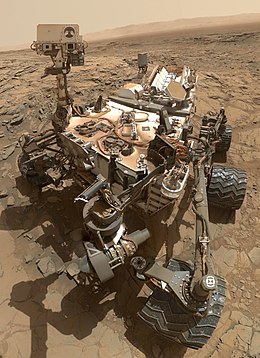
How could we even make such a list as this and not include our loyal Curiosity.
Originally Rover was sent to Mars to a explore a crater. A simple mission, right? But in December 2012, Curiosity‘s two-year mission was extended indefinitely. He remains operational and to this day, collecting samples for scientists to analyze.
8/10
5. Oppy Rover
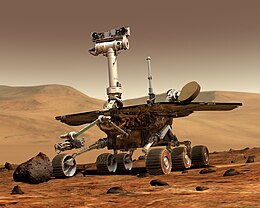
You probably already know the extensive tale or Opportunity Rover, effectionately nick named Oppy for short. Part of NASA’s Mar’s exploration program, Oppy landed on the Planet on January 25, 2004, three weeks after its twin Spirit (MER-A) touched down on the other side of the planet. Rover spent its days on the planet doing various tasks for scientists, being powered by its solar panels and hibernating during dust storms. This careful operation allowed Opportunity to exceed its operating plan by 14 years, 46 days (in Earth time), 55 times its designed lifespan. However, Oppy did not reboot after a dust storm in 2018, suggesting to scientists that it had some sort of failure, or that, perhaps, the machines solar panels got too covered by dust to operate. Scientists hope to go back soon and reactive this little machine. But until this, this little machine occupies a little space in our hearts.
“More than 835 recovery commands were transmitted since losing signal in June 2018 to the end of January 2019 with over 1000 recovery commands transmitted before February 13, 2019.[16][31][32] NASA officials held a press conference on February 13 to declare an official end to the mission. NASA associate administrator Thomas Zurbuchen said, “It is therefore that I am standing here with a deep sense of appreciation and gratitude that I declare the Opportunity mission is complete.”[33] As NASA ended their attempts to contact the rover, the last data sent was the song “I’ll Be Seeing You” performed by Billie Holiday.”
I used to think dreams were for the rich. The ones with money. And that if you weren’t allowed it when you were born then you were just out of luck. But I was wrong.
Dreams are for those with friends. Those who are willing to work hard. And for those who are willing to keep on trying and trying. Who are willing to keep their promises. Who are loyal. And who instead of looking for the good in people, choose to live it instead because others actions shouldn’t mandate whether or not you’re happy and neither should your circumstances. Dreams are for us.








 By the Brooke