Tagged Tunes: A Music Blog Tag

First off, a big thank you to Diamond for tagging me in this super fun music blog tag! I had the best time reflecting on the songs that have been with me through different seasons of life. Whether it’s a soundtrack/instrumental piece in the background or a lyric that punches you in the gut (in a good way), music is such a personal part of how we process and celebrate life. So here’s a little peek into my playlist!

And now… to the questions:

Your favorite song right now
Right now, I’m obsessed with a piece from The Wild Robot soundtrack called “I Could Use a Boost.” It’s cinematic, slightly whimsical, and hits that perfect sweet spot for a soundtrack lover like me. If you’re into instrumental pieces that tug at the heartstrings and make you feel like you’re on an adventure, give it a listen. You’re life or drive will feel like a coming of age movie.

Favorite Christian song
For a modern Christian track, “I Need You” by Gable Price and Friends has been on repeat in my car. It’s raw and real and feels like a journal entry to God when you’re burnt out. Plus bonus points for the Screwtapes Letters reference. But if we’re going classic, nothing beats “Be Thou My Vision.” That hymn just has a staying power. It feels like stepping into something ancient and deeply rooted every time I hear it.

Your favorite song five years ago
Back in college, I was loving “Ultralife” by Oh Wonder. It’s just so bright and energizing. Also had “You Already Know” by JJ Heller on my heavy rotation. There’s something about her voice and lyrics that always feels like a deep breath and quietly talking to God about what’s honestly on my mind and heart.

Your favorite lullaby/soothing song
Scripture Lullabies’ “Be Still and Know” is the definition of calming. It’s soft, peaceful, and reassuring in a way that always helps me unwind when life feels too loud. The piano intro is my favorite. Kind of reminds of me of the Princess Diaries Soundtrack in a weird way???

A song that made you cry
“Dear Mum” by Cassa Jackson. Oh my goodness. It’s tender and heartbreaking in the most beautiful way. The lyrics carry such a gentle ache. Definitely one for the “feel your feelings” playlist.

A song that makes you dance
“Sunroof” by Nicky Youre is bubbly and fun. It’s perfect for spontaneous dance sessions in your kitchen in the summer when the windows are open. And for a totally different vibe, “Harpy Hare” by Yaelokre makes me want to swirl around like I’m at a medieval faire. I’m not saying I’ve danced around in a circle skirt to it… but I’m also not not saying that.

A song you covered/performed
I’m not much of a performer, so I’m skipping this one. Unless you count car concerts or singing to my cats….

Favorite movie song
Is it dramatic? Yes. But “The Rohirrim Charge” from Lord of the Rings gets me every time. Epic, powerful, and goosebump-inducing. Instant motivation. Just wanna draw my sword every time I hear it.

Favorite song from a new album
Confession: I’m way behind on new music. I mostly live in my soundtracks and favorite artist bubble. So… if you have album recs, I’m all ears.

A song that makes you sentimental
“Birthday Cake” by Dylan Conrique is like a gentle punch to the gut. So melancholy and nostalgic. It makes me reflect on time passing and all the bittersweet little moments that go with it. The epitome of losing someone before you’re ready.

A song you’ve heard a lot lately
I don’t really do radio, so I don’t have a specific answer here. I tend to get obsessed with a few songs and loop them forever until I emotionally retire them.

A song you’d do at karaoke
Any cringe-worthy 2000s pop hit. Something the whole crowd knows and secretly loves. I want maximum nostalgia and minimum vocal expectations.

A good road trip song
“Driving Myself Home” by Rose Betts is just the right mix of fun, bounce, and sing-along potential. Great for windows-down cruising.

A cute love song
“Ordinary” by Alex Wallen gives me all the cozy love story feels. Simple, sweet, and a little dreamy. I’m not trying to be basic, but I am trying to be honest.

Favorite country song
“Dooley” by The Dillards. Please tell me someone else knows this gem. It’s a classic. Bluegrassy, catchy, and full of charm.

A song you love but cannot sing
Literally any song sung by a male artist in that awkward mid-range that’s too low and too high depending on how you try to adjust. My vocal range just gives up and goes home.

And that’s a wrap on this musical journey! I’d love to hear your answers—consider yourself tagged if you’re reading this and feel inspired. But specifically, I’m tagging:

  1. @The Texas Lass
  2. @KatiesCottagebooks
  3. @Little Blossoms for Jesus

Can’t wait to see what songs have been living rent-free in your heads!

Spring Reset for Writers: Refreshing My Writing Routine 🌷✍️

Ah, spring. The season of blossoming flowers, fresh starts, and freshly ignored writing goals. Oops. Did I say that outloud?

Anyways, I am determined to refresh my writing routine this spring as well as declutter my workspace, and become the productive, flourishing writer I was always meant to be. Or at least… try.

Step One: The Desk Purge

Right now, my desk is less of a workspace and more of an archaeological dig of sorts. There are at least three half-filled notebooks, a graveyard of pens (some working, some with ink mysteriously dried up overnight), and a coffee cup that may or may not be from last week. If I dig deep enough, I might find a long-lost plot outline or a note that simply says, “fix this, it’s bad.” Oh, and stickers. Lots and lots of stickers.

This happens periodically. My desk space over any given amount of time will become…how is it we say here in the south? Ah, yes, a HOT MESS.

So, I’m decluttering. The goal is to turn my desk into a space that actually invites creativity instead of making me want to lie down and take a nap. A candle? Yes. A cute notebook that I will definitely use? Absolutely. The ten random receipts and a variety of rogue paperclips? No thanks. You’re out of here (until I somehow collect another collection and do another deep clean this next fall).

Step Two: Reworking the Writing Routine

Right now, my “routine” consists of staring at my laptop at odd times (basically when the whimsy hits), opening a blank document, and then somehow ending up scrolling on my phone for 45 minutes. It’s an art form, really. And while I have been trying to tackle my phone addiction lately (it’s its own issue separately, ok?) my writing routine still lacks consistency.

To fix this, I’m trying out a more structured approach this spring. Instead of telling myself “I’ll write later” (which is a fancy way of saying “I won’t write at all”), I’m setting dedicated writing times. Mostly in the evening after work or after dinner. I have experimented with a few time slots (will be writing a blog post about this later, I’m all about experiments over here), and the evening time slot seems to work best with my lifestyle and schedule. So that’s what we’re going with.

Step Three: Setting Writing Goals That Aren’t Overly Ambitious

I alluded to this already in my New Years post in January. I love making big, dramatic writing goals. “I’ll finish my novel in two weeks.” “I’ll write 1,000 words every single day without fail.” “I’ll win a Pulitzer by June.”

And then reality hits. Life is busy. Some days, writing just doesn’t happen. So I’m continuing to focus on, goals that are actually achievable. Maybe it’s writing for 20 minutes a day. Maybe it’s finishing a single chapter this month. Small, consistent progress is better than unrealistic goals that just make me feel guilty when I inevitably don’t hit them. Right now I’m attempting to finish my Poetry book by the end of summer. That’s THE goal right now.

Step Four: Romanticizing the Writing Process

If there’s one thing I know, it’s that writing is way more fun when you make it an aesthetic experience. I’m talking fairy lights, soft music, a warm cup of tea, and the illusion that I am a 19th-century author composing a masterpiece in my candlelit study. Does this actually help me write better? Debatable. Does it make me want to write more? Absolutely.

So, part of my spring reset is making my writing time feel special. A cozy spot by the window, a new playlist, maybe even a fancy new pen. Whatever it takes to trick my brain into thinking this is a magical, must-do activity. If everything feels stale in your writing process right now, just try and make a few fun little changes.

Final Thoughts: Let’s Make This Our Season of Writing Wins

Spring is a time for growth, so I’m going to try and grow into better writing habits. Whether it’s finally decluttering that desk, setting realistic goals, or simply making writing feel more fun, this is my effort to reset and refresh.

How are you resetting this spring? Do you even believe in spring resets or is time simply an illusion to you? Let’s talk about it in the comments! 🌸✨

I Tried As Many Hobbies as I could In A Week

Growing up, I had so many hobbies I enjoyed. I loved drawing. I loved painting. I loved writing. I rode horses. Did gymnastics. Was briefly on an archery team?? I had so much time and energy—it felt like nothing could stop me. Now, I’m older, with significantly less time on my hands, and what little time I do have is not always spent… wisely.

It’s my phone. The eternal black hole of productivity. On and off, I try to counter this issue, but it’s way too easy to fall back into the habit. It sneaks up on me. One minute, I’m checking one little thing, and the next, I’m horrified by my weekly screen usage report, which is somehow two hours higher than it should be. My goal? Keep my phone use under an hour a day. My reality? A solid three. That adds up to a whopping 1,095 hours a year. That’s 45 entire days.

Wild.

So, in an attempt to reclaim my life from the digital abyss, I decided to try as many hobbies as possible in one week and see how they stack up. My criteria?

  1. How well does it keep me off my phone?
  2. How much do I enjoy it?
  3. Is it something I’d realistically keep doing?

Here’s how it went:

Day 1: Guitar – 5/5

Super easy to pick up. I took lessons for years but stopped when I moved out. I still strum occasionally, but life (aka school and work) got in the way. Now that I have a stable schedule, it’s actually feasible to play again, and I should. It was cathartic pulling out my old music, even if my skills have gotten a little rusty. The only time I reached for my phone was to look up song tabs. A win.

Day 2: Baking – 3/5

I made brownies and a strawberry cake. Baking is a high risk, high reward type of cooking. When you nail it, you feel like a domestic goddess. When you don’t, you’re left with wasted ingredients and existential despair. Also, those 30-minute baking times? Very tempting for a little doomscrolling.

Day 3: Drawing – 4/5

I love making stuff, but I have to be in the mood for drawing. At first, I wasn’t feeling it, but once I got started, I enjoyed it. The tangible result is satisfying, but my inner perfectionist is a menace. Still, solid phone-free time.

Yoga – 5/5

So relaxing. Felt great afterward. No desire to check my phone because I was literally too busy being zen.

Day 4: Running – 4/5

I felt amazing afterward, but actually convincing myself to start? Struggle city. Also, my cardio is tragic. I sounded like a winded cow. But I can see this being rewarding long-term.

Fashion Design – 4/5

A throwback hobby. Very fun and creative, but I didn’t love it as much as I used to. Also, I wish I didn’t despise sewing because that would make this hobby a lot more functional.

Day 5: Journaling – 4/5

I like journaling, but sometimes my brain is just ??? when trying to figure out what to write. Pinterest prompts were a lifesaver. Also, my handwriting is an atrocity, but I powered through.

Graphic Design – 5/5

Worked on page designs for my poetry book and loved it. Canva supremacy. Zero distractions.

Day 6: Reading – 3/5

My attention span is fried, friends. I struggled so hard to focus on what I was reading for longer than 15 minutes. This isn’t the book’s fault. I just need to rewire my brain to focus again.

Crossword Puzzles – 3/5

Fun! Until my brain taps out and I stare at a half-finished puzzle, contemplating my life choices. A clear sign I need more mental workouts.

Day 7: Junk Journaling – 5/5

A top-tier hobby. Relaxing, creative, and sentimental. I collected bits and pieces throughout the week, making it feel like a little time capsule. Highly recommend—but invest in quality glue, or you’ll have regrets.

And there you have it! A week of hobbies, a slight reduction in screen time, and a few activities I might actually stick with. If you’re looking for a way to break free from the phone trap, I highly suggest giving this a go!

TikTok and Promoting your Writing: My-not-so-Scientific Findings

I gave TikTok a shot. I really did. I have a WIP poetry book, and frankly, poetry is coming out of my ears at this point. Why not see if TikTok could help me get some eyes on my work? A little poetic clout, perhaps? I have seen so many creators get a nice little audience boost from tik tok but that led me to ask a few questions: First off, how long does this take? Second, how luck based is it? And third, is it something I could even remotely pull off? The only sure-fire way to figure this out for myself was to try. For about 2 weeks. (Ok, ok, it’s not that long of a time frame but I just wanted to give it a quick little go, alright?)

TikTok is an interesting creature when it comes to promoting writing. It moves fast. I soon found out that it moved so fast that most users are like ships passing in the night. They’ll comment something like “Wow, love this!” and then vanish, never to be seen again. Which is nice in the moment, but also? Not super helpful when you’re trying to build a consistent audience.

It seems like the only way to really win at TikTok is to post every single day (consistently for more than two weeks), possibly even multiple times a day, for an extended period of time. And I don’t know about you, but I have a full-time job. I have a life. I have two cats who expect me to provide them with a high standard of living. I cannot be out here churning out viral poetry videos while also making sure I have clean laundry.

Oh, and the algorithm is super punishing if you miss a day or two. When I built what felt like momentum towards the middle of the first week, it was great. My videos were consistently getting around 600-900 views. Then I missed a day and it felt like I was starting on square one all over again.

By the end of the experiment, I ended up with around 49 followers and 1,421 likes. A little disappointing especially given my account had around 40 posts one it. So, I gained like a follower per post I guess? No wonder people have to post a lot to gain traction with that kind of math!

So, for now, my TikTok writing experiment is on pause. But maybe one day, when I have the time (or when my poetry royalties pay my rent—ha!), I’ll give it another go.

Until then, I’ll just be over here, writing poetry and thinking about posting it on TikTok. I hope you’ve found this post insightful and maybe even…helpful? Perhaps I have squelched your curiosity when it comes to sharing your writing on tik tok or at least answered a question or two.

AI for Writers: How to Use it Ethically

In a world teeming with AI-generated essays, AI-written novels, and even AI poetry (which, let’s be honest, reads like it was composed by a very earnest but deeply uninspired toaster), creatives everywhere are understandably wary. The existential crisis among writers is real.

I, too, have had my moments of wild optimism. AI seemed like such a useful tool! An endless supply of writing prompts? An easy way to get revision advice? Blog post title suggestions so I don’t have to stare at a blank screen in despair? Sign me up!

Oh, how naive I was.

I didn’t fully comprehend the sheer scope of AI misuse. AI-written books clogging up Amazon? Students submitting entire AI-generated essays as their own? As I watched the chaos unfold, I started to wonder: is there a way to use AI ethically as a writer? Or am I a hopeless fraud for even considering it?

After much reflection, I’ve come to this conclusion: AI and computers exist to do the boring stuff. The soul-sucking, time-wasting tasks that drain the joy from creativity. But the actual creating? That’s the part I want to hold onto. Because honestly, why would I want to shortcut the best part of writing? AI writing is often as bland as a bowl of plain oatmeal. No sugar. No nuts.

AI feels less like a foe or friend and more like a really boring intern/writing assistant in my humble opinion.

So, in the interest of making peace with AI (and ensuring it remains a helpful assistant rather than an artistic overlord), I’ve compiled a list of ways writers can use AI ethically and usefully without sacrificing their creative souls.

1. Character Development

Stuck on how your main character would react in a specific scenario? Describe them to AI and ask how they might logically respond. Or, better yet, throw them into a random situation and see what AI suggests and then tweak it until it actually feels like your character. Develop it. Run with it. Think of it as a digital version of those acting exercises where you “become” your character so to speak.

2. Synonyms: Because “Thingamajig” is too vague I guess

We’ve all been there: that word is right there on the tip of your tongue, but your brain has checked out for the day. AI can help you find the perfect synonym without forcing you into a three-hour thesaurus rabbit hole (which somehow always ends with you reading about the etymology of “spork”).

3. World-Building Without the Headache

Need to develop a magic system? A fictional government? A convincing but totally made-up economy? AI won’t write it for you, but it will ask you logical, specific questions that help flesh out your world. Think of it as a world-building coach, but not a ghostwriter.

4. Writing Exercises: When Your Muse is on Vacation

AI is great for generating writing prompts and exercises when you need a little jumpstart. You can take what it gives you and twist it into something uniquely yours. Don’t use it to write the whole thing. Use it to springboard you into your own little writing project.

5. Helping You Tackle That One Problem Paragraph

Ever stare at a paragraph, knowing it’s bad but not quite sure why? AI can help you pinpoint what’s off. Whether it’s tense shifts, awkward phrasing, overuse of adverbs (my personal Achille’s heel). It’s something akin to a second pair of eyes giving your work a quick glance, minus the existential dread of asking another human for feedback. (Though, personally, a real human is needed to fully help you realize the full potential of your work but maybe I’m just stuck in the stone age.)

6. Titling: The Worst Part of Writing (Fight Me)

I am a “working title” kind of person. If left to my own devices, all my drafts would be titled “Ugh, I’ll Fix This Later.” AI helps me generate blog post and chapter title ideas so I can get back to the fun part—actually writing the thing.

Final Thoughts

AI isn’t evil, but it also isn’t a replacement for creativity. It’s a tool. It’s a tool that, when used wisely, can make writing easier without making it soulless. Let’s not let it take over. After all, writing is about creating, not just generating words.

A Review of Logseq: Is it a Valid Obsidian Alternative?

So, I heard all the hype about Obsidian. Yaknow, the digital brain-builder everyone’s (or at least my side of the internet) raving about. Naturally, I was intrigued by the idea of weaving a web of my thoughts into an interconnected masterpiece. But then I saw the price tag. I wasn’t exactly thrilled to part with my money just yet.

So after a little googling I came up with Log Seq. It’s the free alternative that claims to do the same thing. By the same thing I mean build a network of your thoughts like some sort of mind-map wizardry. So, I took it for a spin for a week, all in the name of saving a buck (or several). Here’s how it went.

The Good Stuff

First off, Log Seq is phenomenal. Like, truly fascinating. The ability to link thoughts, ideas, and random musings into this complex web of information is seriously cool. I started from scratch, and by the end of the week, I had an impressive digital mind-map that was organized based off of tags. My main tags were #poetry, #science, #writing, #religion.

The Not-So-Good Stuff

There is only one thing that I really think hurts the log seq experience. Log Seq has no app. And while typing on my laptop is fine when I’m already sitting at it, capturing thoughts throughout the day? Not so much. I don’t know about you, but I have a knack for coming up with my best ideas at the most inconvenient times. Like, standing in line for coffee or pretending to listen during a meeting. Without an app to sync my thoughts, I was left trying to remember everything until I got back to my laptop… which is like trying to carry water in a colander. To well that’s reaaaally far away. An unneccessary metaphor I know. It’s just a funny mental image.

The Verdict

So, would I recommend Log Seq? Definitely. Especially if you’ve got the discipline to sit down and dump your brain at the end of the day. If not, you might be out of luck until they roll out an app. But overall, it’s an incredible tool with a ton of potential. I might just keep using it (at least until my wallet decides Obsidian is worth it).

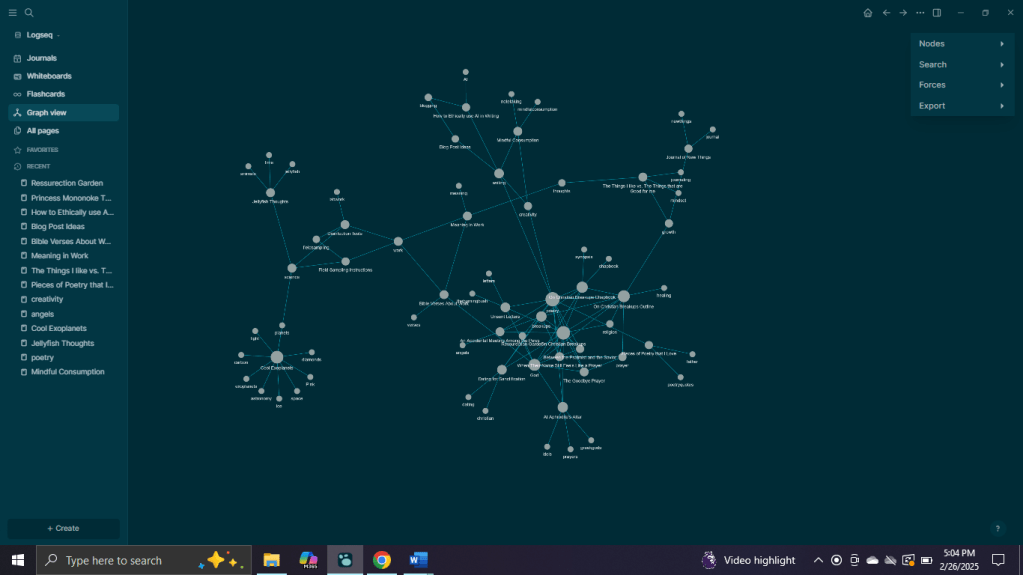
Oh, and as promised, here’s my brain-web after a week of using Log Seq.

So, what do you think? Have you tried Log Seq or Obsidian? Do you have any other alternatives I should check out? Drop a comment below!

okay byeeee

Would You Join a Cozy Writing Forum?

Hello, lovely readers!

I’ve been thinking a lot about how writers connect with each other online. Over the years, platforms like WordPress have been an amazing way to share thoughts, stories, and tips. Most of you drop by to read, and every now and then, someone leaves a comment that warms my heart. Honestly, I love this dynamic, and it’s perfectly fine if reading and moving on is your vibe.

But lately, I’ve been wondering: is there interest in something more community-oriented?

I’ve scrolled through countless writing forums, and while some are thriving, they tend to have huge memberships. That’s awesome for activity, but for me (and maybe for you?), it’s easy to feel lost in the crowd. I started thinking about what it would be like to build a smaller, more personal writing space—something cozy where everyone has a seat at the table.

Since I’m not ready to spend $300 a year upgrading my WordPress just to test this idea, I did a little digging and found freeforums.net, a platform that lets you create forums for free. It was so easy to set up (seriously, 10/10 recommend if you’ve ever thought about this yourself), and now… I have a forum ready to go! Here’s a quick preview:

I’ll introduce you to the spaces I’ve set up so far:

🪑 The Coffee Shop
This is the general hangout spot. Think casual chats, checking in on how everyone’s doing, and sipping virtual lattes while talking about anything and everything.

✍️ The Writing Lab
For technical discussions about writing. Need feedback on sentence structure? Want to debate the merits of first vs. third person? This is the place.

📚 The Library
Here, we’ll share what we’re reading or watching—whether it’s the latest bestseller, a nostalgic TV show, or an indie book you can’t stop thinking about.

🛍️ The Bookstore
A space to celebrate writing achievements, share self-published works, and recommend tools, resources, or books you love.

🏛️ The Town Hall
Where announcements, updates, and fun events (think writing challenges or contests) will live.

📌 The Bulletin Board
Looking for beta readers? Want to collaborate on a project? This is where networking happens.

🌳 The Park
A lighthearted zone for creative writing games, prompts, or exercises to spark inspiration. Also For those tough days when writer’s block hits or imposter syndrome creeps in. A safe place to vent, seek support, and remind yourself you’re not alone.

I’m genuinely curious—does this sound like a space you’d want to join? Or do you prefer to keep your writing life separate from structured communities? Either way, there’s no pressure!

I’ll include a poll below to get a feel for interest, but feel free to drop a comment, too. I’d love to hear your thoughts.

Poll: Would you join a cozy writing forum?

Whether the forum takes off or not, I’m just happy to keep connecting with you all here. Thank you for always making this space feel so welcoming.

Cheers!


The Over-acceptance of Introversion: When to Know When You’re Just Being a Bad Friend

This post is a little different from my usual topics. It’s not some big epiphany, just a thought that’s been bouncing around in my head for a while. As someone who enjoys overthinking (a core introvert trait, we all know it), I couldn’t shake this idea. So, here we are. Let’s talk about introversion, friendships, and whether some behaviors we attribute to being “introverted” are actually… kind of selfish.

This train of thought started when I stumbled across one of those relatable memes. Yaknow the type. Something that went along the lines of : “I don’t want to go, but I do want to be invited. Lol, introverts, am I right?” At first, I chuckled, because I could relate. But then I started reflecting on what it’s really saying. Is this just a funny nod to introverted tendencies, or does it normalize putting minimal effort into our friendships? Cue the over thinking due to a relatively harmless online post.

The more I thought about it, the more it reminded me of a situation from my late high school and early college years. Back then, my close friend and I loved organizing activities for our friend group. Bowling nights, game days, holiday parties—you name it, we planned it. We weren’t just trying to have fun; we genuinely enjoyed bringing everyone together.

But more often than not, it ended up being just the two of us. Our friends, though kind and fun in their own right, rarely showed up. The reasons varied. Some excuses were totally valid—homework, work shifts, family obligations. But over time, it became clear that many simply didn’t prioritize showing up. A few even admitted they “liked being invited” but never had any intention of coming.

At the time, it was frustrating. We’d put in all this effort, only to feel like the rest of the group didn’t care enough to reciprocate. It stung, but life moved on, and so did we. Now, years removed from those memories, I look back without resentment. Those friends weren’t bad people—they were just young, busy, and maybe a little unaware of how their actions came across.

Still, that experience planted a seed in my mind only to be watered by a random Instagram post on a random Tuesday. The memes and “relatable” posts about introverts avoiding plans or ghosting their friends in the name of self-care make me pause. Are we glorifying a healthy need for recharge time, or are we excusing bad friendship behaviors?

Here’s the thing: self-care is important. Recharge time is vital. Life gets busy and overwhelming, and sometimes, skipping plans is the right choice for your mental health. But if every plan becomes your recharge time, you’re not just protecting your peace—you’re neglecting your friendships.

Good friendships require effort. Showing up matters. And showing up only when the whim strikes you? That doesn’t make you a good friend. Sure, you have the right to set boundaries. But if you consistently flake, cancel, or avoid participating, maybe it’s time to reassess what you can realistically give to your friendships. I maybe it’s significantly less than it once was?

If that’s the case, the kinder thing to do is to be honest with yourself—and with your friends. Let them know if your capacity to maintain the friendship has changed. It’s far better than leading someone on to believe you want to stay close, only to repeatedly let them down when it comes time to show up.

Here’s the plot twist (that almost everyone knows): I am an introvert. A big one. I thrive on alone time, I love my cozy evenings at home, and I sometimes dread leaving my bubble. I’ve canceled more plans than I care to admit. But I’ve also been on the other side of this equation—the one doing the planning, hoping people will show up. And that’s given me a deep appreciation for the balance between respecting my own needs and respecting my relationships.

It’s not about guilt-tripping yourself into saying yes to every invite or sacrificing your mental health for others. It’s about being intentional. Being an introvert doesn’t give us a free pass to neglect the people who care about us. If anything, it challenges us to communicate better, show up when it counts, and be honest about what we can give.

So, the next time you’re tempted to laugh off a missed gathering with, “Lol, introverts, am I right?” take a moment to think about what that really means. Are you protecting your peace, or are you unintentionally letting your friends down? Because the truth is, being an introvert doesn’t mean we don’t care about our friendships. It just means we have to work a little harder to show it.

Hopefully you found this post useful in some way. I suppose in some ways, it could be considered a little mini-rant. More than anything, I think it’s a reflection and I hope it makes you reflect too, whether you’re an introvert like me or a big planner who relates to the feelings of disappointment when no one shows. Just know you’re not alone!

Take care, friends, and thanks for reading!

The Great Writing Recalibration: Navigating the Role of Writing in Adulthood

For many young writers, the identity of “writer” takes root early. In grade school or high school, it’s easy to dream big and write even bigger. Stories pour out effortlessly between homework assignments, and the dream of publishing a novel or becoming the next great poet feels within reach. Writing becomes a cornerstone of self-expression, a part of who you are. Then, adulthood arrives like an unexpected plot twist, and suddenly, the words stop flowing.

I like to call this phenomenon The Great Writing Recalibration. It’s not just writer’s block in the traditional sense—the frustration of not finding the right words or ideas. It’s the struggle of figuring out where writing fits into the bigger picture of your life. Is it a fleeting phase? An on-and-off-again hobby? A consistent passion? A side hustle? Or is it the full-time job you’ve always dreamed of?

You’re not a failure, okay? We’re all having a hard time here….

The Great Writing Recalibration often begins when you hit the gauntlet of adulthood—new responsibilities, time constraints, and a world that demands practicality. Suddenly, writing no longer feels effortless or essential. The hours you once spent dreaming up stories might now go to a 9-to-5 job, errands, or simply catching your breath. Writing gets pushed to the back burner, and for some, it’s a bitter pill to swallow.

I know, because I’ve been there. For years, I felt like a writing failure. I had proudly finished the first draft of my novel, only to let it sit and collect dust for three years. I’d talk about how I was “working on it” or how I was “so close to finishing,” but deep down, I didn’t want to work on it. It felt like a chore. Each time I sat down to write, it was as though I was forcing myself to relive a version of me that no longer existed—the high school writer who poured her heart into this draft.

Looking back, I realize part of the problem was that I hadn’t considered the possibility that I simply needed a break from writing or that my old stories didn’t speak to me anymore. I didn’t give myself permission to grow beyond them. I was holding onto an idea of what writing “should” be in my life, instead of asking myself what I actually wanted it to be.

The key realization here is that a lack of time reveals priorities. This is not a bad thing—it’s simply life asking you to reassess what matters most. If you’ve always defined yourself as a “writer” but now find that writing has slipped down your list of priorities, that’s okay. It doesn’t mean you’re less creative or that you’ve “lost” something. It means you’re growing up, figuring out who you are, and redefining what you want.

The tricky part is coming to peace with this recalibration. For many, it feels easier to cling to the idea of being a writer and blame an ongoing “writer’s block” for not producing anything. But if months—or even years—pass without the drive to write, it’s worth asking yourself: What role does writing truly play in my life?

If it’s a hobby you love but don’t feel the need to commit to, that’s perfectly valid. If you still dream of making writing a central part of your career, then finding time to nurture it—even in small ways—is essential. And if it’s something that fades from your life entirely, only to resurface years later, that’s okay too. Writing doesn’t demand permanence; it only asks for honesty.

The truth is, adulthood is full of recalibrations. We struggle to define not only writing’s place in our lives but also our very sense of self. And in that process, the role of writing might shift, expand, or contract. Embracing that change—rather than resisting it—can help you move forward without guilt or regret.

The Great Writing Recalibration isn’t a sign of failure. It’s a chance to reflect on your passions, priorities, and evolving identity. Writing will always be there, waiting for you, in whatever role you choose for it. So take the time to decide, and remember: it’s okay if the words come and go, as long as you’re at peace with what you’ve written into the story of your life.

Keep writing, friends! Or don’t! It’s all okay!

The Twitter Experiment: Is It a Good Platform for Writers?

Ah, Twitter. The home of 280-character rants, controversy, and the occasional cat meme that restores your faith in humanity. But amidst the tweets, retweets, and hashtags, is Twitter actually helpful for us writers? I really didn’t know the answer to this question so I struck out to answer it for myself. And so here we are- me writing this post to share with you my findings and observations. Let’s break down the pros, cons, and along with a bit of my own Twitter escapade to see if this bird app deserves a place on your bookmarks bar or app homepage.

The Ups

Networking Like a Pro
Twitter connects you to a world of agents, publishers, and fellow writers that might otherwise be impossible to reach. Think of it as your literary networking cocktail party, where you can rub elbows with people you respect and admire without the actual pressure of elbow-rubbing. You can follow your favorite authors, ask questions, or even have the odd chance of interacting with a big-name editor. If you’re looking to build a network of writing buddies and potential mentors, Twitter definitely has the reach.

Possible Feedback on Your Work
Twitter is also a great testing ground. Have a line you’re unsure of? A tiny snippet you’re kind of proud of but want some feedback on? Post it. Writers love to share and support each other on Twitter, so you can get responses on tiny samples of your writing. Just don’t post too much—you want to avoid giving away too much of a work-in-progress!

A Constant Feed of Inspiration
Thanks to #WritingCommunity and #AmWriting hashtags (tags not limited to twitter alone one should note), Twitter provides a steady stream of advice, tips, prompts, and writing-related memes that will either make you laugh, sigh, or just plain inspire. Whether it’s celebrating a 50k word count or the struggle to write two sentences, Twitter’s got a solidarity vibe that’s comforting. It really feels like you’re not alone in this whole writing thing and that’s neat and definitely earns twitter a few brownie points.

Promo Without the Sales-y Feel
If you’re a self-published writer or have a new book out, Twitter’s a good place for quick, casual promotion. Just don’t overdo it. Twitter works best when you focus on sharing and interacting rather than constantly pitching your own work. (People might get off-put if your profile is 90% self-promo.)

The Downs

So many opinions
Twitter can be an echo chamber where everyone has an opinion (and are not at all shy about sharing it). Writers (ahaha me) can get bogged down by what’s trending and feel like they need to shape their stories or characters to fit popular discussions. So if you’re easily influenced or find it hard to stay true to your style, Twitter can sometimes veer into counterproductive territory. People are VERY vocal on twitter and that can be overwhelming if you’re an overthinking personality like me. Yes, advice is wonderful but I think there is such a thing as advice overconsumption/intake. It would be really easy to hype fixate on the wellspring of advice and opinions that are available on Twitter. One thing I had to remind myself and that I’ll remind you of too is this simple fact: Not all writing tips/advice is meant for you. It is, however, up to you to parse out what is helpful and what is not and that takes energy for sure.

And so here is my advice to you if you choose to embark on your own twitter escapade: follow a few writers that you look up to and wish to emulate and follow them along with a few publishing companies and agents that you are interested in. Then go from there. This will help you from being TOO bogged down by advice and opinions that may or may not apply to you.

Algorithm Struggles and Follow Fatigue (ugh, another algorithm to keep up with??)
Growing your following on Twitter as a writer can be a real pain. The platform seems to favor viral content, and if you’re not constantly tweeting or getting engagement, your posts can sink fast. If you’ve ever tweeted something that was pure genius (in your humble opinion) only to get… crickets… you’re not alone. The algorithm’s quirks mean that building an audience is often slow, which can feel demoralizing if you’re there to share your writing with the world and the world doesn’t seem like it’s ready to listen quite yet. Of course, just like with anything, give it time and be consistent and result will likely follow. I’m going to be honest, that seems to be the most consistent thing among all these social medias I have reviews. Instant results are not really likely. You have to play the game first and you might see success after awhile of constant posting.

The Temptation to Chase Virality

We’ve all heard stories of tweets going viral and driving tons of engagement to people’s work But here’s the unfortunate reality check: it’s rare. Trying to go viral can feel like chasing after a breeze. Not only is it unpredictable, but it can also become an obsession that takes up way too much time. As I stated in the previous paragraph, rather than aiming for that one breakout tweet, Twitter can be better as a slow-and-steady kind of thing. Build relationships, engage, and post content. Rinse. Repeat. Viral success might never come, but if you’re focused on finding a real community, you won’t mind as much. Make sure you goals and focus are realistic and clear when it comes to Twitter (or any social media for that matter).

The Verdict

So here’s where I landed. Twitter, like most social medias, is a mixed bag. I think it serves it’s purpose best as a means to connect with the broader writing community and keep up with what people in your specific genre are looking for. It’s also great for stoking discussion and inviting people to have a discussion with you or even just commiserate. I think that’s where it stops however. Twitter content must be short, snappy, and (mostly) to the point and doesn’t leave room for sharing bigger works though you can definitely use it to tease something.

So, if you’re a social butterfly, writing trend enthusiast (or simply just want to keep up-to-date on the writing market in general), or are a one-liner genius, Twitter might be for you! If you’re a long-form content writer like the beloved Tolkien or have little to no interest in muddling your head with the fleeting trends of our time, don’t worry about it. Not all discussions or engagement is healthy or fruitful for oneself. There’s no shame in that (it’s sort of like reading the news. Sometimes I don’t want to know everything going on!). Personally, I think I’ll leave twitter be for the time being, perhaps picking it up when I ready to engage with the fun (albeit sometimes messy) chaos of the writing world.

And I think that’s a wrap. Thanks for stopping by!