Perks of being a Writer

There are a lot of reasons I love writing. The expression, the escapism, the feeling of improving your craft just to name a few. But sometimes I can lose sight of these things. I place a lot of pressure on myself to perform well at many tasks in my day to day life. School, work, and anything in between. As a result, sometimes I exert this pressure upon myself when it comes to writing. On my bad days, I can sometimes lose sight of why I love doing this. So I composed a little list, more for myself than anything, of reasons I love the art form of putting your thoughts in pen.

Your work will outlive you and you leave something behind.

Not to be a wet blanket or anything, but sometimes I think about how long the world has been around and how very brief my existence is in it. It just puts things in perspective. But the thought that maybe someone years after I’m gone could stumble across any of my work and feel connection, makes me feel sunny inside.

You get the joy of exploring ideas and concepts without being bound to reality.

Reality can be a bit of a downer. This probably can go into the same category of escapism. Sometimes It’s nice to “play God” a little in your world and not be bound by the laws that actually govern you in the real world. You have freedom to explore whatever you wish.

You get to explore parts of yourself that you probably didn’t know.

I figured this out the more I started writing vent poetry that will never see the light of day. But I did find it very therapeutic and it helped me work through stuff and vocalize certain parts of myself that wouldn’t have gotten otherwise. Something about putting your thoughts in rhyme makes it almost fun and digestible even if the part of me the piece represents isn’t my favorite to look at.

You have the ability to touch people through your work.

Probably one of the biggest why’s as to why I write. Writing touched me as a young person (specifically during my lonely middle school days). I hope that my work can do the same for someone else, and perhaps make someone out there feel a little less lonely.

Increasing your knowledge of language and how to communicate with people.

English as a subject wasn’t always my favorite. It wasn’t terrible, don’t get me wrong, but I found I liked it much more in practice than when its broken down into rules and definitions. But one thing I did find and the more I wrote and read, the easier this subject got. Probably because English, like most all languages, is easier to learn in practice and the more you toy around with it.

You can live hundreds of lives.

Coming back ’round to the mortality thing, there are many things I will not get to experience. But writing offers me a little window into the many lives I will never truly live and I think that’s really special.

It doesn’t really cost you anything.

As a broke college student, this is a MARVELOUS perk. A healthy hobby that doesn’t dost anything is invaluable.

You can write for a long, long time.

A wonderful thought is that I can write all through my life. It is something that, If I want it to be, can be a constant in my life. I am not bound by the physical tax that puts an expiration date on many hobbies. I can write well into my older years, and that comforts me more and more with each passing year.

Being An All or Nothing Writer

One of the many writing struggles I have had to overcome as I write more and more is the issue that I tend to be an “all or nothing” person. And that transcends to nearly everything I do, including to my writing. So what does this look like exactly?

Well, for me personally, it looks like writing 4,000 words in an evening and then not touching the project for 4 months. It looks like powering through the first couple of chapters of a book and then going “alright, I’m not feeling this anymore”, and walking away.

And it sucks.

I have unfinished projects everywhere that include stories and other creative projects alike. I covered this in a similar way in my other blog post “The Struggles of a Project Bouncer”, one of the first Writing Blog posts I posted on this blog. In this post, I focused on this is a broad sense in that I have a bad habit of just jumping from one thing to another and not seeing stuff through to the end. And this seems to be particularly bad when it comes to my writing.

And the solution?

Well, it’s kind of boring, not gonna lie. It’s the answer to like 75% of must problems writer’s have and a lot of people have for that matter (myself included).

Self. Discipline.

Yuck. I don’t like that word. But it really is the answer to this “all or nothing” problem I have. But to get more specific, what does “self discipline” look like when it comes to pacing myself so I actually finish something in less than two years as oppose to typing out three chapters and walking away for 6 months?

Well, for me it looks like a writing schedule. And one that I stick to.

Everyone’s writing schedule looks different. In fact, many people measure it in different ways. Some people set the goal of writing X amount of chapters every week or month and others set their goal in amount of words. This seems to be the most common strategy.

Getting back to my particular solution, my goal tends to be around 5,000 words every week which comes to about 700 words every day which I know is manageable, at least in the summer time (my plan changes when school starts back of course). And even though I don’t stick to it perfectly, I find the pacing helps me see writing a more of a habit and something I do more consistently as oppose to a project I add to when the moon is in the sky just right and I actually feel like writing. Because If I do that, come to find out, I never get it done.

So if you’re an “All or nothing” writer like me, I definitely recommend trying this strategy. Try setting a goal and pacing yourself and resist the urge to spit up 5,000 words in one sitting and then running away.

You can do it! You can finish that story or that book! I believe in you!

Writing Cheat Sheets You Should Know About

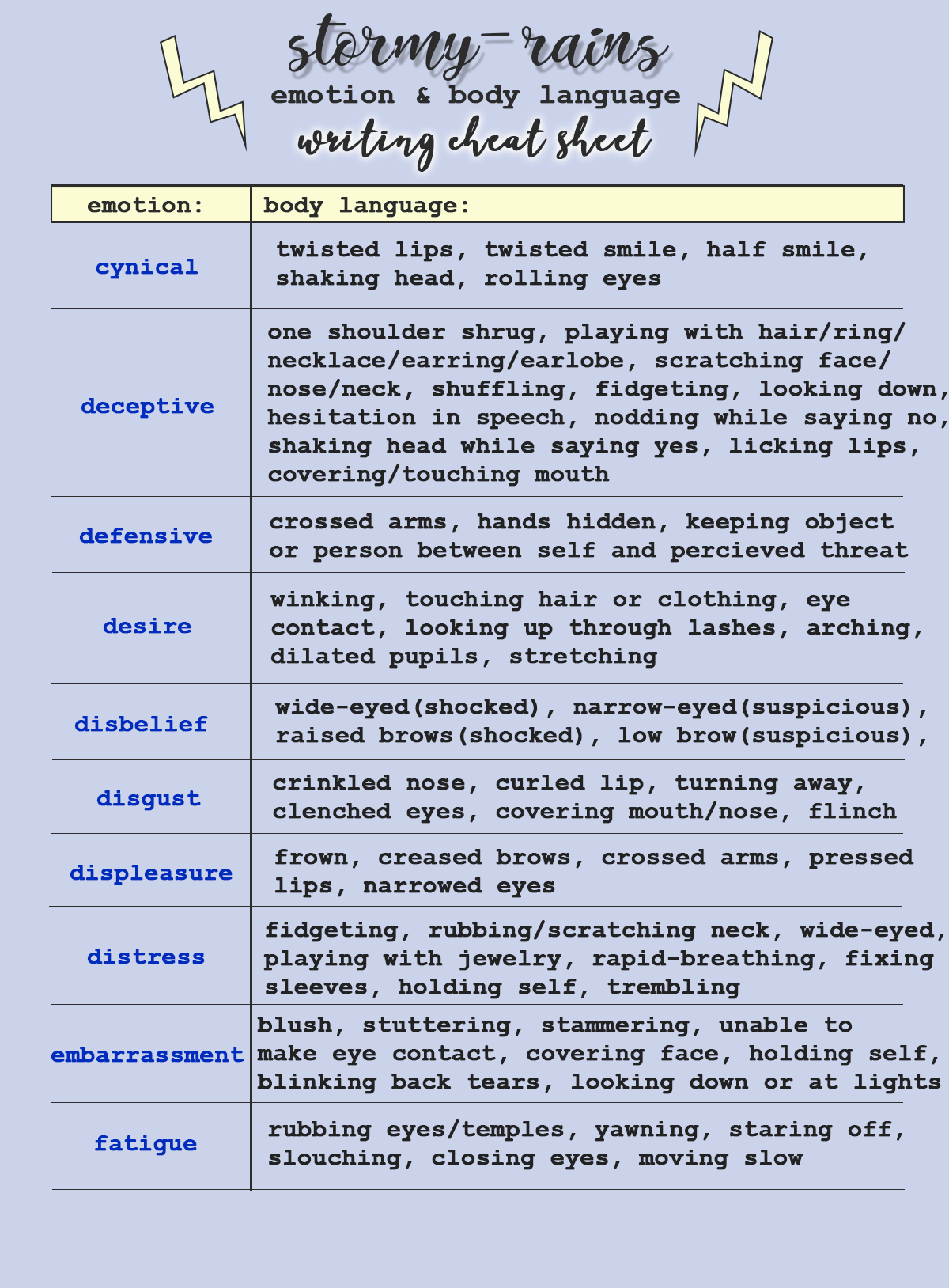
Writing can be really hard sometimes. Some days the words flow seamlessly from my finger tips and there other days where I get stuck on every little thing. One things that I have found that has helped me with these mini challenges and road blocks is having a few choice writing cheat sheets on hand that can help me when I’m stuck on how to write a specific scene or character. And so I would like to share these little cheat sheets with you.

Emotion Cheat Sheets

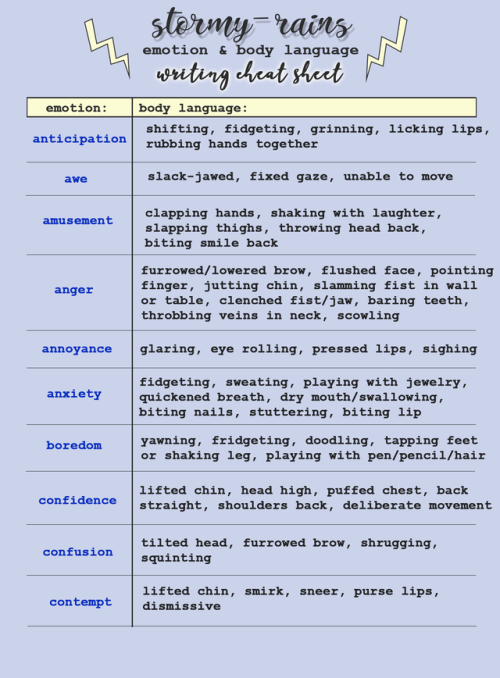
Writing certain emotions are harder for me than others. Especially when writing more obscure emotions that go beyond “happy” and “sad” and “angry”. This is because, sometimes, I can only recall one or two actions that reflect that specific emotion and I don’t want to sound like a broken record when writing their non-verbal cues. “She shook her head”, “She grit her teeth”, “He smirked”, “She smirked”. It can get pretty redundant.

These emotion cheat sheets help me with that. They each give me an emotion and a brief list of mannerisms and reactions associated with that emotion that one can integrate between the dialogue.

cheat sheet 1

cheat sheet 2

cheat sheet 3

Conciseness

This might be more helpful for essay writers or article writers but it can be useful for story writer’s as well. If you have a bad habit of writing overly wordy phrases that could be replaced with a more condensed version of the phrase for clarity, then this cheat is for you. It goes through a few commonly used wordy phrases in writing and suggests replacements.

clarity of writing cheat sheet

Actions that don’t sound repetative

I have a bad habit of over using specific actions in writing.

Look. Walk. And smile.

These are three actions that happen quite a lot in a book. But I personally struggle to find other words that convey the same meaning to avoid sounding redundant. So here are a few cheat sheets I use to help me “dress up” and better describe these actions.

Words to replace “look”

Words to replace “walk”

Words to describe a smile

Various ways to integrate “smiling”

The Replacement of very

Yet another cheat sheet that can help you specifically combat the redundancy of overusing the word very.

A Very Helpful Cheat Sheet

The Death of Said

Aaaaand here is the last one. And probably the one I struggle the most with. Said. Now contrary to what you might have read online, said is not dead. Let’s not overlook the danger of getting to flowery with our writing. There are still places for simple versions of words. Said will always have a place in writing, But again, this is cheat sheet is made simply for when you fear you’re sounding tedious and like you’re repeating the same word over and over and over and over and over and over again. And sometimes these words and phrases can better describe the tone with which an action is done much better than “said” can.

Said Cheat Sheet

Pausing vs. Quitting

I have a hard time with self-guilt when it comes to writing. I feel like I am never satisfied with my productivity levels when I write, like I can always be doing better. But despite this attitude, I’ve found it takes away from my productivity more than it helps it. You see, it’s taken me awhile to figure this out, but holding myself to such a high “writing” standard that I am inevitably am not going to meet hinders me much more than it helps me. Procrastination feels much more attractive when I am disappointed in myself.

I think this is why I have a tendency to take looooong gaps in between my writing weeks. Ones that I didn’t plan. And all that time I’m mentally yelling at myself, “get back to writing your book! Stop being a quitter!” and yet this attitude does very little to get me back into my writing habit. I just feel guilty.

So recently I wanted to reframe my thinking. To stop demonizing “breaks” because breaks are not synonymous with quitting. Quite the opposite actually. Everyone needs a break every now and then, even from stuff they really enjoy. So I decided to start referring to my non-writing periods as “pauses” not “quitting”. Already I can tell a difference in the way I view writing. It feels less like a chore. And I won’t leave it to sit for weeks on end either. Because a “pause” I implies that it will be continued, whether it be tomorrow or next week. Pauses are healthy every now and then, I shouldn’t yell at myself for taking them otherwise I will associate writing with dissatisfaction and this immense feeling of “I don’t want to do this”.

So if you’re a writer like me who has bad habit of yelling at yourself every time you step away from a project, maybe consider taking a well-needed “pause”. And then come back to it.

The 7 deadly writing sins that ruin your productivity

Good morning! Long time, no blog post? With that in mind, I think it’s either befitting or ironic that I am sharing a little list of comprised of some of the most common “Writing Sins” that totally mess with my writing productivity. Little things that mess with my best of intentions to write buuuut I could just refresh my pinterest feed one more time, right?

Having your phone nearby and not silenced.  

Is it no surprise that I’m a super distracted writer? Generally I don’t see myself as an easily distracted person but there is something about sitting down that makes my wonder from whatever I am supposed to be doing and search for something else. And, often, that something else, is my phone. Phones basically give you instant engagement and gratification. I’m sure we’ve all heard the studies done on this. The tiny dopamine rush we get from the stimulation of entertainment (this rush being small but effective in wiring our brains to seek it out more or “refresh” the page). But, because of this, having my phone nearby, can often be a distraction waiting to happen. Especially if I don’t silence it. These days, for many reasons, I have my notification completely off nearly 100% of the time, and I will say, it really, really helps.

Having too many tabs up. 

I’ll often find myself wanting to clarify this one “thing” in my writing so I open up a new tab, to research said “thing” and one rabbit hole of research later, here I am with 1000 tabs up and no writing actually done. So, for my benefit, I limit the amount of “tabs” I’m allowed to have open. In fact, it has to be really important for me to minus my word document and look up because I know my own tendencies. This is why I recommend that if you ever need to further research something for clarification in your writing,  insert a filler word and move on. The filler word should be weird like “pink elephant” for its easily searchable in a word document and found. Come back to it later.

Getting a little to caught up in music

I feel there’s a common theme of distraction here. I cannot write with music really. I end up humming along and just getting way to into it and Oh! Look! Now I’m distracted. Again. If I do happen to be in a focused mood, instrumentals often work best. Chill instrumentals. And even then, it’s probably best I don’t recognize it so I’m not tempted to hum or sing along.

Being too perfectionistic and getting too bogged down in getting everything just right.  

Hmmm… distractible AND perfectionistic? What a great combo! This is more of a mind thing. If I’m ever to get any writing done, I have to tell myself over and over again “you can’t edit a blank page, just keep writing”.

Not having a snack nearby.  

I’m just repeating myself at this point. This is yet another gateway to distraction. Take my word, have food nearby, unless you have a specifically planned break for food.

Not knowing your productivity pitfalls or strengths.  

Hence this list. But it can be different for everyone. It’s simply a matter of knowing yourself and your own unproductive tendencies and having specific ways to counter them. Not only that, but try and play to your strengths as well. If music really helps you picture the ambiance of a story, by all means, utilize that. If it is nothing more than a source of distraction (like it is for me), then maybe resort to some other background noise like ambiance sounds.

Getting too caught up in word counting.  

If I am struggling to pump out some writing, I find I have a huge problem with typing, and then checking the word count like I’m writing an essay for school. This is because I have a word goal I hope to meet every day, and while this does me good, on bad days, I find myself way too caught up in meeting the quota. I haven’t really found a way to combat this if I’m honest. I feel that if I don’t force myself to write at least a little everyday, it is easy to get out of the habit and oh! Now I haven’t written for a month. Yay. But I definitely feel like my writing suffers when I am just checking a “list”. My only tip on this specific tendency is just know, that we all have bad writing days. But I think I ascribe to the idea that something, even if its a bit forced on this particular day, is better than nothing. Really I think that’s the ideology that’s at the heart of productive writing.

“Something is always better than nothing”.